



Rotating Book Shelf
A rotating book shelf brings compact utility and turning access to studies and parlours, holding a working library within arm's reach.
Rotating Book Shelf
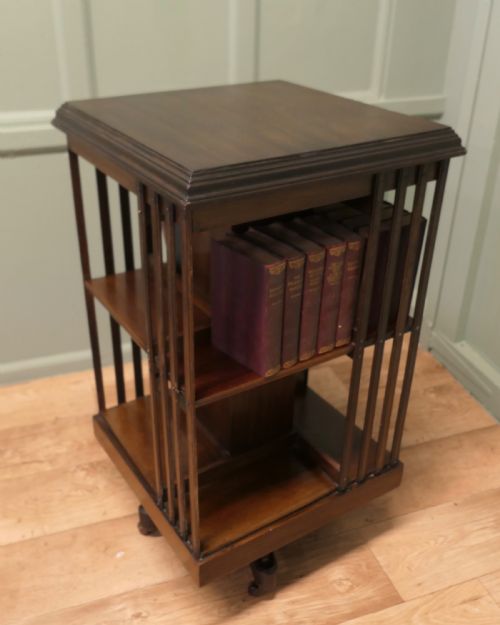
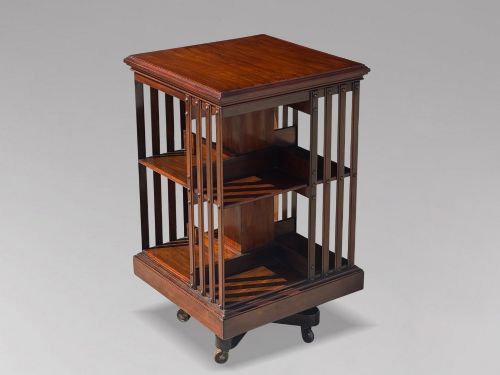
A rotating book shelf sits upon a concealed mechanism that allows the entire tier of volumes to turn smoothly on a fixed base. These pieces serve domestic and professional spaces where desk-side access to reference texts matters more than static display.
The pieces on this page span the Victorian and Edwardian eras, alongside later examples from nineteen thirty, taking forms from petite four-shelf heights to large freestanding circular designs.
Mahogany and oak dominate the construction, often enhanced with satinwood inlay or brass fittings, reflecting the dominant cabinet-making materials of the nineteenth and early twentieth centuries.
How they were made
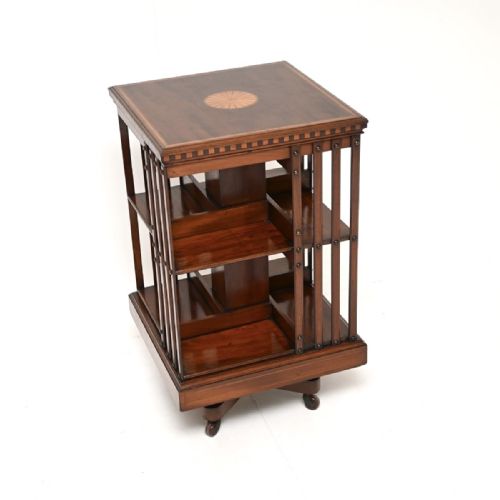
Cabinet-makers relied on solid mahogany and oak for the primary frame and shelves, ensuring the structure could bear the heavy weight of bound volumes without sagging. Satinwood inlay provides decorative contrast on select Edwardian surfaces.
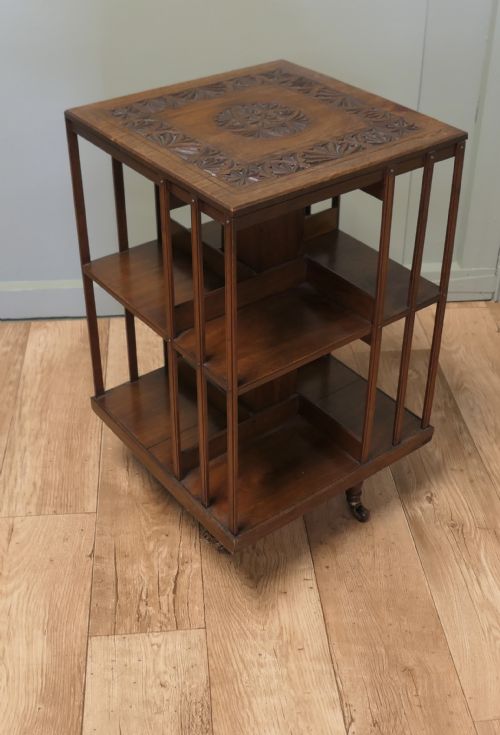
Internal engineering combines timber framing with metal and brass components to support the smooth rotary action, keeping the load balanced over the central axis. French provincial and Anglo-Indian variants show regional interpretations of this turning architecture.
Rotating Book Shelf Retail Price Guide 2026
Typical asking prices for rotating book shelf among the pieces listed under this phrase on Sellingantiques today, from the lower quarter to the upper quarter. They describe what is for sale here now, not the wider market.
A petite French model shares shelf space with a very large oak variant.
What varies in quality
The refinement of the internal turning mechanism separates standard pieces from superior examples, dictating how evenly and quietly the tiers revolve under a full load of books. Smooth rotation depends on precise engineering within the hidden base.
Surface detailing such as fine satinwood inlay, carefully chosen mahogany grain, and robust brass fittings elevate the visual presence of Edwardian and Victorian models, while simpler oak versions prioritise straightforward utility.
The Rotating Book Shelf Glossary
- Revolving bookcase
- A freestanding piece of furniture fitted with a concealed pivot mechanism enabling the book tiers to turn freely. This design grants all-round access to volumes in tight spaces.
- Satinwood inlay
- A decorative technique using contrasting light-coloured wood veneers set into the primary timber surface. Cabinet-makers used this method to create geometric or floral borders on Edwardian panels.
- Edwardian
- The period of British design spanning the reign of King Edward VII until the First World War. Furniture from this era often lighter in proportion than heavy Victorian pieces.
- Anglo-Indian
- A descriptive term for items produced in the Indian subcontinent under British rule, frequently employing local timbers and traditional carving techniques. These pieces blend British furniture forms with indigenous craftsmanship.
Rotating Book Shelf: Frequently Asked Questions
How do rotating book shelves work?
These pieces use an internal pivot mechanism concealed beneath the lower tier or base, allowing the entire wooden structure to turn on a central axis. This engineering enables users to reach books on all sides without moving the furniture.
Makers balanced the weight distribution carefully so the tiers spin smoothly even when fully loaded with heavy volumes.
What periods do these pieces come from?
The listings span the Victorian, Edwardian, and later periods up to nineteen thirty. Victorian examples tend to be heavier and more substantial, while Edwardian pieces often incorporate satinwood inlay and lighter proportions.
Occasional regional variations, such as Anglo-Indian or French provincial designs, appear alongside standard British cabinet-making from these decades.
Where should I place a rotating book shelf?
These pieces suit corners, studies, or beside armchairs where floor space is limited but immediate access to a working library is useful. Because they turn through a full circle, they require a small clearance radius from walls or other furniture.
Placing them away from direct heat sources helps protect the mahogany, oak, and satinwood veneers from drying out.
What woods were used to build them?
Mahogany and oak form the structural foundation for the vast majority of these pieces. Cabinet-makers selected these hardwoods for their strength and durability under the heavy weight of books.
Finer decorative examples feature satinwood inlay and polished wood surfaces, while internal components occasionally incorporate metal and brass.