




Rosewood Side Table Fold Top
A rosewood side table fold top is a versatile piece of period furniture offering concealed utility and rich timber surfaces for any room.
Rosewood Side Table Fold Top
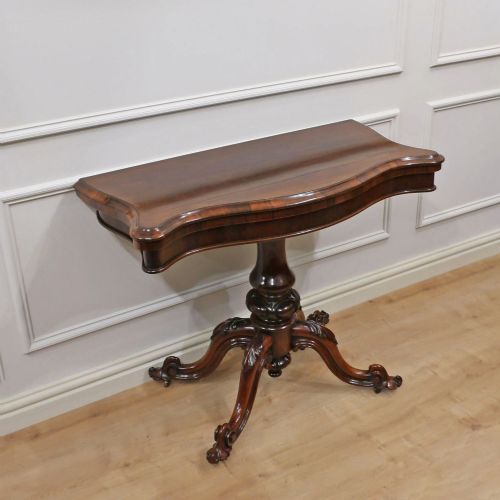
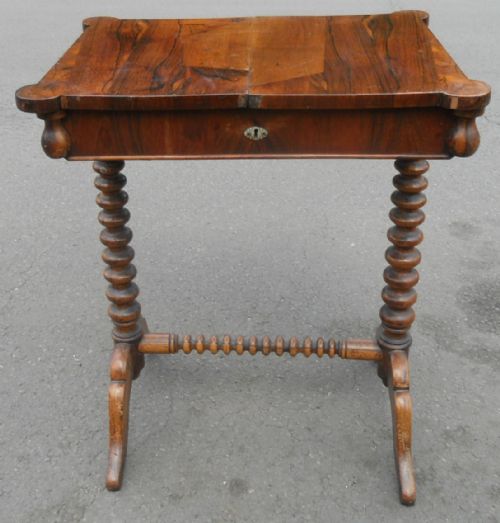
A rosewood side table fold top functions primarily as a card, games, or tea table, transforming from a compact console into a larger surface when needed. These pieces emerge predominantly from the Regency, William IV, and Victorian periods, alongside Edwardian and Chinese Qing Dynasty examples.
The form relies on a hinged flap or flip top that rests upon a pivoting or folding mechanism, revealing a baize-lined interior or a polished timber surface beneath. Card tables and games tables dominate the offerings, though occasional tea tables and freestanding centre tables also appear.
Origins span English cabinet-making traditions, Anglo-Indian workshops, and Chinese craftsmanship in Hongmu and hardwood. Buyers encounter both pedestal bases and traditional four-legged designs, often shaped for domestic entertaining in nineteenth-century drawing rooms.
How they were made
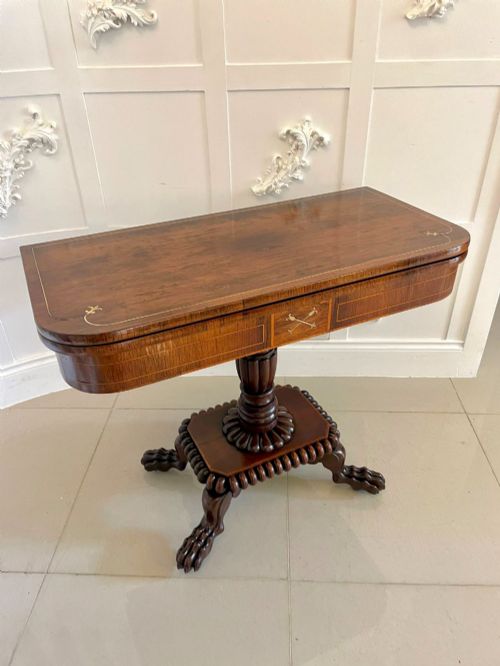
Makers utilised dense tropical hardwoods, choosing rosewood and palisander for their rich grain patterns and deep colour. Surfaces frequently incorporate intricate wood inlay, boxwood stringing, and brass details to frame the edges and tabletops.
Cabinet-makers constructed the folding tops with precision hinges to ensure the leaves aligned smoothly when opened. Pedestal bases and carved supports required robust internal framing to sustain the weight of the pivoting tops during use.
Many a Victorian card table secretly swallows a deck of cards and some bone counters inside its hidden waist.
What varies in quality
Quality rests upon the selection of timber veneers and the precision of the brass inlay or boxwood stringing. Finer examples display continuous grain alignment across the fold and crisp, well-defined carving on the pedestals and legs.
The structural integrity of the folding mechanism dictates daily usability, where superior examples pivot and lock without wobble. The crispness of the secondary woods used in the frame and the retention of the original finish further distinguish top-tier pieces.
The Rosewood Side Table Fold Top Glossary
- Fold top
- A hinged tabletop that opens to double the surface area for dining, writing, or gaming. When closed, it functions as a side or console table against a wall.
- Card table
- A specialist table designed for evening card games, usually featuring a baize-lined interior and a concealed compartment for counters and packs.
- Palisander
- A dense, heavily figured timber belonging to the rosewood family, prized by nineteenth-century cabinet-makers for its rich dark tones and striking grain.
- Boxwood stringing
- Fine inlaid lines of pale boxwood set flush into dark rosewood surfaces to create geometric borders and decorative contrast.
Rosewood Side Table Fold Top: Frequently Asked Questions
How were fold top tables used?
These tables stood against drawing room walls holding decorative objects or lamps until guests arrived for evening card games, tea, or social assemblies.
The hinged leaf unfolded to provide a stable, baize-lined playing surface, keeping domestic spaces adaptable before dedicated games rooms became common.
How do I date a rosewood table?
Dating relies on observing the combination of structural forms, leg designs, and decorative motifs characteristic of periods like Regency, William IV, or Victorian.
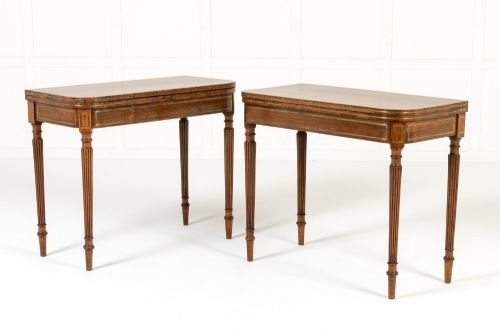
Regency examples often feature brass inlay and slender supports, while robust pedestal bases and heavier carved rosewood point towards William IV and Victorian eras.
Can I use this as a dining table?
Most of these pieces are built for card games, tea, or occasional display rather than heavy family dining, possessing narrower dimensions and delicate mechanisms.
While the unfolded top provides ample space for drinks or cards, daily use for full meals may strain the antique hinges and polished veneer.