




Rosewood Music Stool
A rosewood music stool brings practical elegance to a piano or dressing table, offering adjustable height and rich timber grain.
Rosewood Music Stool
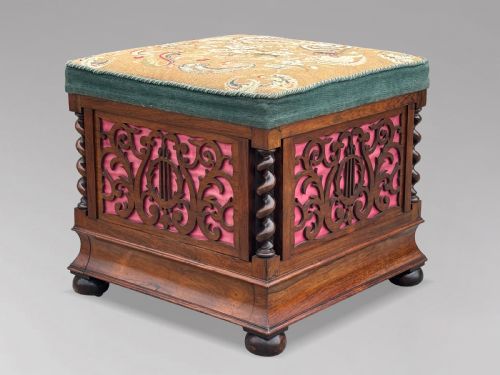
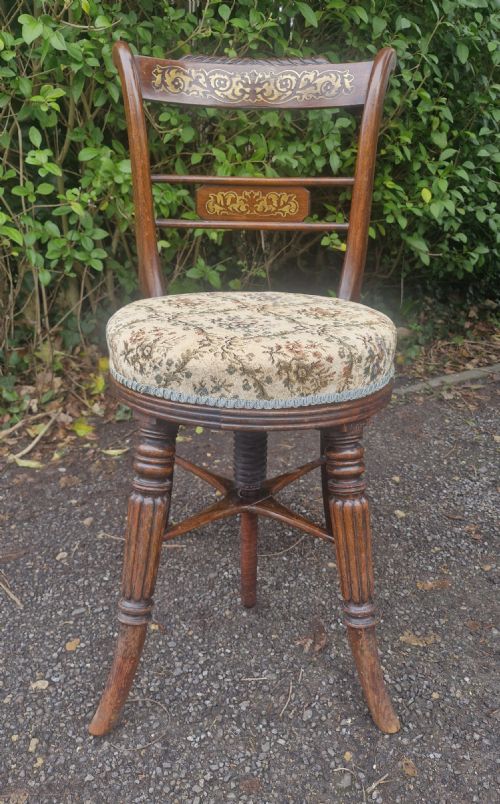
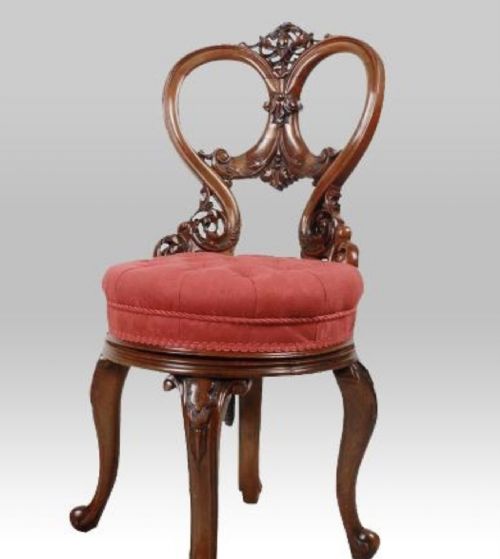
A rosewood music stool serves both practical and decorative purposes in the parlour or drawing room, functioning as a seat for pianists, harpists, and singers. Buyers seeking a rosewood music stool encounter diverse forms spanning the Georgian, Regency, William IV, and Victorian periods.
The most common examples on this page are Victorian and Regency piano stools featuring revolving tops or rise-and-fall screw mechanisms. Alongside standard piano stools, the selection includes music chairs, harpist chairs with specialised backs, and occasional dressing table stools.
Makers and workshops utilised rich tropical hardwoods and contrasting inlays to create seating that matched contemporary keyboard instruments. The forms range from simple round-topped stools to elaborate duet benches with needlepoint or velvet upholstery.
Markers of quality
The distinction between standard production pieces and finer examples rests upon the execution of the timber work and the complexity of the adjusting mechanism. Superior items display crisp boxwood inlay, finely carved solid rosewood supports, and smoothly operating screw threads that raise the seat without binding.
Makers who supplied high-end establishments invested greater effort into secondary timbers, hand-stitched needlepoint upholstery, and stable revolving platforms. The weight of the timber and the solidity of the joints distinguish workshop output from mass-produced late examples.
Rosewood Music Stool Retail Price Guide 2026
Typical asking prices for rosewood music stool among the pieces listed under this phrase on Sellingantiques today, from the lower quarter to the upper quarter. They describe what is for sale here now, not the wider market.
Listings feature rosewood music stools spanning the Georgian, Regency, William IV, and Victorian eras, alongside Edwardian examples.
Charles Nosotti·Gillows·James Shoolbred
The Rosewood Music Stool Glossary
- Rise and fall
- An internal screw mechanism operated by turning the seat top to alter the height of the stool. This system allows musicians to find a comfortable playing posture.
- Harpist chair
- A specialised seat featuring a lowered or asymmetric backrest designed to accommodate the frame and player of a harp. These chairs often swivel or feature adjustable heights.
- Simulated rosewood
- A painted or stained finish applied to a less costly timber to imitate the grain and colour of genuine rosewood. Artisans used this technique during the Regency period.
- Needlepoint
- Hand-stitched canvas embroidery traditionally used for covering the seats of piano stools and footstools. It provides a durable and decorative surface for daily use.
Rosewood Music Stool: Frequently Asked Questions
How do I adjust the height on these stools?
Most antique music stools feature a central wooden screw mechanism concealed beneath the upholstered seat. Rotating the top in a clockwise or anticlockwise direction raises or lowers the sitting height.
Simpler models rely on a rise-and-fall ratchet system or a revolving platform that turns freely on a central iron spindle.
Were these stools only used for pianos?
While primarily designed for keyboard players, music stools found placement across the home as dressing table seats and occasional chairs. Harpist chairs were specifically adapted for musicians playing standing instruments.
Duet stools accommodated two players practicing piano pieces together in nineteenth-century parlours.
How do I date a rosewood music stool?
Dating relies on stylistic shifts from Georgian restraint through Regency neoclassical revival to ornate Victorian carving and late Arts and Crafts simplicity. Turned legs, brass inlay, and the type of secondary wood provide further clues to the decade of manufacture.
Makers' stamps or labels beneath the seat offer definitive confirmation of the workshop and period.
What is the difference between rosewood and simulated rosewood?
Genuine rosewood is a heavy tropical hardwood valued for its deep reddish-brown colour and dark grain figuring. Simulated rosewood is a substitute timber painted or stained by graining artists to mimic that appearance.
Both materials appear in Regency and Victorian seating, with simulated versions offering a fashionable look at a lower cost.