
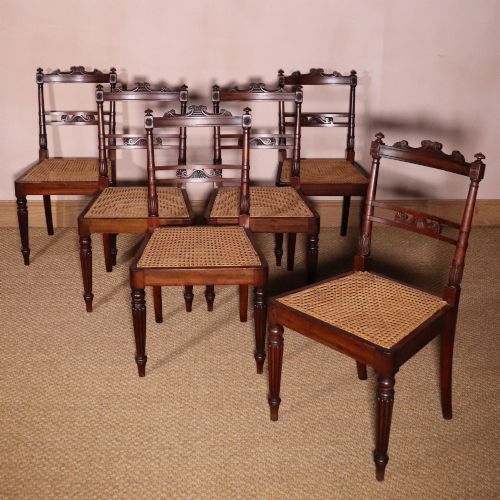
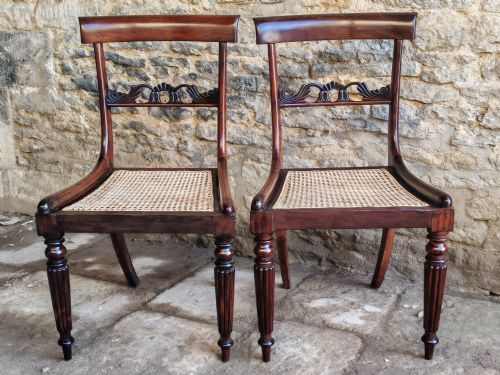
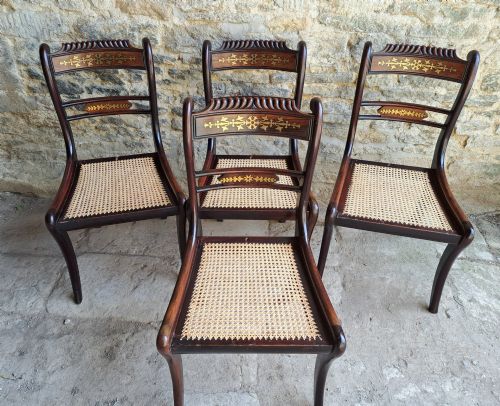
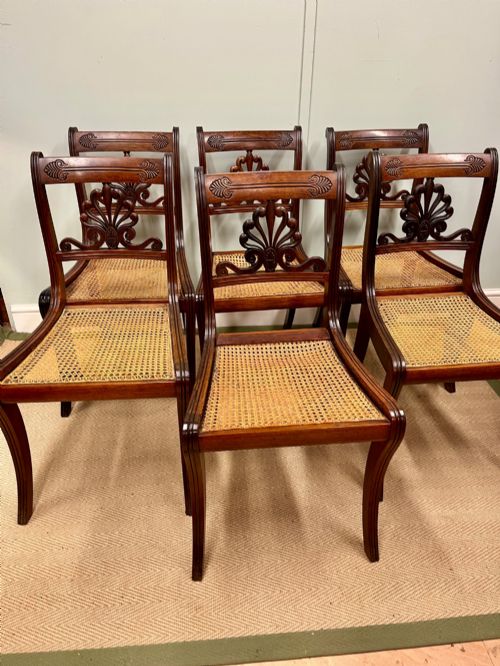


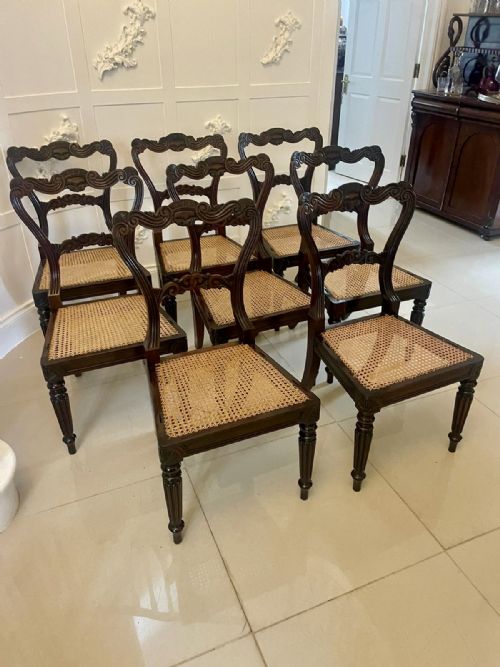


Rosewood Caned Chairs
Rosewood caned chairs bring richness and texture to a room, offering sturdy seating framed in dark timber and woven plant material.
Rosewood Caned Chairs
When you search for rosewood caned chairs, you encounter seating largely rooted in the Regency and 19th Century periods, encompassing Georgian and Victorian examples. These pieces span dining chairs, armchairs, side chairs, library armchairs, and planters chairs.
The selection includes solid rosewood alongside simulated or faux rosewood frames, often shaped with brass inlay, rope twist details, or bobbin turnings. You will find sets of varying sizes, from pairs up to sets of eight, as well as individual elbow chairs.
Anglo-Indian and Bombay rosewood variations also appear amongst English pieces, showing regional diversity in form and decoration. The predominant styles lean towards Regency, Grand Regency, William IV, and Anglo-Indian designs.
How they were made
Craftsmen shaped dense tropical timbers, utilising genuine rosewood or painting native woods to simulate the distinctive grain as faux rosewood. Frames were constructed using traditional joinery methods to support the weight of daily use.
Seats and backs incorporate woven cane panels, threaded through drilled holes in the wooden frames to create a resilient, flexible surface. Brass inlay, carved rope twists, and upholstered elements were added to elevate the visual detail of the finished seating.
Planters chairs feature exceptionally long extending arms designed for resting weary legs after a long day in the tropics.
What varies in quality
The distinction between standard and superior pieces rests on the crispness of the carving and the precision of decorative additions like brass inlay. Finer sets display a uniform grain in the rosewood or a convincing application of simulated rosewood paint.
The tightness and regularity of the woven cane work significantly influence the overall standard of a chair. Consistency across a large set marks out higher-grade workshop output compared to mismatched or later replacement components.
Gillows
The Rosewood Caned Chairs Glossary
- Bergere
- An upholstered or cane-sided armchair with a solid back and sides, popular during the Regency period. These chairs often feature low proportions and deep seats designed for lounging.
- Simulated rosewood
- Timber painted to imitate the rich, dark grain of genuine rosewood, also referred to as faux rosewood. This technique allowed makers to achieve an expensive look using more accessible woods.
- Cane
- Material woven from stripped rattan plants to form light, porous panels for chair seats and backs. It provides flexible support while maintaining an airy visual profile.
- Rope twist
- A carved decorative motif resembling a twisted rope, frequently found on the top rails or crossbars of Regency chairs. This detail adds tactile texture to the wooden frame.
- Anglo-Indian
- Furniture made in India by local artisans using regional timbers like Bombay rosewood, often for export to Britain. These pieces combine British furniture forms with intricate local carving techniques.
Rosewood Caned Chairs: Frequently Asked Questions
Are caned seats strong enough for daily use?
Traditional cane work is surprisingly resilient and distributes weight evenly across the woven strands. With sensible care, it handles regular sitting without sagging.
Avoid kneeling on the cane panels or placing sharp objects directly on the woven surface. Keeping the material conditioned prevents it from becoming brittle over time.
How do I spot simulated rosewood?
Simulated rosewood involves painting a lighter wood base, such as beech or birch, to mimic the dark, variegated grain of genuine rosewood. Close inspection under good light reveals brushwork or a painted grain pattern rather than natural timber figures.
This technique was common in the Regency period to offer a luxurious appearance at a lower cost. Examining the underside or unexposed areas often exposes the underlying light wood.
What is an Anglo-Indian chair?
Anglo-Indian chairs were produced in India during the nineteenth century, blending British furniture shapes with local carving traditions. They frequently utilise dense regional timbers like Bombay rosewood and display deeply carved ornamentation.
These pieces arrived in British homes through trade and colonial connections, bringing a distinct stylistic flair. They stand apart from domestic English production through their ornate botanical motifs and heavy proportions.