

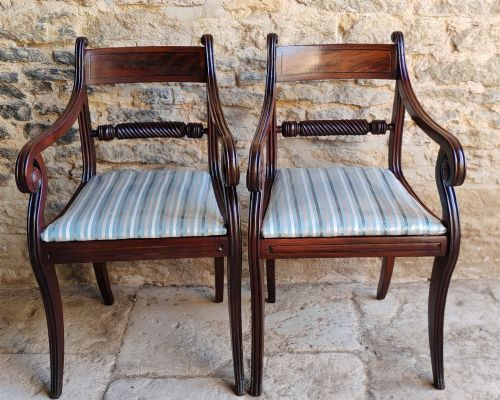


Rope Back Chairs
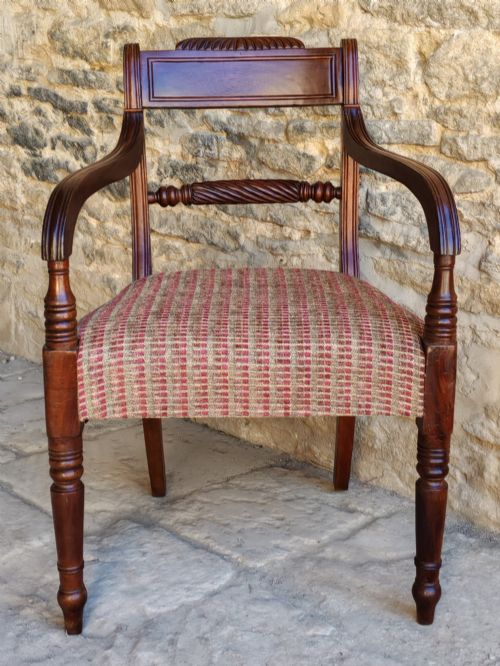
Rope back chairs bring carved elegance to the dining table, pairing crisp joinery with fluid, twisted rails that define the Regency period.
Rope Back Chairs
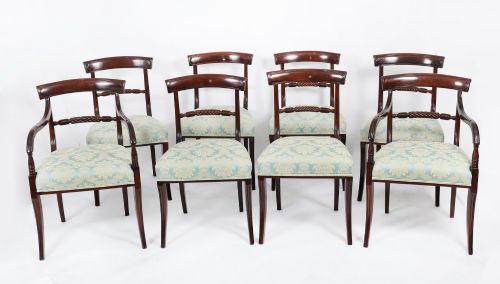
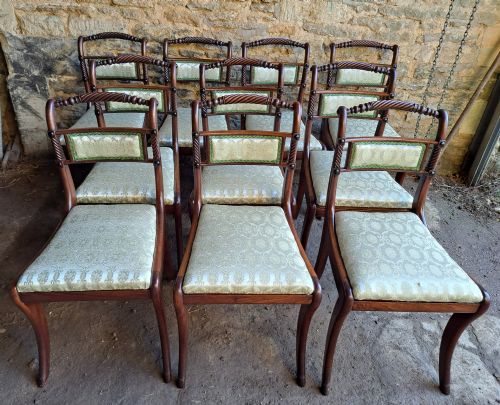
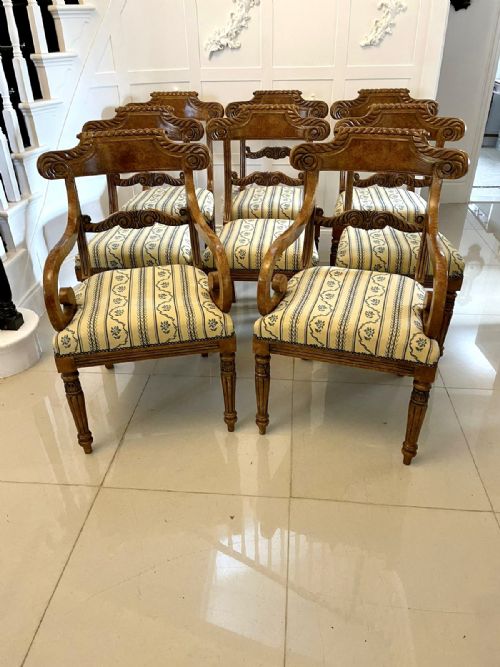
When you search for rope back chairs, you encounter seating built predominantly during the Georgian, Regency, and nineteenth century eras. The form centres on a horizontal top rail carved to resemble a twisted length of rope, often paired with matching splats that provide both support and distinct visual rhythm. Dining chairs and carver chairs appear frequently in these listings, offering options for full dining sets or smaller matching pairs.
The version you are most likely to meet on this page is the single side chair or carver fashioned from mahogany, frequently found as part of larger matching sets ranging from four to ten pieces. Alongside standard mahogany frames, the archive and current listings reveal variations in rosewood, simulated rosewood, faux birds-eye maple, and regional kitchen chairs constructed from beech and elm. These pieces range from formal dining room seating with upholstered seats to simpler country kitchen Windsor forms.
Materials and construction methods
Cabinetmakers relied heavily on dense hardwoods such as mahogany and rosewood to achieve the crisp, durable carving required for the twisted top rail. Timber selection determined how sharply the rope twist could be detailed, with straight-grained mahogany allowing for deep, clean incisions that retain their edge over centuries of use. Secondary woods and local timbers like beech and elm appeared in provincial kitchen variants, shaped to withstand daily domestic service.
Joinery techniques combined traditional mortise and tenon framing with steam-bending for curved components like arm supports and back rails. Seats were traditionally stuffed with natural materials and secured with webbing before receiving covers of fabric, leather, velvet, or French linen. Surface finishes relied on hand-applied polishes that highlighted the natural grain and colour variation of the timber.
Listings for these chairs span the Georgian, Regency, and Victorian periods, utilising mahogany, rosewood, beech, elm, and simulated timbers.
Measures of quality and distinction
Quality in these chairs rests upon the depth and precision of the carved rope twist along the top rail. Master carvers achieved crisp, rounded twists that catch the light, whereas lesser examples show shallow, smoothed-off cutting that lacks definition.
The structural integrity of the frame, particularly the joints where the back legs meet the seat rails, dictates longevity. Original timber surfaces with deep patina and minimal structural replacement command greater respect than pieces with heavy repairs or swapped components.
The Rope Back Chairs Glossary
- Carver chair
- An armchair designed to match a set of dining chairs, typically placed at the head of the table. These feature supportive armrests integrated into the back design.
- Harlequin set
- A collection of chairs that match in style and period but were assembled from different sources over time. They share common characteristics like rope twist rails while varying slightly in timber or proportions.
- Rope twist
- A carved decorative motif resembling a twisted cord or rope, applied horizontally across the top rail of the chair back. This detail is the defining visual element of the form.
- Simulated rosewood
- A painted or stained finish applied to a lighter timber to mimic the rich grain and colour of genuine rosewood. Cabinetmakers utilised this technique to achieve a high-status appearance at a lower cost.
Rope Back Chairs: Frequently Asked Questions
What is a rope back chair?
A rope back chair is a form of antique seating featuring a horizontal top rail carved to imitate a twisted rope. These pieces date primarily from the late Georgian and Regency periods.
They served as formal dining room seating and are commonly found in mahogany, rosewood, or fruitwoods, often accompanied by matching carver chairs with arms.
How do I spot a harlequin set?
A harlequin set consists of chairs that match in design, such as the rope twist motif, but were gathered from separate origins. Close inspection reveals subtle differences in timber grain or height.
These sets were often assembled by owners who needed to expand their seating capacity without purchasing a completely new suite.
Were these chairs used for dining?
These pieces were built primarily for use around the formal dining table. The inclusion of carvers provided armrests for the hosts.
Simpler provincial versions in beech and elm also served domestic dining functions in nineteenth-century kitchens.
How do I care for antique timber?
Maintain antique timber by keeping chairs away from direct heat sources and sudden humidity changes. Regular dusting with a soft cloth preserves the polish.
Avoid modern silicone polishes, opting instead for traditional wax applied sparingly when the wood appears dry.
Can I mix carvers and side chairs?
Matching carvers and side chairs form the standard arrangement for traditional dining sets. The armed carvers sit at the table ends while side chairs line the sides.
Ensure the timber and carving details align when combining separate pieces into a unified dining setup.