

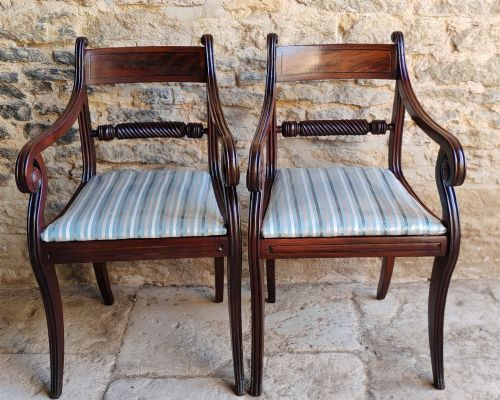


Regency Rope Back Chair
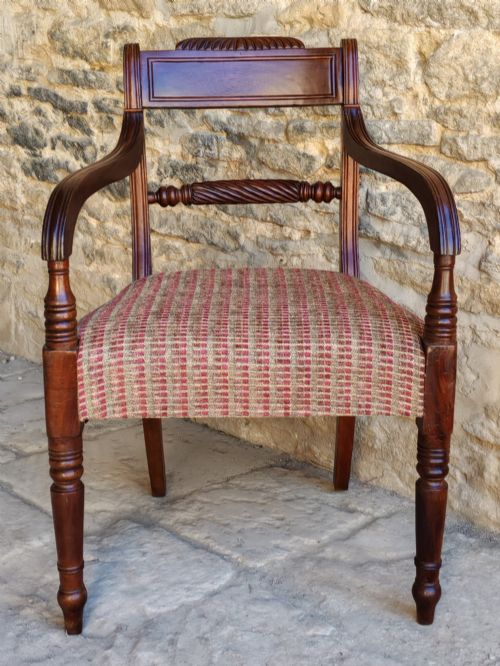
A regency rope back chair brings sculptural elegance to a dining table through carved timber twists.
Regency Rope Back Chair
A regency rope back chair is a dining or carver chair defined by its distinctive carved rail mimicking twisted rope, appearing across the Regency, Georgian, and nineteenth-century periods.
You will most frequently encounter mahogany examples alongside simulated rosewood and ebonised variations, shaped as single side chairs or matched sets.
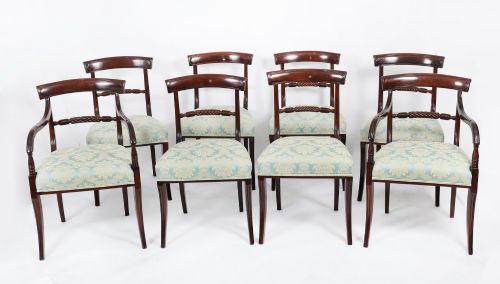
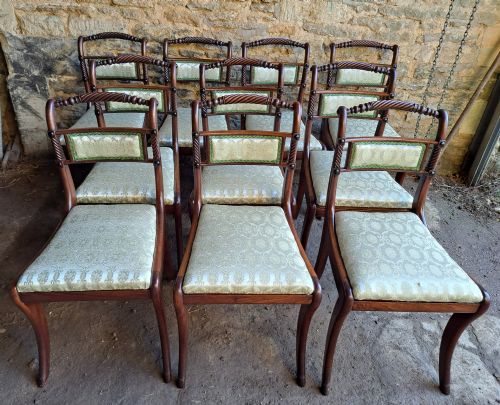
The form spans straightforward four-chair groupings up to larger sets of eight or ten, often accompanied by matching carver armchairs.
Materials and construction
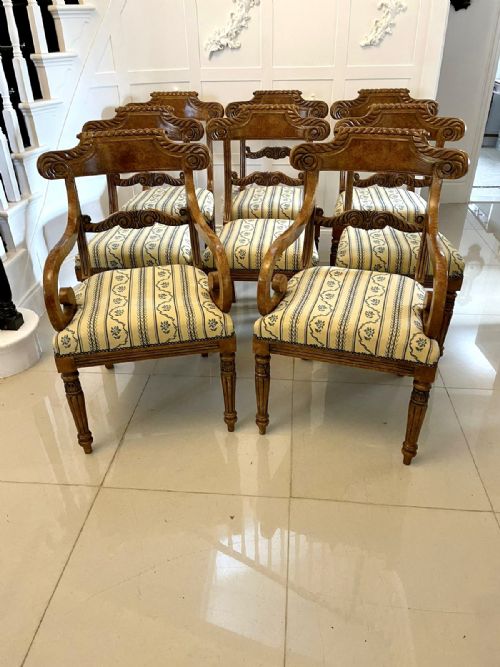
Cabinetmakers shaped these seats primarily from solid mahogany and rosewood, whilst timber frameworks also received faux birdseye maple decoration or ebonised finishes.
The defining rope twist across the top rail required careful hand carving to achieve convincing cord effect, joined to the vertical stiles with traditional cabinet joints.
Listings feature mahogany, rosewood, faux birdseye maple, and ebonised timber across Regency and Georgian periods.
Judging quality and character
The sharpness and depth of the hand-carved rope twist dictate the primary visual distinction between standard production and superior work.
Timber selection and the integrity of the original frame construction govern longevity, where tighter grain patterns and well-balanced proportions separate the finest pieces.
The Regency Rope Back Chair Glossary
- Carver chair
- An armchair designed to sit at the head of a dining table, featuring supportive armrests.
- Ebonised
- Timber treated with a dark stain or finish to imitate ebony wood.
- Simulated rosewood
- Wood painted or stained to replicate the rich figuring of genuine rosewood.
- Stile
- The upright vertical side post of a chair back.
Regency Rope Back Chair: Frequently Asked Questions
What defines a regency rope back chair?
These seats feature a distinctive carved horizontal top rail shaped to resemble a twisted length of rope.
This specific decorative carving emerged during the Regency period and remained popular throughout the nineteenth century.
Were these chairs made in large sets?
Makers produced these seating designs in various quantities, ranging from individual armchairs to large matching sets of eight or ten.
Sets frequently combined side chairs with one or two matching carvers for the heads of the table.
What woods were used for these chairs?
Solid mahogany and rosewood served as the primary timber choices for these dining and library seats.
Craftsmen also utilised alternative timbers finished with ebonisation or painted to simulate exotic grains.
How do I care for antique timber chairs?
Keep wooden frames away from direct heat sources and sudden temperature shifts to prevent timber splitting.
Apply traditional furniture wax sparingly to nourish the polished surface without building up excessive residue.