
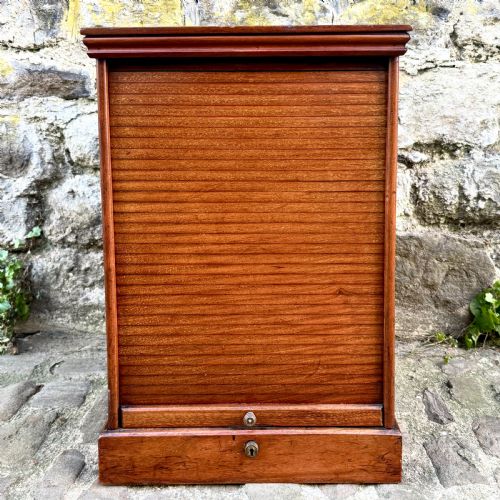
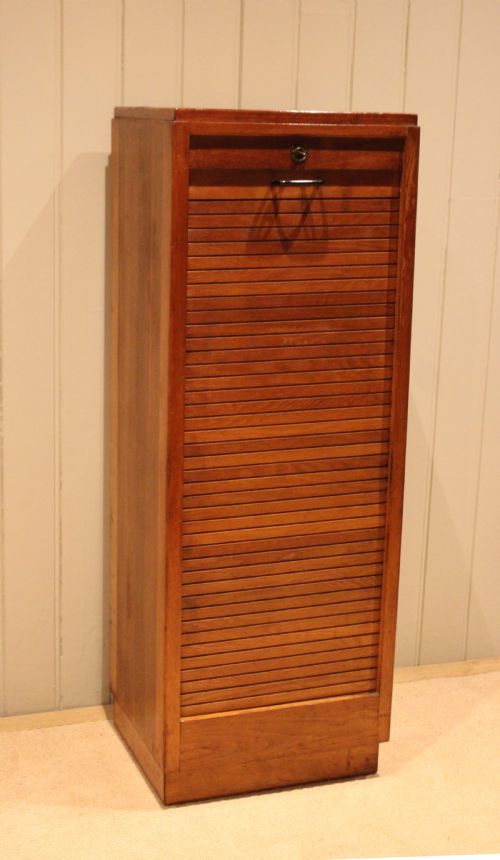
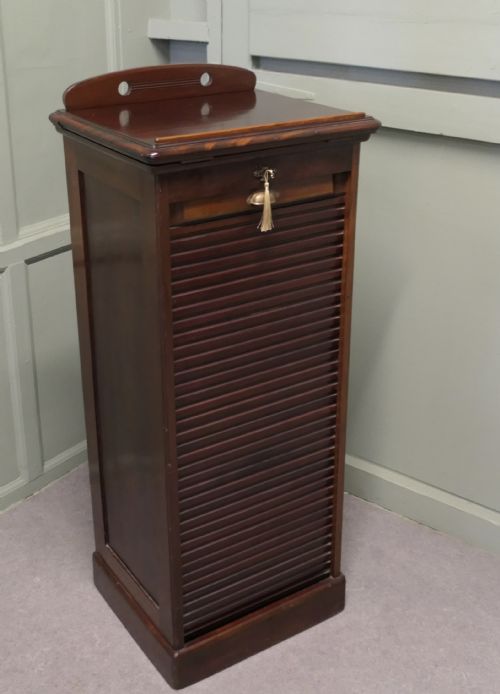


Roll Front Document Cabinet
A roll front document cabinet brings clever sliding tambour doors and tidy storage to a study.
Roll Front Document Cabinet
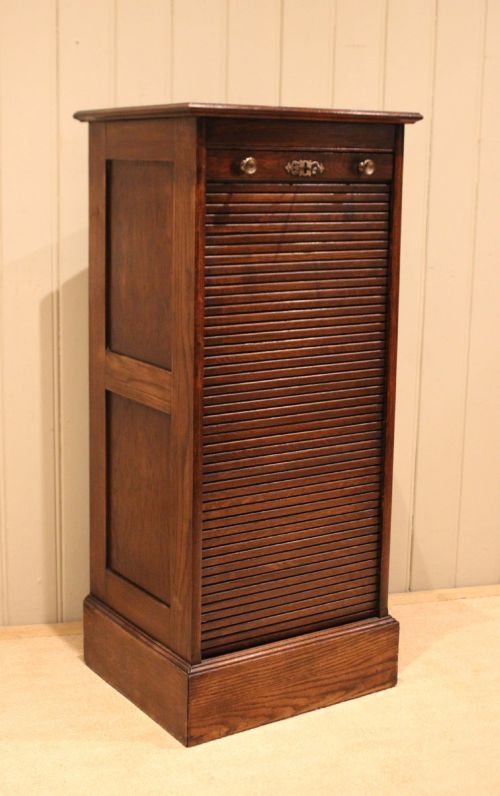
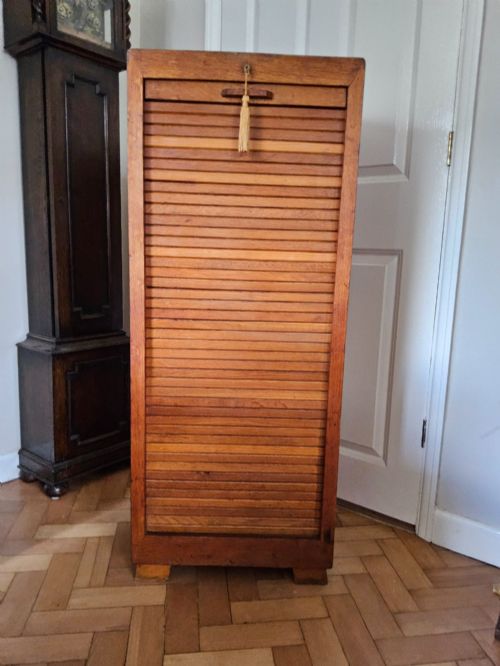
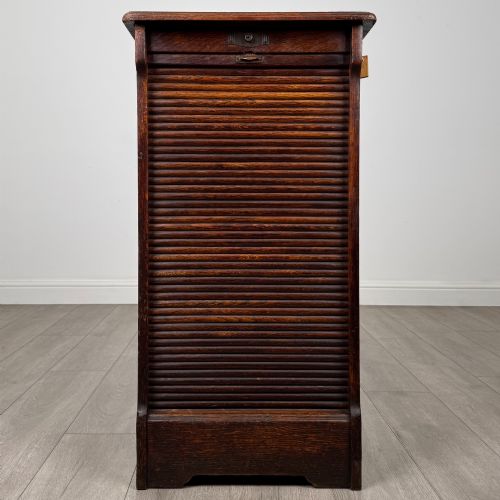
A roll front document cabinet serves as an efficient office or study storage piece, concealing paperwork behind slatted wooden doors that slide smoothly around a track. These practical units appear in various forms, from single tambour front filing cabinets to pedestal reception desk greeters.
Most examples found here date from the late nineteenth century through to the mid-twentieth century, with a strong representation of Edwardian and 1930s pieces. Buyers frequently encounter oak constructions, though rosewood, mahogany, and pine also emerge across different decades.
The primary appeal lies in the clever tambour mechanism, which saves space by eliminating swinging doors while keeping everyday documents secure and out of sight. Whether configured as a compact small proportioned light oak filing cabinet or a larger office cabinet, each piece solves workspace clutter with traditional craftsmanship.
How they were made
Cabinet makers constructed these functional pieces using durable timbers such as oak, rosewood, mahogany, and pine, often selecting quarter-sawn oak to display attractive figuring along the grain. The defining feature, the tambour door, relies on individual wooden slats glued to a flexible canvas or fabric backing so the curtain can bend around tight internal corners.
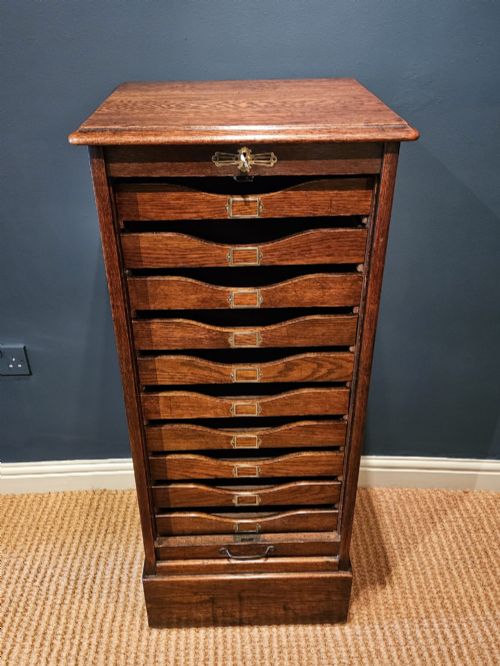
Hardware played a crucial supporting role, with brass and metal fittings used for handles, locks, and card holders on the drawer or cabinet fronts. Joinery had to be exceptionally precise because the sliding tracks required exact alignment to ensure the tambour mechanism operated without catching or jamming over decades of daily office use.
Listings span from the late nineteenth century through to 1940, featuring Edwardian, Victorian, and Art Deco styles constructed in oak, rosewood, and pine.
What varies in quality
Quality in a roll front document cabinet rests entirely on the precision of the tambour mechanism and the smoothness of its track. Superior examples glide effortlessly with minimal resistance, whereas lesser pieces suffer from stiff slats or warped backing fabric that binds in the runners.
Timber selection and internal joinery also divide the range, as finer cabinets utilise solid hardwoods throughout, complete with well-fitted internal pigeon holes or document dividers. Secondary woods, simpler pine constructions, and heavy wear to the sliding tracks distinguish more utilitarian pieces from the finest cabinet maker output.
The Roll Front Document Cabinet Glossary
- Tambour
- A flexible door made of narrow wooden slats attached to canvas, allowing it to slide around a curved track and conceal the cabinet interior. This ingenious design saves valuable floor space in cramped offices.
- Pedestal
- A support structure beneath a cabinet or desk, often fitted with banks of drawers for filing and storage. Victorian examples frequently utilise this sturdy configuration.
- Quarter-sawn
- A method of cutting logs radially to produce timber with enhanced dimensional stability and a striking medullary ray grain pattern. Cabinet makers favoured this cut for premium oak office furniture.
- Pigeon hole
- A small, open compartment inside a cabinet used for sorting letters, documents, and correspondence. These internal divisions keep paperwork organised behind the main sliding door.
Roll Front Document Cabinet: Frequently Asked Questions
How do tambour doors work?
Tambour doors consist of narrow strips of wood glued side by side onto a flexible canvas backing. This construction lets the entire panel bend smoothly around a curved track inside the cabinet.
When pushed open, the door slides away into the side or back of the unit, remaining completely hidden from view while granting full access to the contents.
What wood were they made from?
Oak is the predominant timber found in these cabinets, ranging from dark oak finishes to light oak and Edwardian examples. Cabinet makers also utilised rosewood, mahogany, and pine for specific pieces.
Hardware components incorporated brass, metal, and steel elements for locks, handles, and internal mechanisms to withstand daily office use.
How do I date an office cabinet?
Dating relies on stylistic clues, timber choices, and construction methods characteristic of different periods like the Victorian era, Edwardian period, or 1930s. Edwardian pieces often feature warm oak tones and traditional brass hardware, while 1930s models lean towards simpler, utilitarian office designs.
Examining the internal construction, backing materials, and any original manufacturer stamps also helps narrow down the decade of production.
Are these cabinets good for modern files?
Many of these cabinets offer internal configurations well-suited to storing modern paperwork, books, and stationery. The adjustable shelving or pigeon holes can accommodate various document sizes depending on the specific model.
Careful measurement of the internal depth ensures that standard folders fit comfortably behind the sliding tambour front without straining the mechanism.