


Revolving Table Server
A revolving table server brings smooth motion to the dining table, offering effortless access to food and drink across Georgian to Art Deco periods.
Revolving Table Server
A revolving table server operates as a rotating tray, dumb waiter, or lazy Susan designed to pass dishes smoothly around the table without interruption. When you search for a revolving table server, you encounter tiered mahogany stands, tabletop porcelain supper sets, and simple wooden trays.
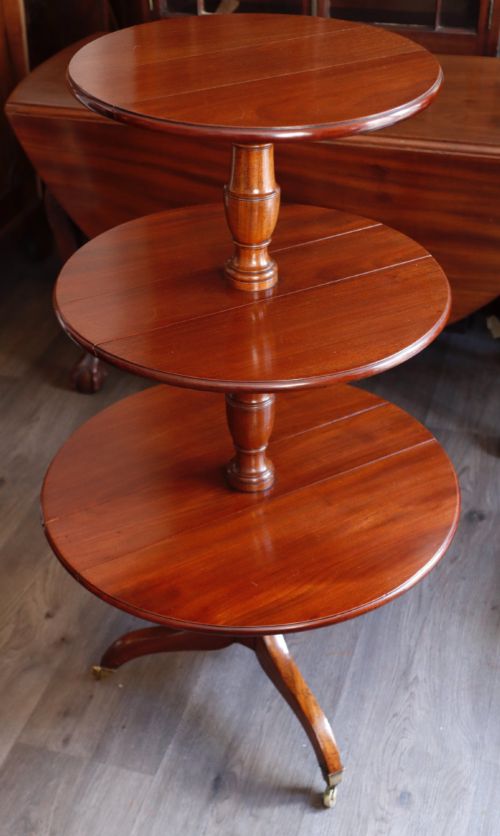
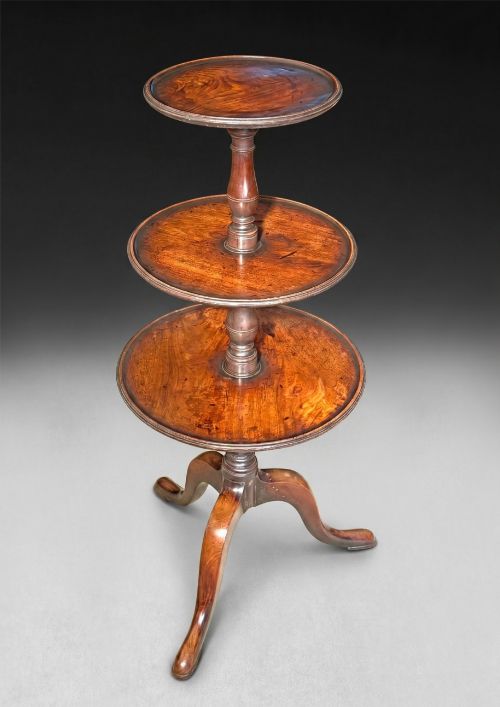
The pieces on this page span several distinct eras, stretching from eighteenth-century George III designs to Edwardian and Art Deco iterations. Mahogany forms the backbone of these offerings, frequently configured in multi-tiered arrangements on tripod bases.
Tabletop lazy Susans and complex dumb waiters represent the primary forms you will meet here. They serve the practical purpose of sharing condiments, courses, or drinks in domestic settings.
Materials and construction methods
Makers relied heavily on solid and veneered mahogany for the structural frames of tiered dumb waiters and revolving trays. Brass hardware often reinforces the central pivot points and joints where movement occurs.
Coalport porcelain appears in specialised supper sets paired with rotating elements, alongside secondary materials such as glass, silver plate, ebony, aluminium, and chrome. Woodturners shaped the central columns and tripod legs to support the revolving tiers securely.
Mahogany is the dominant material seen across these listings, spanning the Georgian, Regency, Victorian, and Edwardian periods.
Distinguishing quality in revolving servers
Quality reveals itself in the smoothness of the rotation and the stability of the central axis. A superior piece maintains an even balance across all tiers without wobble or friction during movement.
The selection of timber grain, the precision of the turning on the column, and the integration of brass fittings determine the visual refinement of the object. Finer examples display meticulous attention to proportion across multi-tiered configurations.
The Revolving Table Server Glossary
- Dumb waiter
- A freestanding tiered shelving unit on a central column, designed to hold dishes near a dining table. These often feature revolving trays.
- Lazy Susan
- A revolving tray placed on a table or countertop to assist in moving food easily. These appear in wood and porcelain formats.
- Tripod base
- A three-legged support structure commonly found beneath nineteenth-century dumb waiters and occasional tables. This design provides stable footing on uneven floors.
- Supper set
- A fitted collection of serving dishes arranged around a central rotating mechanism. These frequently incorporate decorated porcelain elements.
- Tiered table
- A piece of furniture constructed with multiple horizontal surfaces placed one above another. This format maximises display and serving space.
Revolving Table Server: Frequently Asked Questions
What is a revolving table server used for?
These pieces assist diners by rotating dishes, condiments, or drinks within reach around a shared table.
They function as practical dining room accessories, reducing the need to pass heavy serving platters manually.
How do I date a mahogany dumb waiter?
Dating relies on examining the turning style of the central column, the formation of the tripod base, and the overall joinery methods.
Georgian and Regency pieces exhibit different leg profiles and wood finishes compared to later Victorian or Edwardian examples.
Are all revolving servers made of wood?
While mahogany is the most prevalent material across these listings, other substances appear frequently in the record.
Examples incorporate porcelain sections, brass hardware, glass, silver plate, and later twentieth-century metals like chrome and aluminium.
What is the difference between a lazy Susan and a dumb waiter?
A lazy Susan typically sits directly on top of a dining table as a flat revolving tray.
A dumb waiter stands independently on the floor as a tall, multi-tiered piece of furniture with rotating shelves.