

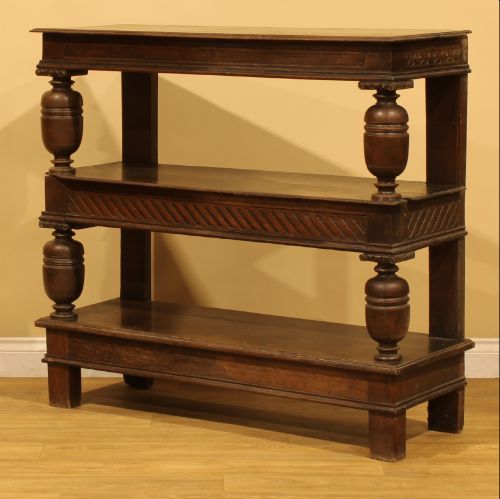
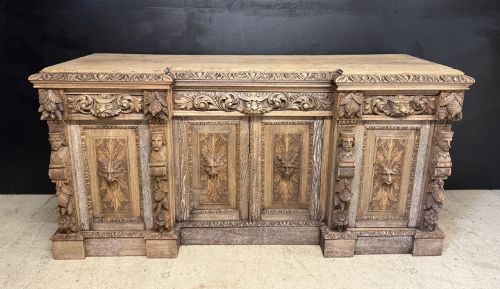
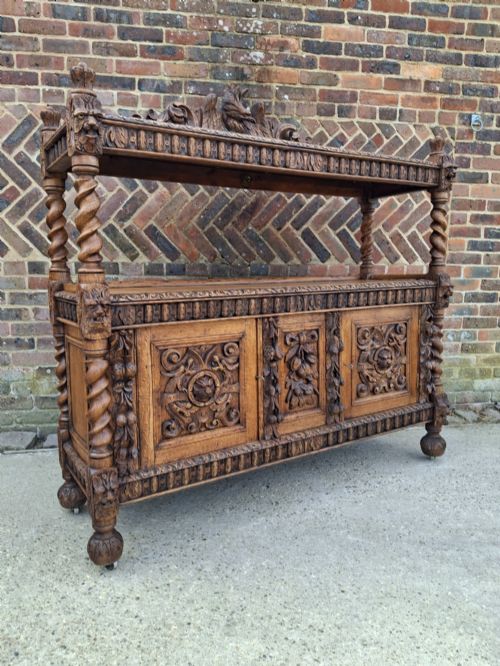
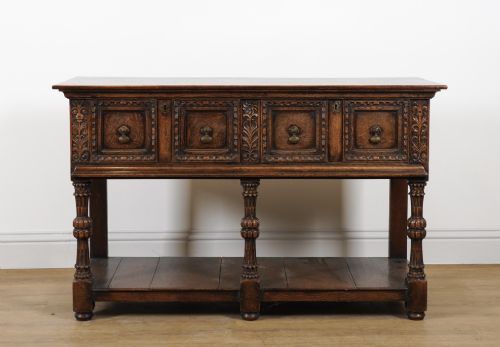
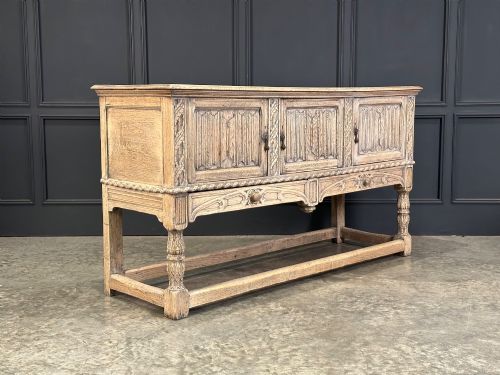
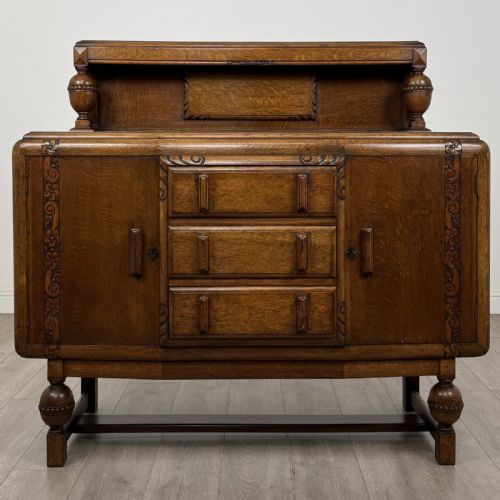
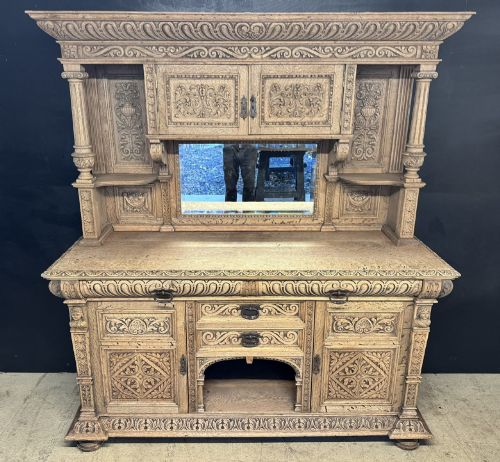
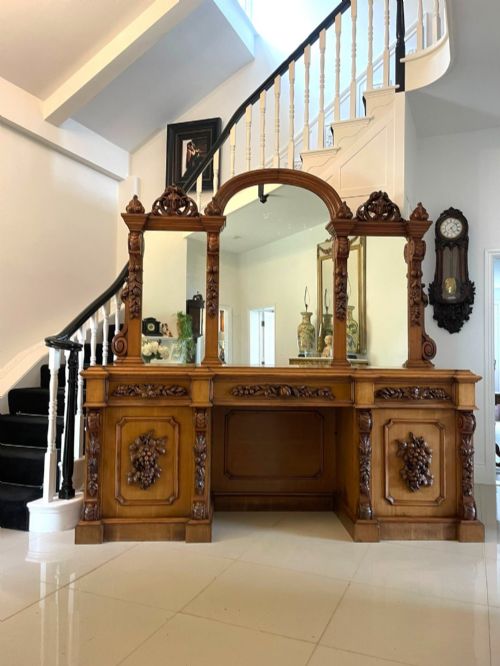
Revival Oak Buffet
A revival oak buffet is a substantial storage piece built to command a dining room, combining historic revival styles with practical utility.
Revival Oak Buffet
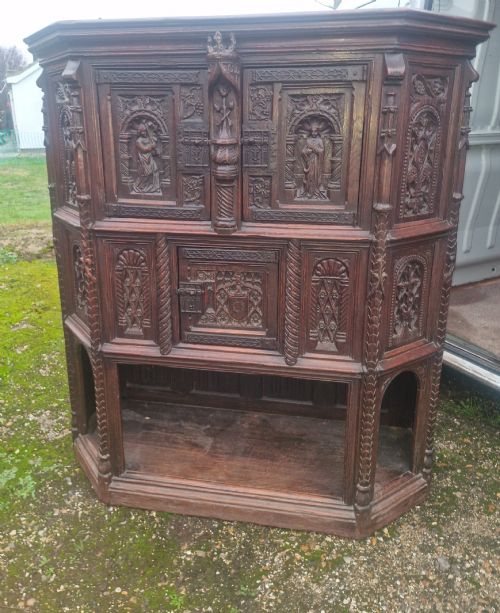
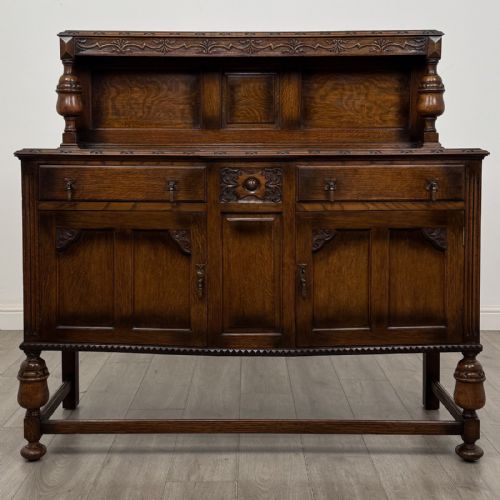
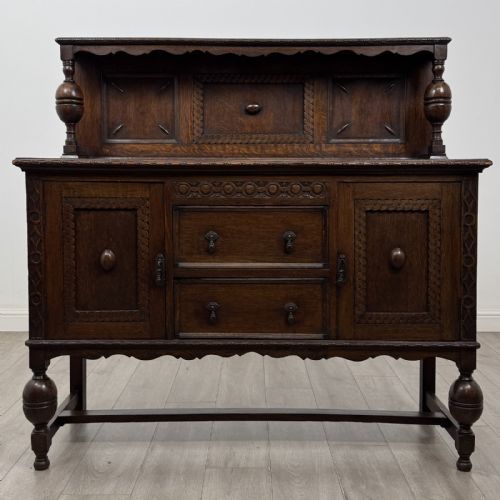
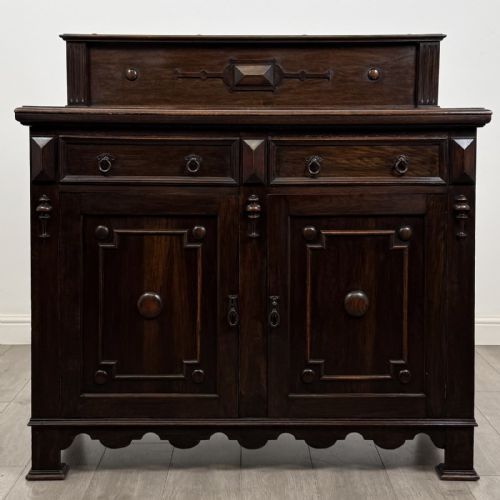
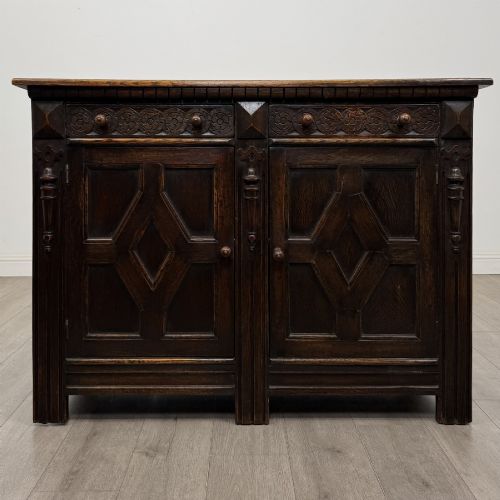
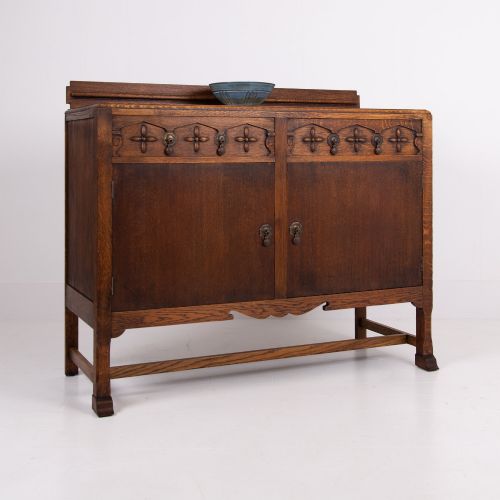
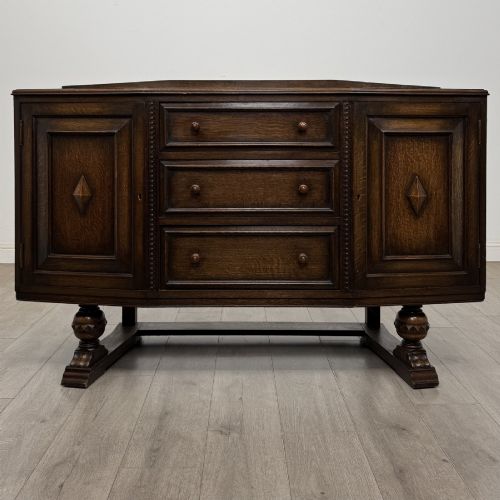
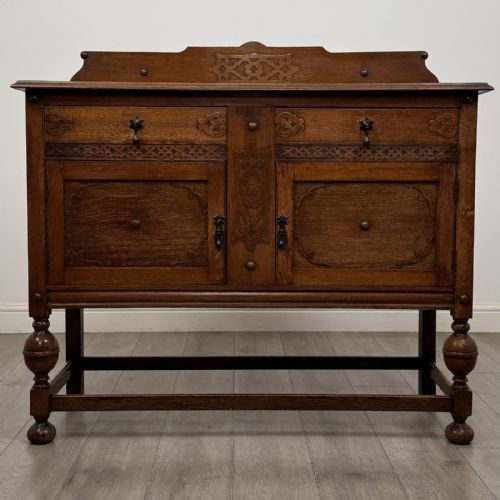
A search for revival oak buffet brings up heavy timber sideboards, dresser bases, and court cupboards spanning the Victorian, Edwardian, and early twentieth-century periods. These heavy storage items draw directly upon earlier centuries, frequently adopting Jacobean, Gothic, and Renaissance revival idioms.
The pieces on this page appear in various formats, from mirror-backed sideboards and French enfilades to narrow dresser bases fitted with barley-twist supports or stretcher bases. Most examples lean heavily into seventeenth-century motifs, reinterpreting them through nineteenth- and twentieth-century workshop practices.
Makers and designers of the period, including Gillows and Leonard Wyburd working for Liberty, translated historical architectural elements into domestic dining furniture. Buyers encounter these forms equipped with practical drawers, cupboards, and pot boards designed for displaying and storing tableware.
Materials and Construction
Solid oak provides the structural core for the vast majority of these items, frequently paired with secondary woods like walnut and fruitwood in regional or continental examples. Timber selection dictates the weight and presence of each buffet, yielding dense frames capable of supporting deep relief carving.
Workshops utilised traditional joinery techniques alongside applied ornamentation, integrating brass hardware, iron hinges, glass panels, and occasionally marble tops or mirror backs. Carved details such as lion masks, green man imagery, and geometric panels are executed directly into the solid timber framework.
Revival Oak Buffet Retail Price Guide 2026
Typical asking prices for revival oak buffet among the pieces listed under this phrase on Sellingantiques today, from the lower quarter to the upper quarter. They describe what is for sale here now, not the wider market.
The inventory spans the Victorian, Edwardian, and early twentieth-century periods, alongside examples attributed to eighteenth-century workshop traditions.
Judging Quality
The distinction between standard commercial output and superior craftsmanship lies in the depth and clarity of the timber carving and the architectural integrity of the proportions. Finer examples display crisply hand-carved relief work, well-figured oak grain, and integrated period mounts rather than mass-produced applied mouldings.
Construction methods also separate the output of notable firms and individual makers from ordinary cabinetworks, evident in the snugness of the drawer joints, the stability of stretcher bases, and the uncompromised thickness of the solid oak panels.
Gillows·Leonard Wyburd
The Revival Oak Buffet Glossary
- Jacobean Revival
- A nineteenth-century style imitating early seventeenth-century English furniture, characterised by geometric moulded panels, strapwork, and heavy turnings. This aesthetic gives revival oak buffets their characteristic architectural weight.
- Green Man
- A sculptural motif depicting a human face emerging from or entwined with foliage and vines. It appears frequently as a carved decorative element on Victorian and Arts and Crafts oak furniture.
- Pot Board
- An open low shelf fitted beneath the main body of a dresser base or sideboard. Originally utilised for storing pots and domestic utensils, it serves as a defining feature of traditional vernacular storage pieces.
- Stretcher Base
- A system of horizontal timber rails connecting the lower legs of a table or sideboard for added stability. These supports often take turned or moulded forms on revival oak pieces.
- Enfilade
- A suite of rooms aligned with each other, or in furniture terms, a long sideboard or buffet featuring a series of cupboards sharing a continuous top surface. French examples frequently incorporate marble tops into this form.
Revival Oak Buffet: Frequently Asked Questions
How do I identify a revival oak buffet?
Look for heavy timber construction, traditional joinery, and decorative idioms borrowed directly from seventeenth-century Jacobean or Gothic architecture. These pieces typically feature dark patinated oak, geometric panels, and substantial cupboard or drawer configurations.
Makers working in the nineteenth and twentieth centuries applied these historicist details to dining room furniture, resulting in imposing sideboards and dresser bases that echo older periods while serving modern storage needs.
Where were these buffets placed in a home?
These large storage items historically anchored the dining room or hall, serving as functional surfaces for carving meats, storing silverware, and displaying ceramics. Their substantial proportions required ample space to avoid dominating smaller rooms.
In contemporary interiors, they continue to function effectively in dining spaces or large kitchens, providing deep drawers and enclosed cupboard space for tableware and linens.
How do I care for solid oak furniture?
Maintain the timber by keeping it away from direct heat sources and rapid temperature fluctuations, which can cause the solid oak panels to split or warp. Dust regularly with a dry cloth and apply a quality beeswax sparingly to nourish the finish.
Avoid silicone-based sprays, as they build up over time and dull the natural patina of the wood. Treating the surface with care preserves the historic finish achieved over decades of handling.
What is the difference between a sideboard and a buffet?
While the terms are often used interchangeably in trade descriptions, a buffet traditionally emphasises lower storage with cupboards and serving space, whereas a sideboard may incorporate a wider variety of drawers and decorative upper structures like mirror backs.
Both forms share similar construction methods and historical revival styles, differing primarily in their internal configuration and overall height relative to the dining table.