

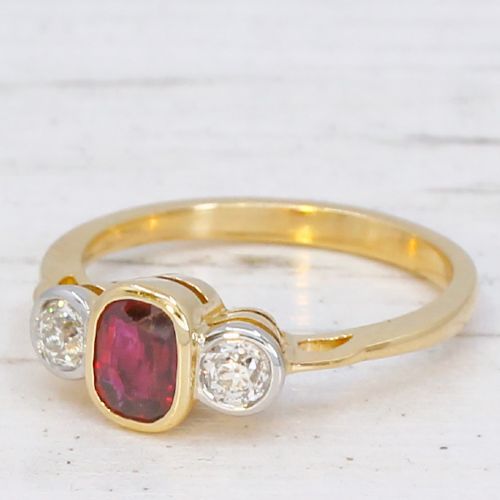


Retro Ruby Ring
A retro ruby ring brings sculptural goldwork and vibrant red stones together, offering the bold character collectors seek in mid-century jewellery.
Retro Ruby Ring
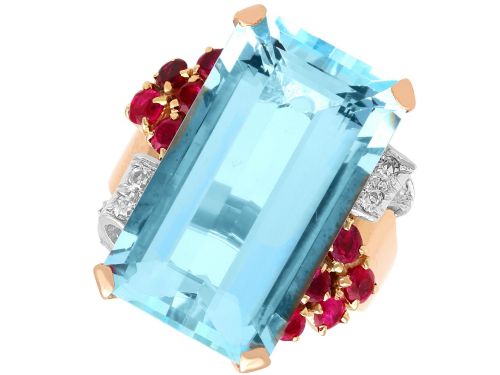
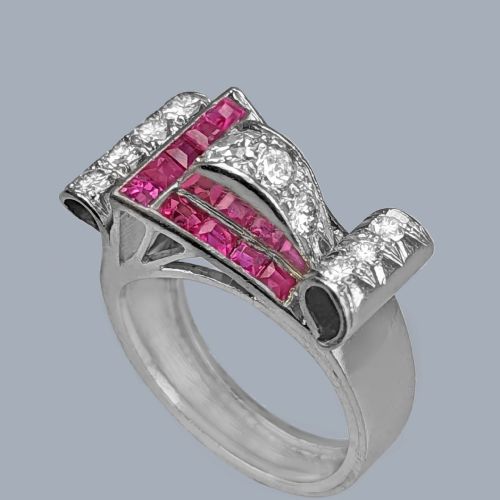
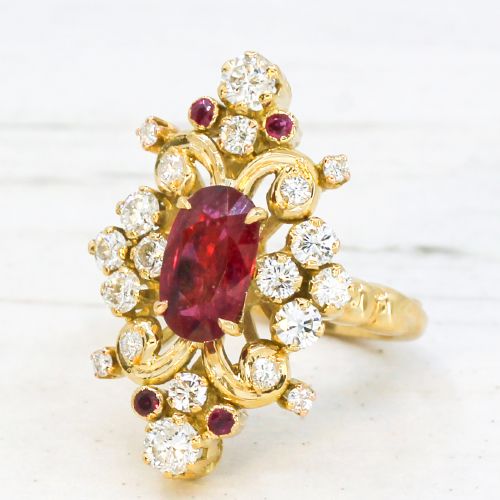
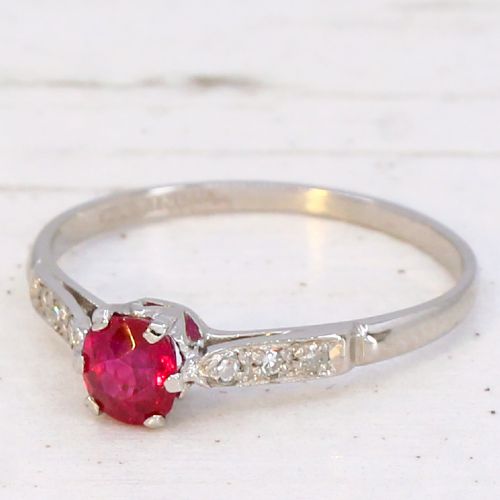
A retro ruby ring draws upon mid-century design, appearing frequently in robust forms from the nineteen forties and nineteen fifties. These pieces often showcase geometric lines or voluminous contours that reflect the post-war appetite for striking cocktail jewellery.
The selection encompasses diverse iterations, ranging from stark tank styles to organic floral motifs and spiral clusters. Alongside these mid-century interpretations, pieces stretch from earlier Edwardian and Art Deco aesthetics through to nineteen sixties modernist creations.
Materials and Construction
Goldsmiths utilised yellow gold, white gold, and platinum to build heavy foundational settings that could support significant stone weights. Platinum frequently highlights diamond details, while yellow gold and eighteen carat white gold form the robust bodies of tank and cocktail rings.
Rubies take centre stage, paired with old cut or rose cut diamonds to create high-contrast focal points. Natural stones from Burma sit alongside synthetic variations in French and British workshop productions from the mid-century era.
Retro Ruby Ring Retail Price Guide 2026
Typical asking prices for retro ruby ring among the pieces listed under this phrase on Sellingantiques today, from the lower quarter to the upper quarter. They describe what is for sale here now, not the wider market.
Distinguishing Quality
The calibre of a retro ruby ring rests on the provenance and origin of its central gems, particularly when unheated Burmese stones are present. Weight distribution across heavy gold or platinum mountings also dictates the physical presence and comfort of the piece.
Execution of complex designs, such as articulated tank forms or detailed animal motifs, separates standard production from superior craftsmanship. The clarity and cut of accompanying old cut diamonds further elevate the overall refinement of the ring.
Kutchinsky
The Retro Ruby Ring Glossary
- Tank ring
- A bold, chunky ring style developed during the nineteen forties, mimicking the geometric lines of military hardware. This aesthetic defines much of the period's heavy gold jewellery.
- Cocktail ring
- A large, showy ring designed to be noticed across a room, typically featuring central rubies surrounded by diamonds. These pieces gained immense popularity during the mid-century decades.
- Old cut diamond
- A precursor to the modern brilliant cut, characterised by a smaller table, higher crown, and distinct hand-faceted proportions. These stones impart a softer, warmer scintillation.
- Unheated ruby
- A natural gemstone that has undergone no thermal treatments to improve its colour or clarity. Such stones command particular respect among serious collectors.
- Bombé ring
- A jewellery form featuring a rounded, domed profile that swells outward from the finger. This volumetric style showcases pavé-set diamonds and rubies to striking visual effect.
Retro Ruby Ring: Frequently Asked Questions
How do I date a retro ruby ring?
Dating relies heavily on stylistic markers, such as the chunky geometric lines typical of nineteen forties tank designs versus the lighter, organic motifs of the nineteen fifties and sixties.
Hallmarks stamped inside the shank provide official confirmation of the assay office, metal purity, and year of manufacture where present.
Are these rubies natural or synthetic?
The inventory contains both natural stones, including Burmese origins, and synthetic alternatives produced during the mid-century period.
Laboratory certificates and microscopic inclusion analysis help verify the geological origin of the ruby.
Can I wear a cocktail ring daily?
While robust gold and platinum settings provide structural integrity, the generous proportions and protruding stones of cocktail rings demand careful wear.
Removing the ring during manual tasks protects both the central rubies and the delicate claw or channel settings.
What metals were used in the forties?
Jewellery from this decade frequently employs yellow gold, rose gold, and platinum, often combined within a single mounting due to wartime metal restrictions.
Eighteen carat and twenty-two carat gold forms provide the weighty foundation characteristic of the era.