




Retro Cocktail Accessories
Retro cocktail accessories bring striking period design and social history to the modern home bar.
Retro Cocktail Accessories
When you search for retro cocktail accessories, you encounter items designed for preparing and serving drinks primarily from the 1920s, 1930s, and 1940s. The selection on this page focuses heavily on Art Deco and Mid-Century Modern barware.
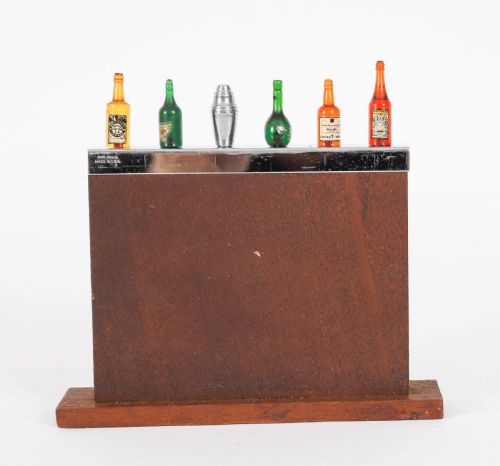
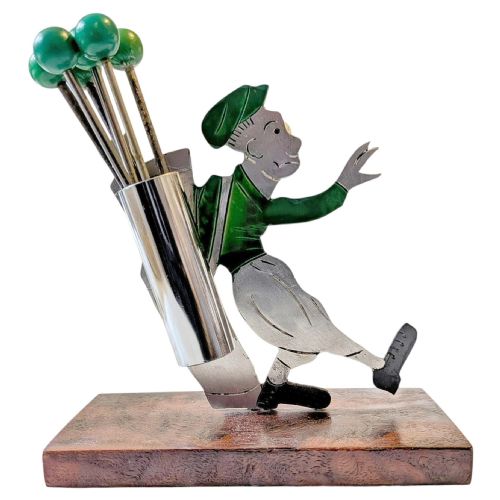
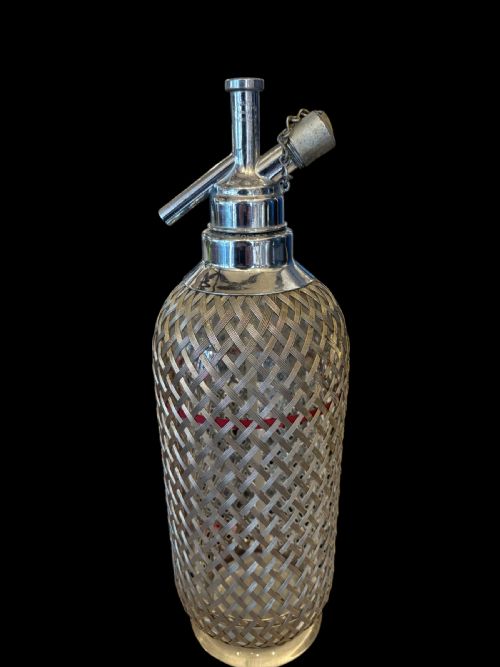
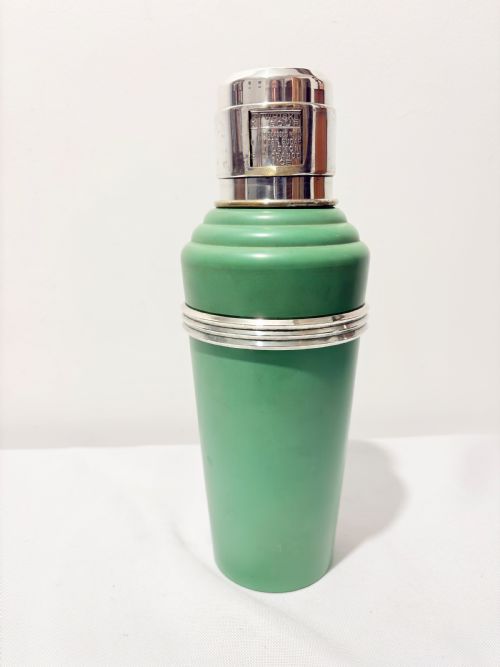
The most common forms you will meet include cocktail shakers, novelty cocktail stick sets, serving trays, and soda syphons. Many pieces incorporate playful figurative designs, such as comical golfers, cherry figures, and cinematic characters like Charlie Chaplin.
Makers from England, France, Switzerland, and Germany produced these items for entertaining guests in style. The objects range from utilitarian soda syphons to intricate silver-plated shakers fitted with rolling recipe mechanisms and integral lemon squeezers.
Materials and construction
Makers relied on silver plate, electroplated nickel silver, and chrome to give metal barware its bright, reflective finish. These metals were shaped into sleek cylindrical shakers and supportive frames for glass vessels.
Bakelite and early plastics provided vibrant colour contrasts for handles, lids, and novelty cocktail stick sets. Glass was frequently utilised for the bodies of shakers and syphons, often enhanced with enamel decoration or combined directly with metal mounts.
Assessing quality in period barware
Quality shows in the weight of the metal and the precision of the joints, particularly on shaker lids and integrated mechanisms like lemon squeezers. Thicker silver plating and sturdier internal elements distinguish well-made pieces from lighter domestic items.
The crispness of the casting in novelty items, such as figural cocktail sticks and trays, separates standard production from finer workmanship. Original combinations of contrasting materials, like coloured Bakelite paired with gleaming chrome, retain sharper definitions on superior examples.
Sudre·J. B. Chatterley & Sons·James Dixon & Sons·William Suckling·C S Green & Co.·Gaskell & Chambers·Lutz & Weiss
The Retro Cocktail Accessories Glossary
- Silver Plate
- A thin layer of silver applied to a base metal such as copper or nickel alloy. This technique allowed manufacturers to produce lustrous tableware at a lower cost than solid silver.
- Bakelite
- An early form of synthetic plastic prized for its durability and rich colour range. It frequently appears in handles, knobs, and decorative bases on barware.
- Electroplated Nickel Silver
- A base metal alloy of copper, nickel, and zinc coated with silver through an electrolytic process. It provides a durable, bright surface common in twentieth-century bar accessories.
- Soda Syphon
- A pressurized bottle used to dispense carbonated water. These functional items often feature mesh wire or metal casings typical of mid-century styling.
Retro Cocktail Accessories: Frequently Asked Questions
What are retro cocktail accessories?
These items comprise functional and decorative objects used for mixing and serving drinks during the early to mid-twentieth century. They include cocktail shakers, trays, and stick sets designed for home entertaining.
Most pieces originate from the 1920s to the 1940s, reflecting the popular Art Deco design movements of the period.
How were cocktail shakers used?
Hosts utilised cocktail shakers to combine spirits, juices, and ice before pouring drinks for guests. Some advanced designs included rolling mixer recipes printed directly onto the metal body.
Other variations featured built-in lemon squeezers to streamline the preparation of citrus-based cocktails.
How do I care for silver plated barware?
Silver plated items require gentle cleaning with non-abrasive cloths and mild polish to preserve the metallic finish. Avoiding harsh chemicals prevents damage to the underlying plating.
Items containing Bakelite or plastic components should be washed by hand rather than placed in an automated dishwasher.
How can I tell Art Deco barware apart?
Art Deco pieces typically display geometric patterns, streamlined silhouettes, and contrasting materials like chrome and coloured plastics. Makers often emphasised symmetry and clean vertical lines.
Later mid-century items introduced more organic forms and different combinations of glass and metal.