

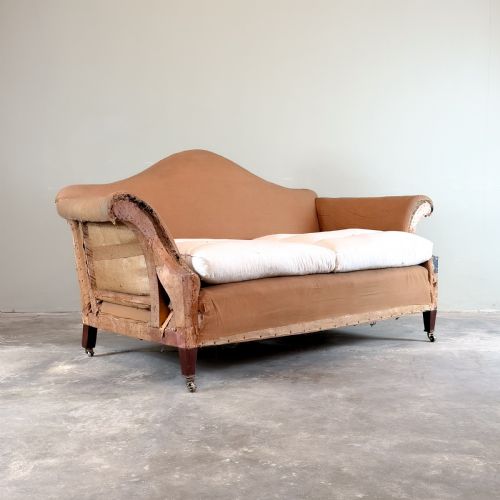


Restored Couch
A restored antique couch brings deep leather seating and sturdy nineteenth-century wooden frames directly into a modern drawing room.
Restored Couch
A restored antique couch encompasses large Victorian and Regency seating forms, most frequently encountered as deep-buttoned leather Chesterfields, serpentine fronted settees, and carved frame drop-arm sofas. These pieces draw from traditional English country house styles and George II revivals, presenting substantial timber frames wrapped in hand-dyed leathers.
The selection centres heavily on nineteenth-century examples, including Edwardian camel back sofas and bespoke nineteenth-century chaise longues fitted with horse hair fill. Buyers meet pieces ranging from walnut-framed Regency pieces to robust Victorian club sofas, each brought back to standard through specialist upholstery work.
How they were made
Makers constructed these frames using dense hardwoods like mahogany and general timber, reinforcing the internal architecture with brass fittings and jute webbing to support heavy daily use. Traditional upholsterers packed the seats and backs using horse hair fill, layering natural fibres beneath durable leather hides.
Workshops finished the surfaces with hand-dyed brown and whisky leathers, often applying tufted buttoning by hand across high-backed settees and carved frames.
Restored Couch Retail Price Guide 2026
Typical asking prices for restored couch among the pieces listed under this phrase on Sellingantiques today, from the lower quarter to the upper quarter. They describe what is for sale here now, not the wider market.
Some nineteenth-century chaises come equipped with drop arms for impromptu afternoon naps.
What varies in quality
Quality separates along the integrity of the underlying timber frame and the precision of the upholstery restoration, where carved herms, serpentine woodwork, and structural joinery dictate the value of a piece. Finer examples retain crisply carved wooden details on Regency frames and deep, even tufting across the leather hide.
The depth and character of the hand-dyed leather finish also distinguish superior specimens, alongside the authenticity of period materials used during the restoration process.
Howard & Sons
The Restored Couch Glossary
- Chesterfield sofa
- A deep-buttoned, upholstered sofa traditionally finished in leather, known for arms and back of the same height. This form anchors many nineteenth-century country house interiors.
- Chaise longue
- An upholstered long chair designed for reclining, combining the backrest of a sofa with a seat long enough to support the legs. Nineteenth-century examples often feature drop arms.
- Horse hair fill
- Traditional stuffing material packed inside upholstered furniture for firm, resilient support. Craftsmen utilised this natural material before modern foam alternatives existed.
- Serpentine front
- A furniture front curving inward centrally and outward at the sides in a continuous wave shape. This contour appears on select Victorian settees.
- Camel back sofa
- An upholstered sofa featuring a graceful, undulating curved backrest resembling a camel's hump. Edwardian makers frequently produced variations of this form.
Restored Couch: Frequently Asked Questions
How do I style a leather couch in a modern room?
A dark leather couch anchors a room with rich texture, pairing easily with minimalist walls and contemporary lighting. The warm tones of whisky or brown leather suit both traditional country house schemes and modern open-plan spaces.
Positioning the sofa away from direct sunlight preserves the hand-dyed leather finish. Adding simple textiles softens the substantial timber and leather frame.
Are these sofas comfortable for daily use?
These historical sofas utilise dense horse hair fill and deep springing to provide firm, supportive seating. The generous proportions accommodate daily lounging while maintaining structural integrity.
Over time, the traditional fillings settle to match the sitter's posture. Regular use helps the heavy leather hide soften further.
How do I identify a Victorian Chesterfield?
Victorian Chesterfields typically feature deep button tufting across the back and arms, paired with substantial turned wooden feet. The leather is often hand-dyed in shades of brown or whisky.
Examining the underside reveals nineteenth-century jute webbing and timber construction. These physical markers separate genuine period pieces from modern reproductions.