



Restoration Era Walnut Chest
A restoration era walnut chest is a sturdy seventeenth-century storage piece built from rich timber, prized for deep grain and historic joinery.
Restoration Era Walnut Chest
A restoration era walnut chest offers solid seventeenth-century storage featuring rich timber surfaces and deep drawer configurations. These pieces embody the domestic craftsmanship of the late sixteen-hundreds, providing functional furniture with distinct historic character.
Most examples appearing here belong to the William and Mary or Charles II periods, often constructed as chests of drawers or two-part forms. Buyers frequently encounter walnut combined with secondary woods like oak or fruitwood, presenting either simple plank construction or elaborate surface decoration.
How they were made
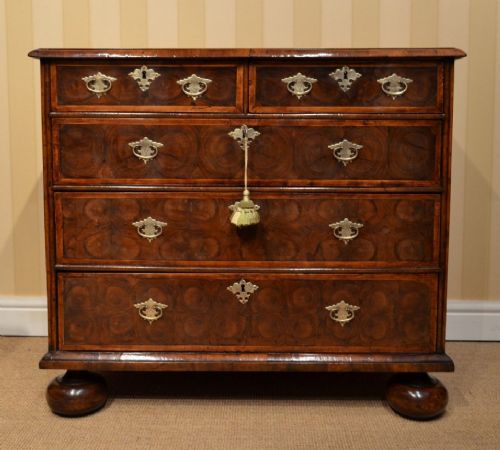
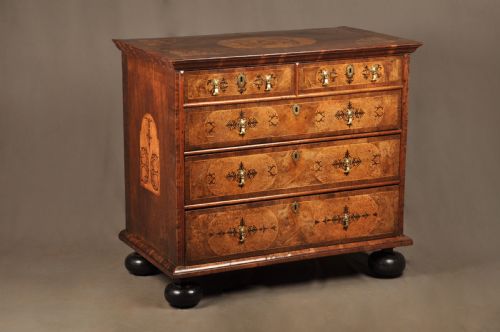
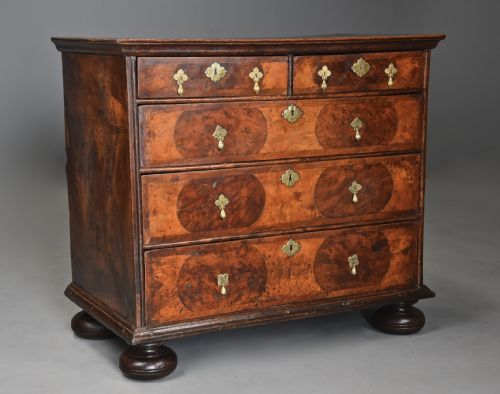
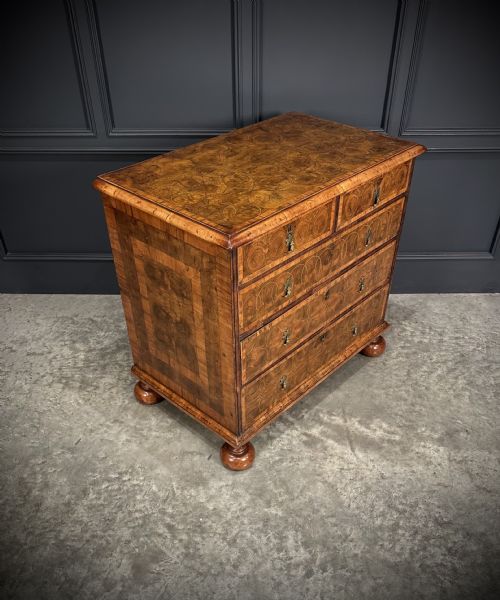
Cabinetmakers built these carcases primarily using solid walnut, oak, and fruitwood, often applying intricate oyster veneers or arabesque marquetry to the visible surfaces. These decorative veneers were sliced from small branches to create repeating circular patterns across the drawer fronts and top panels.
Joinery relied on traditional hand-cut joints supported by brass hardware such as drop handles and escutcheons. Secondary timbers like yew, olivewood, and ebonised wood frequently appeared as contrasting stringing or edge banding to frame the primary walnut panels.
Some seventeenth-century tree branches gave their very best lives just to look like a handful of spilled oysters on a drawer front.
What varies in quality
Quality rests upon the preservation of the delicate veneer work and the integrity of the underlying timber carcase. Pieces retaining their original surface patination and undisturbed marquetry patterns display superior craftsmanship compared to those with extensive later replacement.
The sophistication of the secondary woods and the precision of the brass hardware further distinguish finer examples. The complexity of the arabesque inlay and the grain matching across the drawer fronts reveal the skill of the original workshop.
The Restoration Era Walnut Chest Glossary
- Oyster veneer
- Circular veneer slices cut obliquely from small branches, arranged in repeating patterns to resemble oyster shells. This technique defined surface decoration during the late seventeenth century.
- Charles II period
- The historical era spanning the reign of the monarch from sixteen-sixty onwards, characterised by lavish ornamentation and the rising popularity of walnut in English furniture.
- William and Mary style
- The design aesthetic spanning the late seventeenth and early turn of the century, known for geometric veneering, trumpet legs, and refined proportions.
- Ebonised wood
- Timber treated with a dark stain or finish to imitate expensive ebony. Makers utilised this process to create sharp visual contrasts against lighter walnut surfaces.
Restoration Era Walnut Chest: Frequently Asked Questions
What periods do these chests cover?
These pieces date predominantly from the late seventeenth century, specifically spanning the Charles II and William and Mary eras. Most examples originate from the decades leading up to seventeen hundred.
Makers of this time relied on traditional hand-tool methods, utilising native and imported timbers to construct durable domestic storage furniture.
How were these chests used originally?
Households utilised these chests of drawers for storing textiles, linens, and personal valuables in principal bedchambers and reception rooms. Their sturdy construction and secure drawers kept contents protected from dust and dampness.
Over generations, these functional storage items evolved into treasured focal points within historic and traditional interior schemes.
How do I care for walnut veneer?
Maintain stable indoor humidity levels and keep these pieces away from direct heat sources to prevent timber movement and veneer lifting. Dust gently with a dry cloth and avoid harsh chemical polishes.
Applying microcrystalline wax occasionally helps nourish the historic surface without building up excessive residues that might obscure the natural grain.
How do I distinguish Charles II from William and Mary pieces?
Charles II furniture often displays robust proportions with bolder carvings, heavier mouldings, and rich fruitwood or walnut surfaces. Marquetry inlay and contrasting wood veneers frequently define this earlier aesthetic.
William and Mary pieces tend to exhibit lighter overall forms, geometric oyster veneering, and refined stand bases or more slender framing structures.