





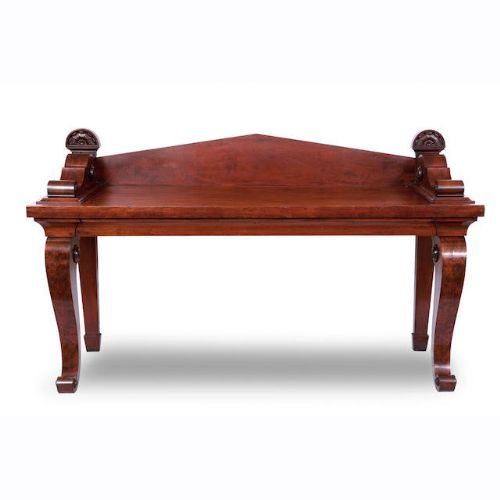

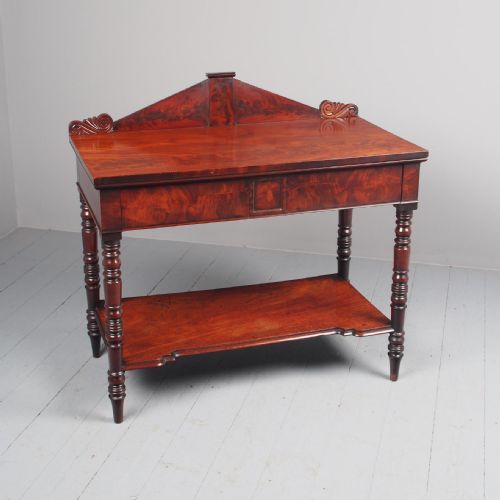
Regency Serving Console
A regency serving console brings stately neoclassical proportion and rich figured timber to a dining room or grand hallway.
Regency Serving Console
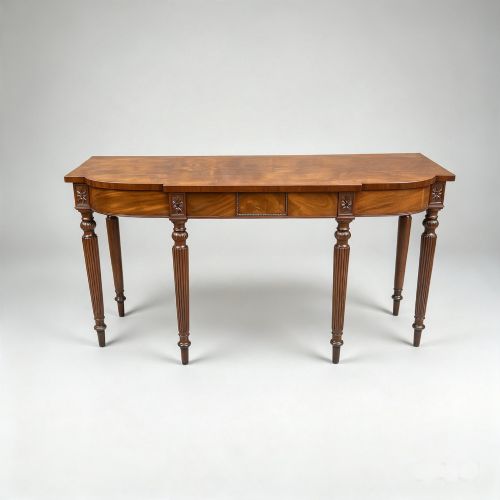
A regency serving console is a heavy, architectural table designed for dining rooms and grand halls during the early nineteenth century. These pieces function as sideboards or serving tables, often featuring long rectangular surfaces supported by robust legs or pedestals.
Most examples found here date from the Regency and William IV periods, executed in solid mahogany or oak with figured veneers. Pieces span English, Irish and Scottish workshops, showing classical restraint alongside bolder regional carving.
Materials and construction methods
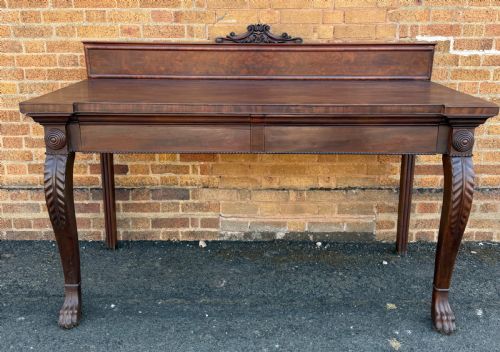
Cabinetmakers built these consoles around sturdy frames of native oak or pine, applying rich mahogany and flame mahogany veneers to the primary surfaces. Brass mounts, castors and gallery rails provide metallic contrast to the dark timber.
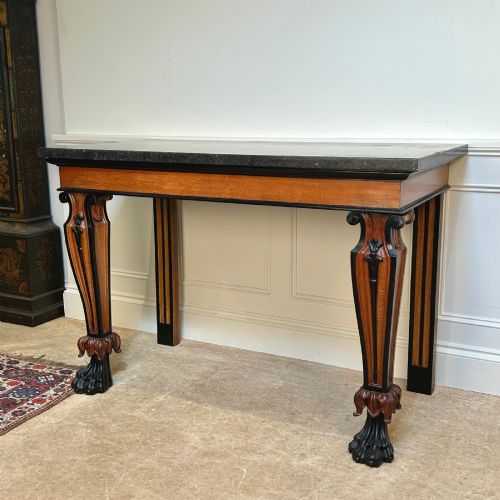
Gesso, gold leaf and ebonised wood appear on more decorative interpretations, particularly those drawing on neoclassical or Brighton Pavilion styles. Marble tops also surface occasionally, offering a cool, durable surface for heavy dining service.
Regency Serving Console Retail Price Guide 2026
Typical asking prices for regency serving console among the pieces listed under this phrase on Sellingantiques today, from the lower quarter to the upper quarter. They describe what is for sale here now, not the wider market.
Listings feature mahogany, flame mahogany, oak, marble, gesso, gold leaf and ebonised wood across nineteenth-century periods.
Judging the quality of execution
The choice of timber sets the finest examples apart from standard production, particularly the depth of figure in flame mahogany veneers. Drawer linings of solid oak and precise dovetailing indicate superior workshop standards.
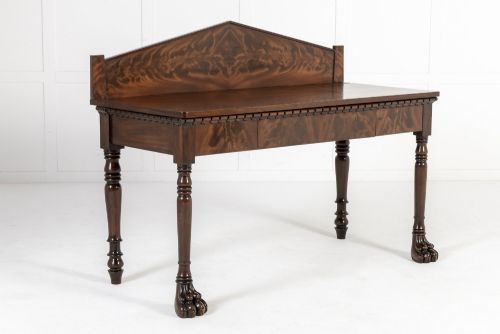
Carved details such as lion paws, reeded legs or neoclassical motifs reveal the hand of skilled carvers rather than routine factory output. Proportion and scale dictate visual success, with the most desirable pieces combining imposing presence with refined joinery.
Robert Strahan and Co·Mack Williams and Gibton·Gillows of Lancaster and London·Marsh and Tatham·James Mein of Kelso
The Regency Serving Console Glossary
- Flame mahogany
- A veneer cut from the fork of a mahogany tree to produce a dramatic, flickering flame-like grain pattern. This timber was favoured by Regency cabinetmakers for principal drawer fronts and tabletops.
- Metamorphic
- A descriptive term for furniture designed to transform its shape or function, such as a serving table that converts into a buffet. These mechanical pieces require careful inspection of their internal pivots and hinges.
- Gesso
- A plaster-like mixture applied to timber frames as a smooth base for gilding with gold leaf. It allows for crisp, intricate neoclassical moulding.
- Ebonised
- Timber treated with chemical stains or dark finishes to imitate costly ebony wood. It appears frequently on Regency and William IV pieces for dramatic contrast.
- Neoclassical
- A style drawing inspiration from the classical art and architecture of ancient Greece and Rome. It dominates Regency design through symmetry, columns and restrained ornamentation.
Regency Serving Console: Frequently Asked Questions
What is a regency serving console used for?
These large tables were originally placed against dining room walls to hold heavy dishes, silver and wine during formal meals. Today they serve equally well as imposing console tables in wide entrance halls or living spaces.
Their substantial depth provides ample surface area for lamps, decorative objects or serving trays without crowding a room.
How do I distinguish Regency from William IV pieces?
Regency furniture generally displays lighter, more refined classical proportions with delicate reeding and restrained brass inlay. William IV pieces tend to be heavier and more robust, featuring bolder scrolling brackets and massive pedestals.
Both styles overlap considerably in nineteenth-century dining rooms, sharing similar mahogany timbers and architectural silhouettes.
Where were these serving tables manufactured?
Production centred on major cabinetmaking hubs in London, along with prominent regional workshops in Lancaster and Scotland. Irish makers also produced distinctively bold consoles featuring deep carving and heavy timber construction.
Attributions often point to celebrated firms such as Gillows or Mack Williams and Gibton based on specific structural traits.
How do I care for antique mahogany surfaces?
Protect the timber from direct sunlight and sudden humidity shifts to prevent the underlying mahogany veneers from lifting or splitting. Regular dusting with a soft, dry cloth maintains the natural lustre of the polished wood.
Avoid silicone-based sprays, relying instead on traditional beeswax applied sparingly to nourish the antique finish.