
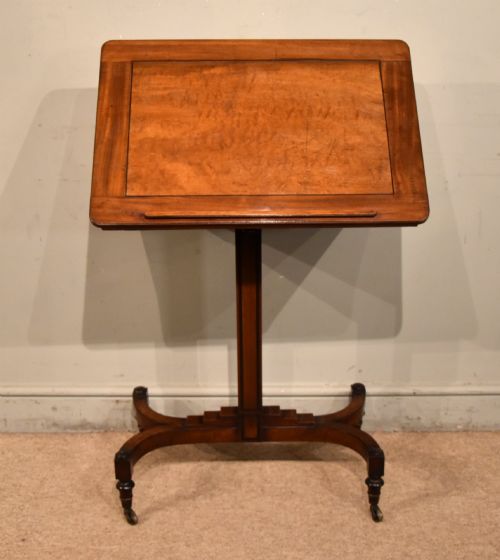
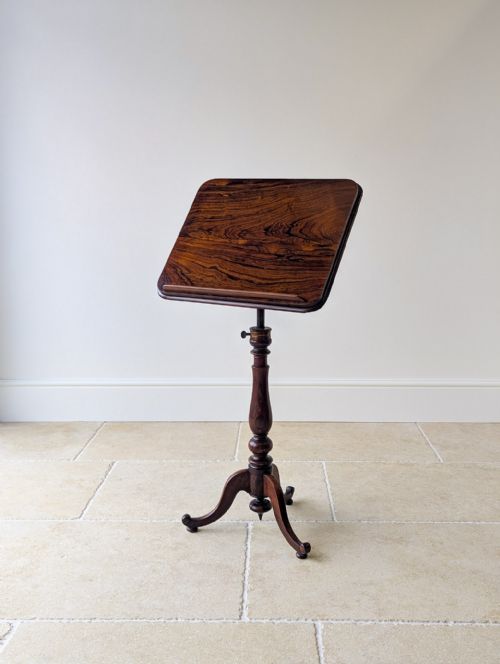


Regency Reading Desk Stand
A regency reading desk stand brings mechanical ingenuity and fine cabinet-making together, offering adjustable surfaces designed for serious study and music.
Regency Reading Desk Stand
A regency reading desk stand encompasses adjustable reading tables, music stands, and campaign table tops found across the Regency, William IV, and Georgian periods. These pieces serve multiple domestic functions, shifting easily between reading, writing, and musical performance.
Mahogany and rosewood dominate the selection, often appearing alongside gonçalo alves and brass fittings in forms ranging from tripod music stands to two-tier side tables and architect's riser desks. The typical piece reflects the neoclassical taste of the early nineteenth century.
Tables with adjustable mechanisms and double-sided surfaces represent the core of what collectors encounter. Occasional tables fitted with rising book rests provide the primary variant seen on this page.
Distinctions in quality
The refinement of the mechanical ratchets and brass adjustment screws marks the primary difference between standard production and superior work. Smooth operation in the rising mechanism signals better original manufacture.
Timber selection and the crispness of any inlay or turned detail dictate the visual standing of each piece. Figured mahogany or rosewood paired with precise joinery distinguishes the finer examples.
Draftsmen and cartographers of the era relied on these rising desk tops to save their backs while peering at endless maps.
The Regency Reading Desk Stand Glossary
- Regency
- A period in British design spanning the early nineteenth century, characterised by neoclassical motifs and inspired by ancient Greek and Roman forms.
- Whatnot
- A piece of open shelving furniture used for displaying or holding books and objects, frequently combined with reading stands in this period.
- Gonçalo Alves
- A dense, exotic timber with striking contrasting grain, utilised for high-status furniture during the nineteenth century.
- Campaign
- Describing portable furniture designed for easy dismantling and transport, often featuring brass corners and flush handles.
Regency Reading Desk Stand: Frequently Asked Questions
What is a regency reading desk stand used for?
These stands were built to hold books, manuscripts, or sheet music at a comfortable viewing angle. Adjustable mechanisms allowed the user to alter the height and slope for reading or writing.
Over time, their utility shifted from working libraries and music rooms to general domestic display and occasional table use.
How do I identify a regency period piece?
Look for characteristic neoclassical lines, turned wooden columns, and specific timber choices like Cuban mahogany or rosewood. Construction details such as hand-cut dovetails and brass ratchets point to early nineteenth-century methods.
Attribution often relies on the presence of specific hardware and the absence of later mass-produced fixings.
Are these stands suitable for daily use?
Most surviving examples remain sturdy enough for regular placement in a study or living room. The adjustable ratchets still function on many pieces, though care should be taken with historical mechanisms.
Treating the polished timber surfaces with appropriate wax keeps the wood conditioned against dry household environments.
What is the difference between a reading table and a music stand?
Reading tables generally offer wider surfaces designed for books and writing implements, sometimes featuring drawers or drop leaves. Music stands often utilise tripod bases and narrower ledges meant specifically to hold sheet music.
Many examples blur these boundaries by incorporating adjustable book rests onto occasional table tops.