
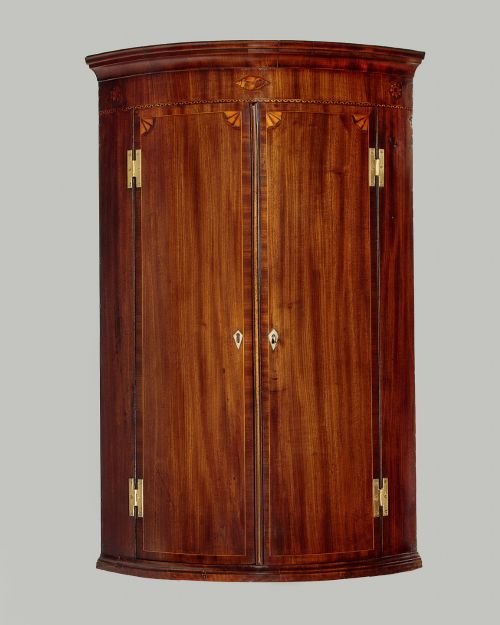


Regency Bowfront Cupboard
These pieces of regency bowfront cupboard bring the unmistakable curve and grain of early nineteenth-century mahogany into domestic spaces.
Regency Bowfront Cupboard
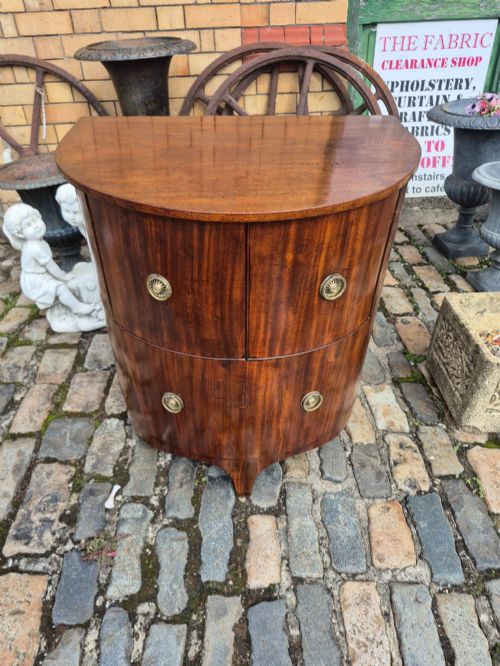
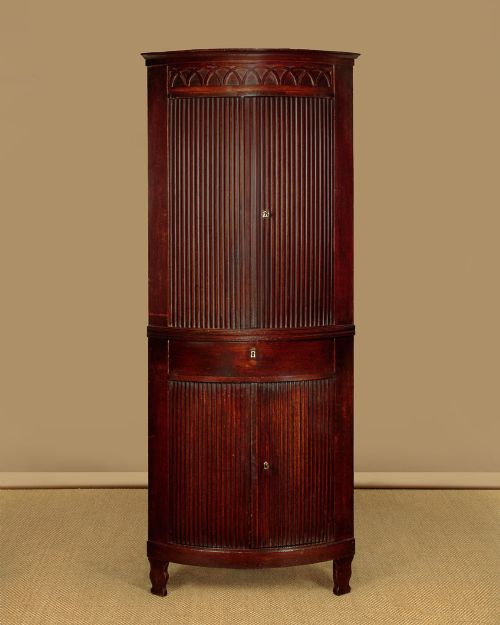
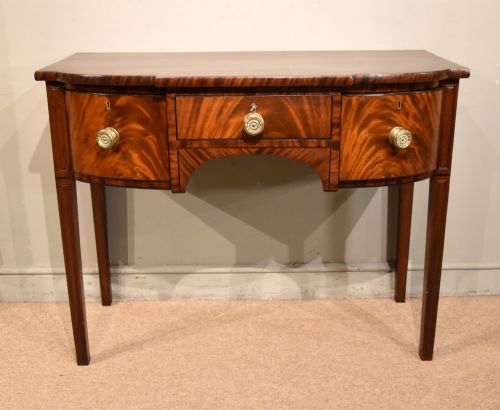
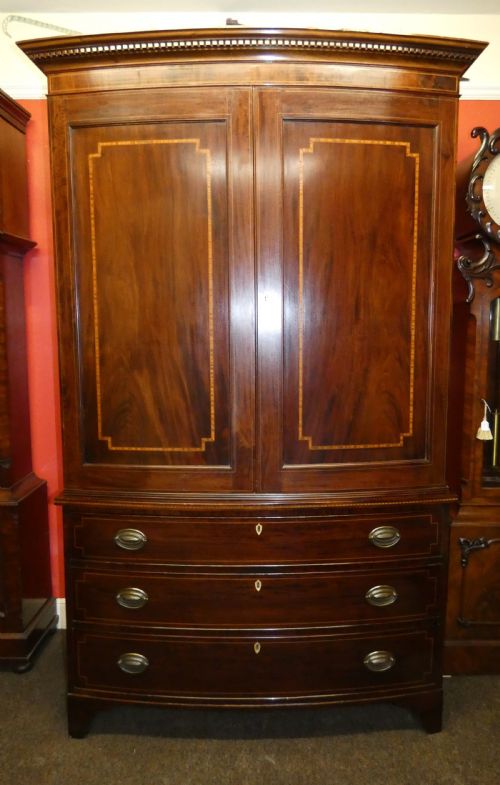
A regency bowfront cupboard presents a curved front profile that softens the geometry of a room while offering practical enclosed storage. Buyers seeking this form encounter examples ranging from compact bedside nightstands to substantial side cabinets, linen presses, and corner cupboards.
The materials and construction span authentic Regency and Georgian periods as well as later revivals from the early twentieth century. Mahogany dominates the selection, frequently paired with flame mahogany veneers, satinwood, and brass hardware.
How they were made
Cabinet makers constructed these pieces primarily using solid mahogany and mahogany veneers laid over secondary timbers such as oak. Selected cuts of flame mahogany provided striking grain patterns across the curved doors, while contrasting stringing in satinwood and ebony added linear definition.
Hardware such as drop handles and escutcheons relied on cast and chased brass, fitted flush to the drawer fronts and doors. Joinery techniques accommodated the constant tension of the curved bowfront shape, ensuring the doors and drawers tracked smoothly within their frames.
Compact bedside nightstands prove that eighteenth-century makers worried just as much about storing their midnight reading as we do.
What varies in quality
The selection of timber dictates much of the visual character, with carefully matched flame mahogany veneers representing a higher standard of craftsmanship than plain or unfigured boards. The precision of the inlay work and the crispness of the mouldings also separate standard utility pieces from finer cabinet work.
Proportions and structural integrity define the overall standing of an individual piece, particularly how well the curved doors maintain their alignment over time. Original brass fixtures and intact secondary timbers contribute to the authenticity and structural coherence of the piece.
Gillows
The Regency Bowfront Cupboard Glossary
- Bowfront
- A convex curved front contour popular in furniture design, particularly applied to chests, sideboards, and cupboards. This curved profile projects outward from the centre, softening room corners and catching the light.
- Flame mahogany
- A highly figured wood veneer obtained from the fork of the mahogany tree where the branch meets the trunk. It creates a distinctive, swirling flame-like pattern across the surface of cabinet doors and drawer fronts.
- Linen press
- A tall storage piece traditionally used for storing folded linen, combining upper sliding trays or shelves with lower drawers. These items often feature the characteristic bowfront configuration.
- Satinwood
- A pale, hard wood with a lustrous, golden-yellow sheen used extensively for decorative banding and inlay work on dark timbers like mahogany. It provides sharp contrast in Regency cabinetry.
- Stringing
- Thin strips of contrasting wood inlaid into channels cut into the primary surface of a piece. This technique outlines drawers, doors, and tabletops to create geometric borders.
Regency Bowfront Cupboard: Frequently Asked Questions
What is a regency bowfront cupboard?
A regency bowfront cupboard is an enclosed storage piece featuring a curved front profile, typically constructed from mahogany during the early nineteenth century or subsequent revival periods.
These items range from small bedside cabinets to large sideboards and linen presses, designed to combine decorative presence with practical storage.
How do I date a bowfront cupboard?
Dating relies on examining construction methods, secondary timbers, timber selection, and hardware styles. Pieces from the Regency and Georgian periods show distinct joinery practices and use specific veneers compared to early twentieth-century revivals.
Secondary woods like oak, combined with hand-cut dovetails and original brass fittings, help establish the timeframe of manufacture.
Where should I place a bowfront cupboard?
The curved profile makes these cupboards suitable for corners, alcoves, or flat walls where a softened rectangular footprint is desired. Smaller bedside versions fit neatly beside a bed, while side cabinets and linen presses anchor dining rooms or living spaces.
The projecting front requires adequate clearance from nearby doorways or walkways.
How do I care for mahogany furniture?
Maintenance involves dusting with a dry, soft cloth and avoiding placement near direct heat sources or strong sunlight that can dry out the timber and veneer. Periodic application of traditional wax helps preserve the lustre of the mahogany surface.
Harsh chemical cleaners and excessive moisture should be kept away from the polished wood.