



Regency Bedside Locker
A regency bedside locker offers discrete bedside storage in handsome timber, combining utility with architectural elegance.
Regency Bedside Locker
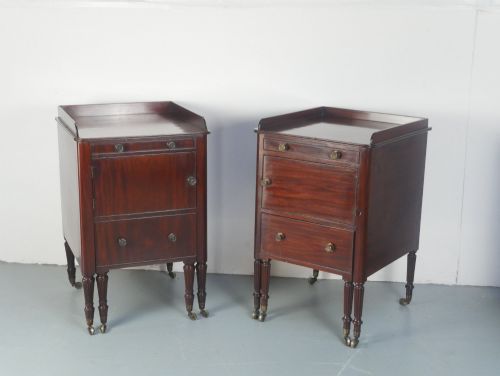
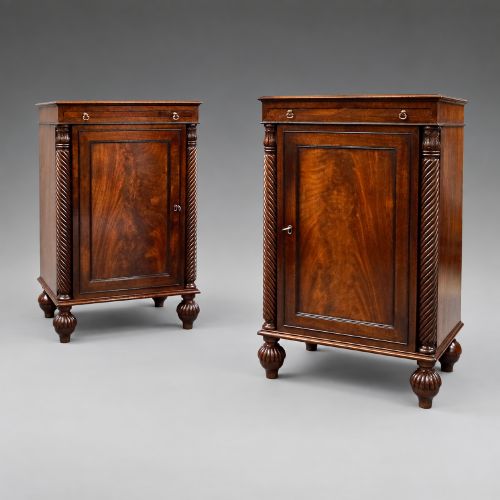
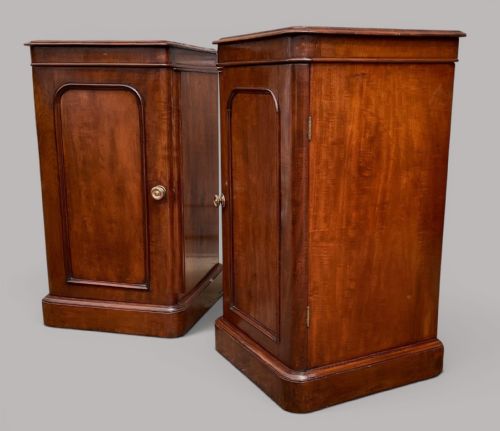
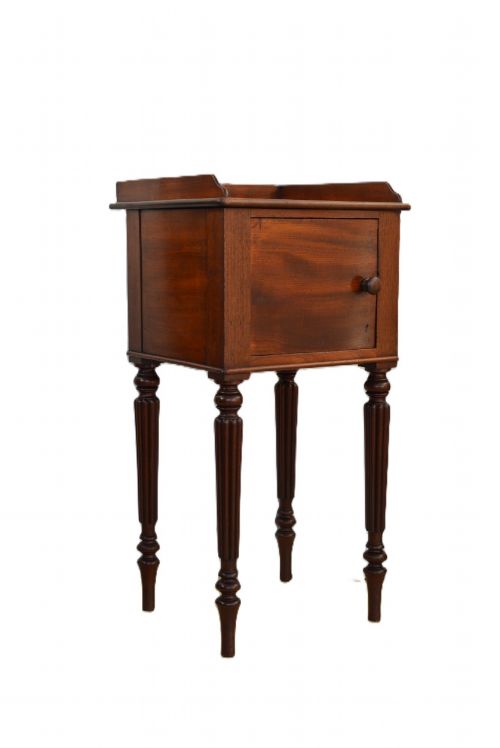
A regency bedside locker sits beside a bed to hold chamber pots, books or personal items, taking the form of a pedestal cabinet, cupboard or chest of drawers. The pieces seen here span the 19th century, Georgian, Regency, Edwardian and 1920 periods, alongside Georgian style, Victorian, William IV, George IV, Grand Regency, late Georgian and Gothic Revival examples.
Makers and workshops associated with these pieces include Holland & Sons and Gillows, bringing notable cabinet-making provenance to the form. Buyers encounter paired items as well as single cabinets, often featuring bow fronts or drop flaps.
The architectural character of a regency bedside locker often shows in column designs and reeded legs, reflecting the neoclassical taste of the period. Woods range from rich mahogany and flame mahogany veneer to rosewood, complemented by brass handles and ebony inlay.
Materials and construction
Makers built a regency bedside locker primarily using solid timber and veneers, selecting mahogany, flame mahogany and rosewood for their rich grain and deep colour. These woods provided a stable foundation for cupboards, chests and pedestal forms.
Cabinet-makers added decorative contrast through wood inlay in ebony and fitted functional hardware in brass. Structural details such as reeded legs and architectural columns required precise turning and joinery.
Regency Bedside Locker Retail Price Guide 2026
Typical asking prices for regency bedside locker among the pieces listed under this phrase on Sellingantiques today, from the lower quarter to the upper quarter. They describe what is for sale here now, not the wider market.
Some bedside lockers featured drop flaps, proving that early nineteenth-century cabinet-makers understood the value of a flexible surface.
Assessing quality in a regency bedside locker
The distinction between standard and exceptional pieces lies in the choice of timber figure, such as the richness of a flame mahogany veneer or the depth of selected rosewood. Finer examples display meticulous execution in decorative details like ebony inlay and brass mounts.
Attribution to prominent workshops like Gillows or Holland & Sons elevates a piece, as does the architectural ambition of the design, such as column construction or reeded legs. Proportions and the crispness of mouldings further separate workshop standards.
Holland & Sons·Gillows
The Regency Bedside Locker Glossary
- Pedestal cabinet
- A tall, narrow cupboard standing on a single plinth or column base. This form supports the compact footprint typical of bedside furniture.
- Flame mahogany
- Timber sliced to reveal a distinctive, flamelike grain pattern. Cabinet-makers reserved this veneer for prominent surfaces to create visual movement.
- Reeded legs
- Cylindrical supports carved with parallel convex mouldings. This classical detail echoes ancient architectural columns.
- Ebony inlay
- Contrasting dark wood inserted into the primary timber surface in thin geometric or linear strips. It provides sharp visual framing on Regency surfaces.
- Drop flap
- A hinged panel that lowers to extend a surface or grant access to an interior compartment. It offers flexible utility in smaller bedroom furniture.
Regency Bedside Locker: Frequently Asked Questions
What is a regency bedside locker used for?
These cabinets served to store night-time necessities discreetly beside a bed, holding items out of sight behind cupboard doors or within drawers. Their enclosed design kept the bedchamber tidy.
Today, they function as practical bedside tables that conceal modern clutter while adding period character to a bedroom.
Are these cabinets usually found in pairs?
Makers frequently produced these pieces in matched pairs to flank a bed symmetrically, a convention popular in formal bedroom layouts.
Single examples also appear in the record, often surviving independently from their original matching counterpart over the centuries.
How do I spot Regency features?
Regency pieces often incorporate architectural elements such as columns, reeded legs and contrasting ebony stringing. These details draw on classical antiquity.
Subtle touches like brass drop handles and flame mahogany veneers further signal the neoclassical taste of the early nineteenth century.
How do I care for antique mahogany?
Mahogany responds best to a stable indoor environment away from direct heat sources and strong sunlight, which can fade the rich timber tones. Gentle dusting preserves the finish.
Occasional application of appropriate wax feeding helps maintain the moisture and lustre of the wood grain.