




Reeded Leg Carvers
Reeded leg carvers are robust mahogany dining armchairs built to anchor a formal table, appearing here in Georgian, Regency and Victorian interpretations.
Reeded Leg Carvers
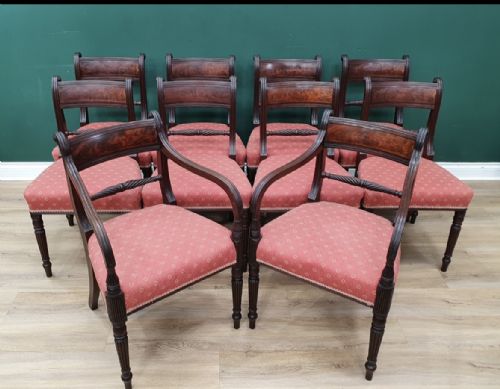
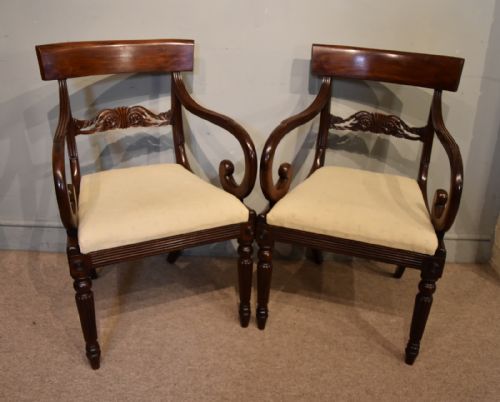
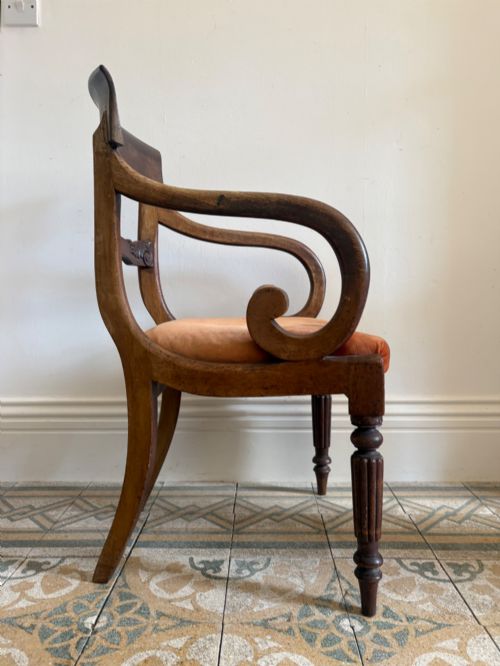
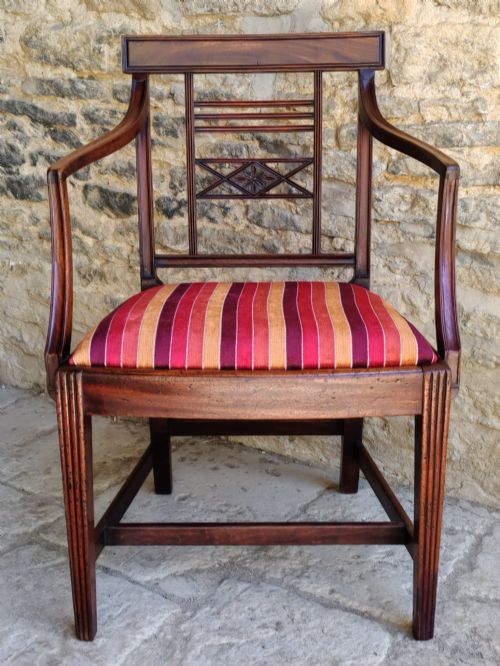
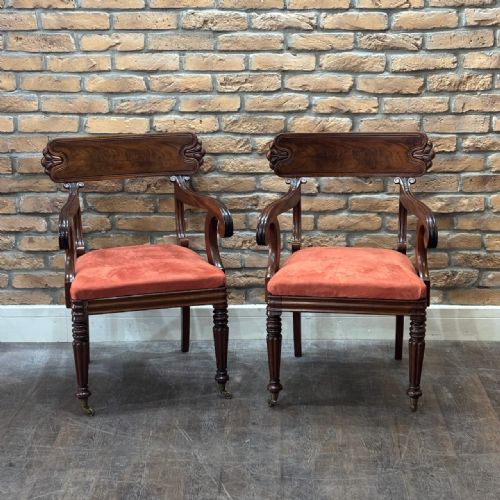
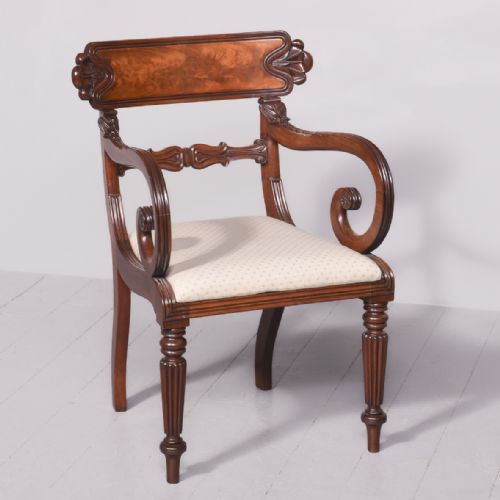
Reeded leg carvers are open armchairs designed to sit at the head of a dining table, featuring linear parallel grooves carved directly into the upright timber supports. Most examples discovered on this page date from the Georgian, Regency and Victorian periods, constructed primarily in solid mahogany or flame mahogany.
These armchairs arrive either as single seating companions to larger dining sets or in pairs bearing matching drop-in seats, leather upholstery or velvet coverings. The stylistic lineage moves from late eighteenth century proportions through to George IV, William IV and later revival interpretations.
Assessing quality and proportion
The distinction between standard utility seating and finer workshop production rests in the crispness of the timber carving and the balanced proportion of the arms. Superior carvers display sharp, cleanly cut reeding on the legs rather than shallow or softened tool marks.
Structural integrity of the arm joints and the selection of well-figured mahogany timber determine the lasting value of each piece. Finer examples maintain original surface finishes and patination accumulated over generations of domestic use.
Listings span the nineteenth century, featuring Georgian, Regency and Victorian periods alongside revival styles executed in solid mahogany and flame mahogany.
The Reeded Leg Carvers Glossary
- Carver
- An armchair designed specifically for the head of a dining table, featuring open sides to accommodate formal clothing. These chairs match or complement the smaller side chairs in a dining set.
- Reeding
- A decorative moulding consisting of parallel convex strips resembling bundled reeds, carved directly into the timber. This technique provides texture and vertical emphasis to furniture legs.
- Drop-in seat
- A removable wooden frame upholstered separately and dropped into a rebate within the chair seat rails. This construction allowed for straightforward recovering over time.
- Sabre leg
- A curving, outward-sweeping furniture leg with a round or rectangular section that tapers toward the foot. This form is particularly common in Regency design.
- Patina
- The surface sheen and softening of colour developed on timber over decades of handling and polishing. It serves as an indicator of age and careful maintenance.
Reeded Leg Carvers: Frequently Asked Questions
What is a carver chair?
A carver is an armchair traditionally placed at either end of a dining table, distinguished from side chairs by its supportive armrests.
These chairs matched the dining sets of the period, offering senior diners or the host a more substantial seat.
How do I date a reeded leg?
Dating relies on observing the timber selection, the depth of the carved channels and the overall proportions of the frame.
Earlier pieces from the eighteenth century show different joinery methods and turning styles compared to nineteenth century Regency or Victorian revivals.
Are drop-in seats original?
Drop-in seats were the standard method of construction for many Georgian and Regency dining chairs, allowing easy reupholstering. Nylon webbing and modern staples indicate later restoration work on an older wooden frame.
Can these chairs be used daily?
These mahogany armchairs were built for active domestic dining rooms and remain structurally robust when handled with care. Periodic checking of the leg joints and arm attachments ensures they stay stable during everyday use.