


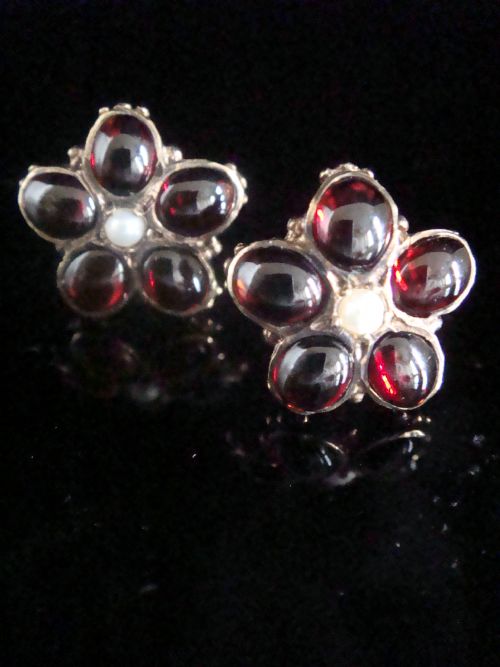
Red Garnet Stud Earrings
These red garnet stud earrings span Victorian, Edwardian, and mid-century eras, offering deep red stones set in gold, silver gilt, and platinum-toned mounts.
Red Garnet Stud Earrings
Red garnet stud earrings encompass classic cluster designs, halo configurations, and drop styles spanning the Victorian, Edwardian, 1950, 1960, and late 20th century periods. Buyers searching for red garnet stud earrings encounter varied forms including flower clusters, pear cuts, round cuts, and cabochon stones mounted on posts or clip-on mechanisms.
The materials paired with the central garnets include 9ct gold, 9ct yellow gold, 9ct rose gold, 14ct gold, 18ct gold, silver gilt, seed pearls, and diamonds. Pieces range from antique Austro-Hungarian and Victorian revival styles to vintage British mid-century items.
How they were made
Craftsmen set red garnets into mounts of 9ct gold, 14ct gold, 18ct gold, and silver gilt, frequently incorporating detailed wirework and filigree. Stone cutting encompasses round cuts, pear cuts, and cabochon forms secured in prong or bezel settings.
Cluster and halo designs combine central garnets with surrounding seed pearls or diamonds, utilising yellow and rose gold alloys characteristic of Victorian, Edwardian, and 1950s jewellery workshops.
Some garnet clusters look so much like little Victorian blackberries that you almost want to pop them in your mouth.
What varies in quality
The standard of materials and complexity of design separate simpler 1950s and 1960s 9ct gold items from intricate Victorian and Edwardian cluster pieces set in higher carat golds or silver gilt with diamond accents. The presence of secondary stones like seed pearls and diamonds elevates the manufacturing complexity.
Execution of filigree work and the uniformity of stone cutting, whether round, pear, or cabochon, define the finer examples within the range.
The Red Garnet Stud Earrings Glossary
- Silver gilt
- Silver covered with a thin layer of gold. This technique was frequently utilised in antique Austro-Hungarian pieces.
- Seed pearl
- A very small natural or cultured pearl. These are often used to form delicate white borders around central red garnets in cluster designs.
- Cabochon
- A gemstone shaped and polished with a smooth convex top rather than faceted. This style highlights the deep red colour of the garnet.
- Filigree
- Ornamental work of fine wire formed into delicate tracery. It is often seen in mid-century 9ct gold mountings.
- Rose cut
- An antique diamond cut featuring a flat base and a domed top composed of triangular facets. It appears in Victorian and Edwardian cluster settings.
Red Garnet Stud Earrings: Frequently Asked Questions
How do I style red garnet stud earrings?
Red garnet stud earrings provide a rich splash of dark red colour that suits both daytime wear and evening attire. Their varied forms, from simple round cuts to elaborate flower clusters, pair easily with other gold or silver jewellery.
Parks of Victorian and Edwardian pieces add historic character to modern outfits, while mid-century designs offer clean, retro lines.
Are these earrings comfortable for daily wear?
Most options are traditional stud or drop-stud configurations designed for secure placement on the earlobe. Certain antique items feature clip-on mechanisms for non-pierced ears.
Weight varies depending on the presence of diamonds, seed pearls, and larger carat gold mounts, though standard 9ct gold studs remain light enough for regular use.
How can I tell a Victorian pair from a 1950s pair?
Victorian and Edwardian pieces often incorporate rose-cut diamonds, seed pearls, and higher carat or silver gilt metals with handcrafted details. Austro-Hungarian styles also fall into this antique category.
Items from the 1950 and 1960 eras typically utilise 9ct yellow gold with cleaner commercial casting, featuring pear cuts, double drops, or filigreed 9ct gold settings.
What is a cluster setting?
A cluster setting groups several smaller stones around a larger central gemstone. In these selections, a prominent red garnet sits at the centre surrounded by seed pearls or diamonds.
This technique maximises visual impact and reflects the aesthetic preferences of the Victorian and Edwardian periods.