



Reclining Day Bed
A reclining day bed offers a place for afternoon repose, combining the seat of a chair with the length of a bed.
Reclining Day Bed
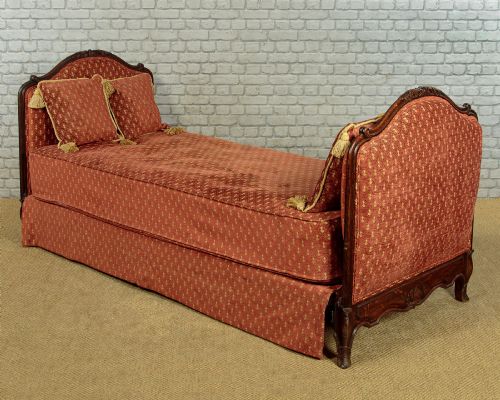
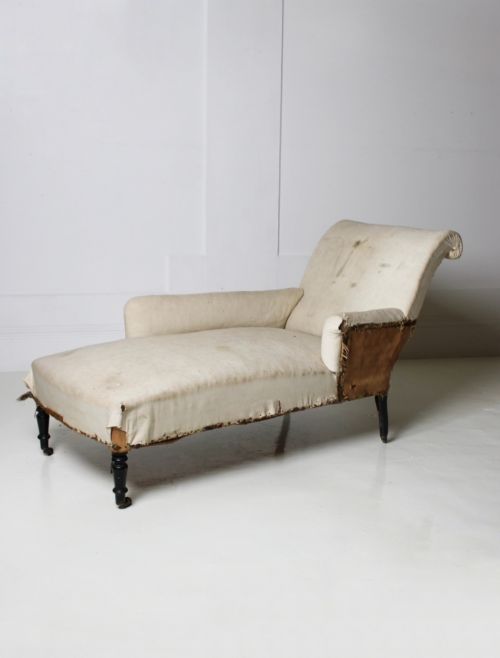
A reclining day bed provides an elongated seat designed for resting in a semi-recumbent posture during the daytime hours. The form merges elements of the settee and the bed, appearing under descriptions such as chaise longue, couch, and daybed. These pieces date across the nineteenth century and into nineteen-twenty, spanning Victorian, Regency, and French styles.
The versions most commonly met on this page include nineteenth-century upholstered day beds, English Regency mahogany pieces, and French provincial examples. Objects range from large country house daybeds to unusual Chinese day beds and matched pairs of chaises. Turned legs, original castors, and bobbin turnings frequently appear across the selection.
How they were made
Maker construction relies on timber framing, predominantly utilising mahogany and rosewood for the structural chassis. Wood surfaces are turned, carved, or shaped into specific regional styles such as Louis XVI or Qing.
Upholstery forms a primary component of the manufacture, employing interior stuffing covered in materials like calico, velvet, satin, and various upholstery fabrics. Metal components, specifically brass, appear in structural hardware and original castors supporting the legs.
Reclining Day Bed Retail Price Guide 2026
Typical asking prices for reclining day bed among the pieces listed under this phrase on Sellingantiques today, from the lower quarter to the upper quarter. They describe what is for sale here now, not the wider market.
Stargazers sometimes rested on Chinese day beds while contemplating the heavens.
What varies in quality
The distinction between tiers rests upon the choice of timber and the complexity of the woodwork. Dense hardwoods like mahogany and rosewood elevate a piece above simpler regional constructions, while refined turning on the legs demonstrates superior cabinetmaking.
Upholstery finish and the retention of original supporting elements influence the character of the object. Pieces retaining original castors and specific maker attributions display greater integrity than later altered examples.
H. Goodall and Sons·Howard and Sons
The Reclining Day Bed Glossary
- Chaise longue
- An upholstered chair that is long enough to support the legs, functioning as a day bed or settee. The name translates from French as long chair.
- Bobbin turning
- A form of woodturning consisting of a series of spherical or cylindrical shapes resembling bobbins on a thread. This decorative woodwork appears on nineteenth-century frames.
- Regency
- An English stylistic period dating from eighteen-eleven to eighteen-twenty, extending into the reign of George the Fourth. Furniture from this era often incorporates classical motifs and mahogany.
- Castor
- A small wheel mounted on a swivel assembly attached to the bottom of a leg. Original castors aid in moving heavy day beds across floor surfaces.
Reclining Day Bed: Frequently Asked Questions
What is a reclining day bed used for?
A reclining day bed serves as daytime seating that allows the occupant to stretch out fully without retiring to a bedroom. Victorians utilised them in reception rooms and boudoirs for resting during the afternoon.
They accommodate reading, relaxing, and casual conversation in an intermediate posture between sitting and lying down. The design provides the support of a backrest combined with an extended seat.
How do I identify a Regency day bed?
Regency day beds date to the early nineteenth century and typically employ solid mahogany timbers. They exhibit classical influences derived from Greek and Roman furniture forms.
Look for clean architectural lines, scroll ends, and saber legs characteristic of English furniture from this period. The woodwork often displays rich grain patterns without excessive surface carving.
How do I incorporate a day bed into a room?
Place a day bed against a primary wall in a living room, study, or large bedroom to create a dedicated reading corner. Positioning it away from heavy traffic allows the elongated form to anchor the space.
Pair the piece with freestanding lighting and low tables that complement its nineteenth-century or provincial style. The upholstery fabric can be chosen to tie in with existing soft furnishings.