

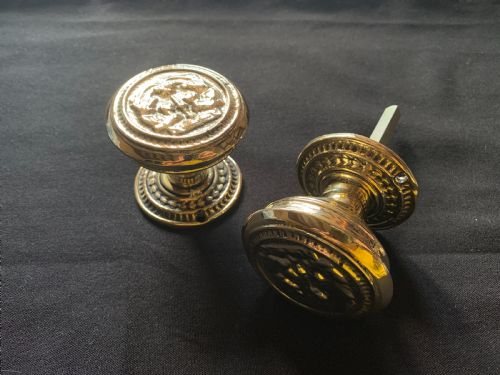


Reclaimed Brass Hardware
Reclaimed brass hardware brings genuine period character to a door, offering solid brass, bronze, and steel fittings saved from older buildings.
Reclaimed Brass Hardware
When you search for reclaimed brass hardware, you are looking at functional architectural fittings salvaged from historic properties. These pieces span several distinct periods including Regency, Victorian, Edwardian, and the late nineteenth century.
Victorian examples dominate the available forms, alongside distinct Arts and Crafts and Art Nouveau designs. Buyers choose these items to restore period properties or to add authentic historic detail to newer interiors.
How they were made
These pieces rely primarily on cast and forged metals, predominantly brass and bronze, shaped to withstand daily architectural use. Artisans utilised traditional casting and finishing techniques to produce robust door furniture that has survived for generations.
Surface ornament and structural elements often include applied details such as acorn finials or urn finials, while multi-component sets combine brass components with contrasting materials like ebony wood or steel screws and spindles.
The listings on this site feature architectural metalwork from the Victorian, Edwardian, and Regency eras, constructed primarily in brass and bronze.
What varies in quality
Quality in these architectural fittings is determined by the crispness of the original cast detail and the integrity of the metal itself. Ornate patterns on Art Nouveau handles or Arts and Crafts finger plates show greater sculptural depth in higher tier pieces.
Weight and substantial construction separate heavier door knobs and hinges from lighter utility hardware. The retention of original patination and matching sets also distinguishes superior examples.
The Reclaimed Brass Hardware Glossary
- Finial
- A decorative terminal ornament, often shaped like an acorn or an urn, placed at the ends of hinges or handles. These elements provide a decorative finish to functional architectural hardware.
- Finger Plate
- A flat protective plate mounted on a door beside the handle to prevent fingerprints and wear on the wood. Victorian examples frequently feature distinct Arts and Crafts designs.
- Centre Door Knob
- A stationary handle fixed to the middle of an exterior front door rather than a operating latch. They are typically larger and heavier than standard room door knobs.
- Patina
- The surface sheen and oxidation developed on brass and bronze over decades of handling and exposure to air. Collectors prize natural patination for its authentic historic appearance.
Reclaimed Brass Hardware: Frequently Asked Questions
How do I clean reclaimed brass hardware?
Wash the metal gently with warm soapy water and a soft brush to remove accumulated dirt without stripping the historic surface. Avoid harsh chemical polishes that destroy the desirable aged patina.
Dry the pieces thoroughly with a soft cloth after washing. Preserving the natural character accumulated over the centuries is generally preferred by collectors.
Are these door knobs suitable for modern doors?
Many of these vintage fittings can be adapted to fit standard contemporary doors with minor adjustments to the spindles or latches. Checking the backset and spindle thickness beforehand ensures a smooth installation.
Some older mechanisms differ in sizing from modern UK standards. Consulting a knowledgeable joiner helps integrate antique hardware into current doors seamlessly.
How do I identify a Victorian door hinge?
Victorian hinges often display specific decorative flourishes like acorn or urn finials cast directly into the iron or brass body. They are typically heavier and engineered for deep, solid timber doors.
Examining the casting marks and screw slots helps confirm the nineteenth century origin. Hand-finished details distinguish these older architectural elements from modern reproductions.
Can I use brass hardware outdoors?
Solid brass and bronze handle outdoor exposure very well because the metals naturally resist deep corrosion. Weathering will gradually darken the finish rather than ruin the structural integrity.
Protected entryways are best for pieces with delicate wooden inserts like ebony. Regular light oiling keeps moving parts functioning smoothly in exterior locations.