




Purple Solitaire Ring
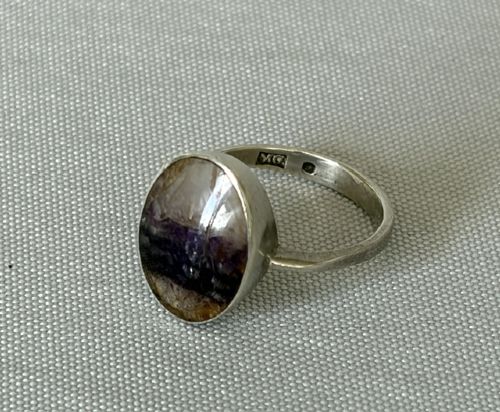
A purple solitaire ring brings a striking single stone to the hand, offering a bold wash of colour from amethyst, sapphire, or Blue John.
Purple Solitaire Ring
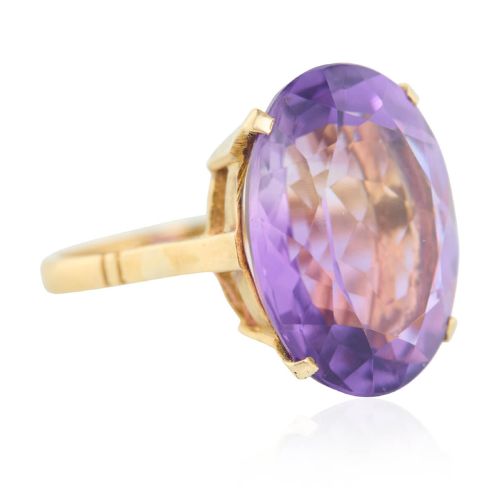
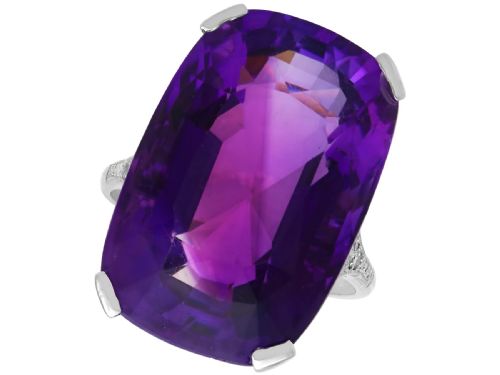
A purple solitaire ring centres upon one principal gemstone set within precious metal, focusing entirely on the singular hue of the stone. When searching for a purple solitaire ring, buyers frequently encounter substantial amethyst and sapphire centre stones shaped in emerald, cushion, round, or heart cuts. These pieces span from Victorian and Art Nouveau periods through Art Deco and mid-century designs.
The selection ranges from delicate Edwardian mounts to heavy mid-century cocktail rings featuring stones exceeding twenty carats. Amethyst dominates the examples in 9ct and yellow gold settings, whilst sapphires and Blue John fluorite appear alongside diamond accents. Each piece highlights the singular character of its central purple gem rather than competing stones.
Materials and construction
Goldsmiths utilised 9ct gold, 18ct gold, silver, and platinum to mount these stones, securing large amethyst, sapphire, and Blue John fluorite crystals. Metalwork reflects the prevailing aesthetic of each decade, shifting from intricate wirework in earlier periods to streamlined geometry in mid-century pieces.
Gemstones are shaped into substantial emerald, round, cushion, and heart cuts, often held by claw settings designed to maximise light passing through the stone. Diamond accents occasionally accompany the central gem in platinum or gold shoulders, adding contrast to the purple centrepiece.
Listings feature periods spanning from the Victorian era through Art Nouveau, Art Deco, and mid-century modern design.
Assessing quality and craftsmanship
Quality rests upon the depth of colour, clarity, and optical performance of the central gemstone, alongside the structural integrity of the metal setting. A superior stone displays an even saturation of purple without dull inclusions, whilst the surrounding gold or platinum mount shows crisp finishing and secure claw work.
The relationship between the scale of the gemstone and the weight of the metal mount determines the overall balance of the piece. Finer examples maintain proportional harmony even when carrying exceptionally large carat weights.
The Purple Solitaire Ring Glossary
- Solitaire
- A ring featuring a single prominent gemstone set alone in the mount. This design focuses attention entirely on the visual properties of that one stone.
- Cushion cut
- A rectangular or square gemstone cut with rounded corners and large facets. This historic shape enhances the brilliance and depth of coloured stones.
- Emerald cut
- A rectangular step-cut style with cropped corners that creates a hall of mirrors effect. It is frequently utilised for large amethyst and sapphire stones.
- Carat
- The unit of weight used for gemstones. Larger carat weights in these pieces often result in substantial, eye-catching cocktail rings.
Purple Solitaire Ring: Frequently Asked Questions
How do I care for a large amethyst ring?
Amethyst is a durable quartz, but stones with high carat weights require gentle handling to avoid impact on sharp edges or corners.
Clean the setting using warm soapy water and a soft brush, avoiding harsh chemical cleaners or ultrasonic baths.
What periods do these rings come from?
The available pieces span from Victorian and Edwardian eras through Art Nouveau, Art Deco, and mid-century modern design movements.
Each period imparts distinct characteristics to the metal mount and the manner in which the central purple stone is secured.
Are these rings suitable for daily wear?
Rings featuring robust metal bands and secure settings can be worn regularly, though substantial cocktail rings demand caution against knocks.
Checking the claws periodically ensures that large stones remain firmly anchored in their mountings.
How do I tell an amethyst from a sapphire?
Sapphires possess a higher mineral hardness and a different crystal structure compared to the quartz composition of amethyst.
Examination under magnification often reveals distinct inclusions and facet behaviours characteristic of each specific gem material.