


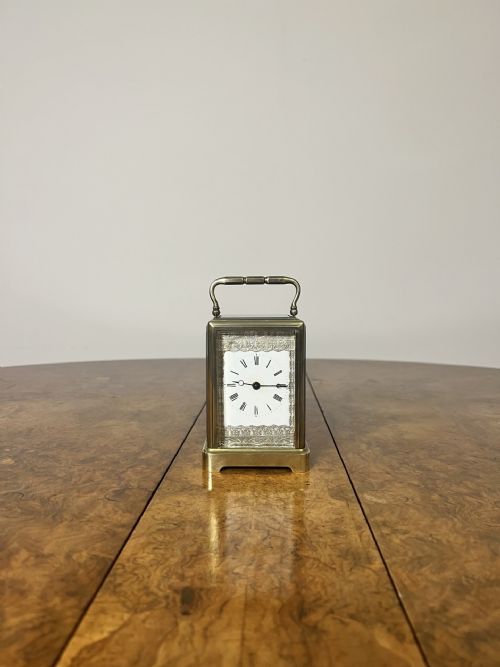


Portable Travel Clock
A portable travel clock offers reliable timekeeping housed in brass or leather cases, built for the journeys of the nineteenth and twentieth centuries.
Portable Travel Clock
A portable travel clock is primarily represented by carriage clocks and cased folding timepieces produced across the Victorian, Edwardian, and Art Deco periods. These items combine robust mechanical movements with compact protective outer housings designed for movement.
The selections available span from large striking pieces in gilt brass to delicate miniature examples intended for bedside use or carriage travel. French workshops and London retailers provided the bulk of these items, frequently supplying fitted leather travelling cases alongside the clocks themselves.
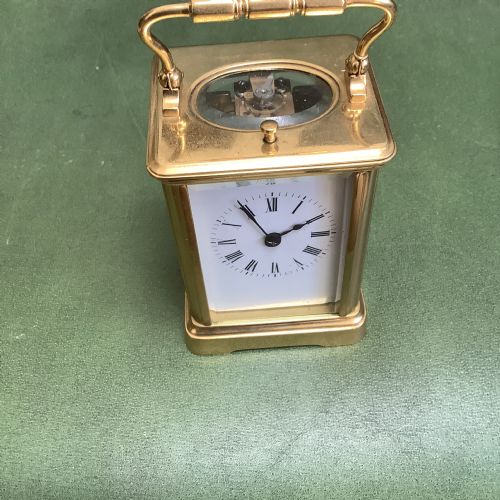
Earlier nineteenth-century models feature substantial cast brass frames with bevelled glass panels, whilst later twentieth-century iterations embrace streamlined Art Deco geometries and silvered metals. Buyers encounter both simple time-only mechanisms and sophisticated eight-day striking movements.
Construction and materials
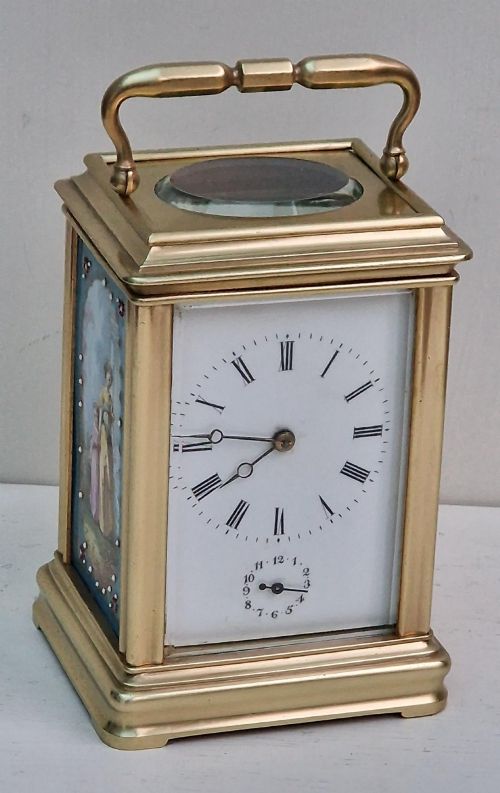
Makers utilised heavy brass and gilt brass to form the structural framework of the cases, housing intricate gear trains behind bevelled glass windows that allowed the movement to be observed. Enamel dials, often featuring delicate hand-painted numerals, were fitted to the front plates alongside finely pierced or blued steel hands.
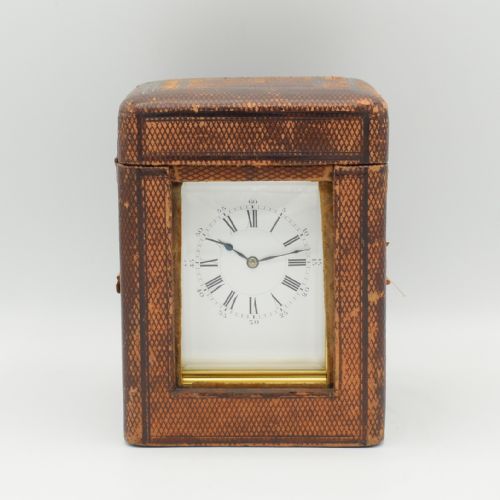
Outer protection was achieved through custom-fitted leather cases lined with velvet or silk, securing the clock against the jolts of travel by coach, train, or early motor car. For luxury commissions, sterling silver and porcelain panels painted with pastoral scenes were incorporated into the housing to elevate the visual appeal.
Movements relied on brass plates, steel pivots, and escapements requiring precise manual adjustment by skilled horologists to maintain accurate time across varying temperatures and motion.
Current selections span from eighteen-fifty to nineteen-fifty, incorporating brass, gilt brass, leather, porcelain, and sterling silver materials.
Quality factors in mechanical timepieces
The distinction between standard commercial production and superior workmanship rests in the finishing of the internal movement and the crispness of the brass casting. Finer examples display engine-turned gilt surfaces, jewelled escapements, and signed backplates from recognised makers rather than mass-produced generic movements.
The integrity of the original case components, including undamaged bevelled glass lights and matching numbered travel cases, substantially elevates the standing of an individual clock. Fading on enamel dials or replacement hands indicate later repair work that alters the original character of the piece.
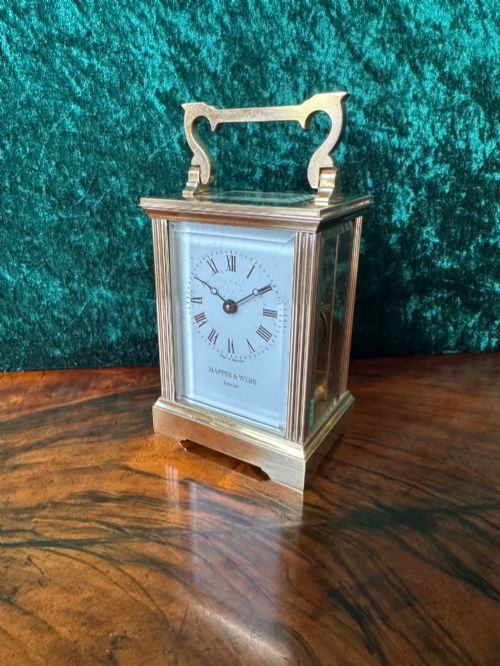
Henri Jacot·Mappin and Webb·Pickford of London·Paul Garnier·Latshea and Sons Edinburgh
The Portable Travel Clock Glossary
- Carriage clock
- A portable spring-driven clock designed for travellers during the nineteenth century, featuring a handle and glass panels on all sides. These timepieces typically run for eight days on a single wind.
- Platform escapement
- The self-contained escapement unit mounted visibly on the top inside of a carriage clock movement. It replaced the pendulum to allow portable clocks to keep time whilst in motion.
- Gilt brass
- Base brass metal treated with a thin layer of gold wash or electroplating to impart a bright, durable golden finish. This treatment protected the metal from tarnishing during transit.
- Bevelled glass
- Heavy window panes with angled, polished edges fitted into the sides of brass clock cases. This technique added structural strength and refracted light across the internal movement.
- Striking movement
- A mechanical complication that sounds the hours and sometimes the quarters on a bell or gong. These systems require additional gear trains within the clock body.
Portable Travel Clock: Frequently Asked Questions
How do I wind a carriage clock?
Most portable travel clocks utilise a key inserted into arbours on the backplate to tension the mainsprings for time and strike trains.
Care should be taken not to overwind the mechanism, stopping firmly when resistance is met.
Why does my clock run fast or slow?
Mechanical timepieces require regulation via a small lever situated near the balance wheel on the top platform to adjust the active length of the hairspring.
Environmental temperature changes and older lubricants can also cause the movement to lose or gain time over a twenty-four-hour period.
Can I travel with an antique clock?
Whilst these items were originally engineered for journeys, modern transit can dislodge delicate pivots and damage antique escapements if the clock is not properly secured.
Original leather travel cases provide essential cushioning, though many collectors prefer to transport them by hand rather than in checked luggage.
How do I identify the date of a carriage clock?
Stylistic shifts in case proportions, dial typography, and escapement design offer clear indicators of period, moving from heavy nineteenth-century gilt brass to sleeker Edwardian and Art Deco forms.
Signatures or maker marks stamped on the brass backplate often provide specific workshop records or registration numbers.