


Plique a Jour Enamel Jewellery
Plique a jour enamel jewellery holds the light like stained glass, bringing translucent colour to wearable pendants and brooches.
Plique a Jour Enamel Jewellery
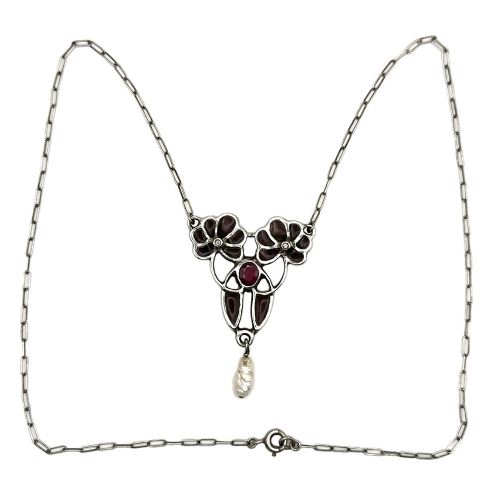
Plique a jour enamel jewellery comprises pendants, brooches, and necklaces defined by translucent enamel cells without a backing, allowing light to pass directly through the design. When you search for plique a jour enamel jewellery, you encounter delicate works from the early twentieth century.
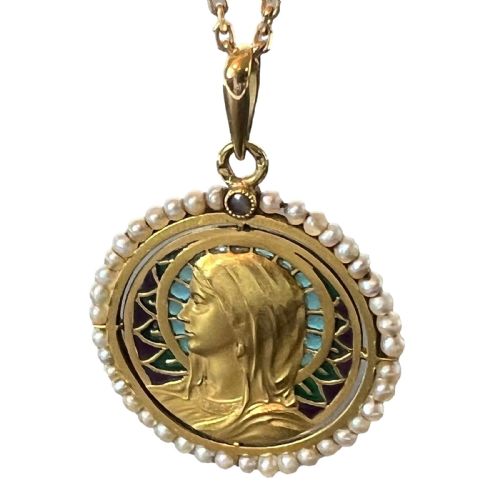
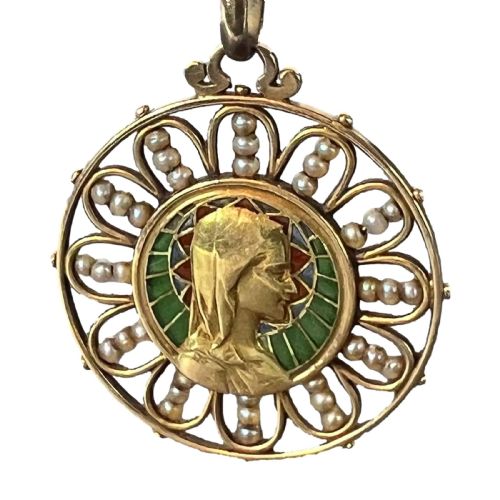
The majority of pieces belong to the Art Nouveau and Jugendstil movements, spanning the years from 1900 to 1930. French examples frequently depict religious subjects such as the Virgin Mary or the City of Paris coat of arms in 18k yellow gold.
German and English makers contributed silver and silver gilt iterations featuring floral motifs, insects, and gemstone accents. Pendants and brooches dominate the selection, often incorporating pearls, peridot, amethyst, or chrysoprase.
How they were made
Maker construction relies on an open wire framework of gold or silver that holds vitreous enamel without a solid backing plate. Firing successive layers of enamel powder within these delicate metal cells creates the stained glass effect.
Goldsmiths and silversmiths combined the translucent enamel panels with precious stones including diamonds, seed pearls, and coloured gemstones. Silver gilt surfaces provide a warm metallic contrast to the vibrant hues of the fired enamel.
Among the delicate floral motifs and religious medals hide tiny enamelled flower fairies and butterflies waiting to catch the morning light.
What varies in quality
Quality rests upon the uniformity and transparency of the enamel cells across the metal armature. Superior execution shows even suspension of the vitreous material without cloudiness or structural distortion in the open windows.
The sophistication of the metalwork and the selection of accompanying gemstones distinguish the finer examples. Articulated silver gilt mounts and carefully matched pearls or peridots elevate the standing of a piece.
Levinger and Bissinger·Heinrich Levinger·Meyle and Mayer·Eduard Loss·Martin Mayer·Theodor Fahrner·Liberty and Co
The Plique a Jour Enamel Jewellery Glossary
- Plique a jour
- An enamelling technique resembling miniature stained glass where transparent enamel is fired in open cells without a metal backing.
- Vitrous enamel
- Glass powder fused to a metal surface through high temperature firing to produce a durable and coloured finish.
- Silver gilt
- Sterling silver plated with a thin layer of gold to provide a rich yellow metal appearance.
- Jugendstil
- The continental German-language manifestation of the Art Nouveau movement spanning the turn of the twentieth century.
- Seed pearl
- A very small natural pearl, often drilled and threaded into decorative clusters in period designs.
Plique a Jour Enamel Jewellery: Frequently Asked Questions
What is plique a jour enamel jewellery?
Plique a jour enamel jewellery consists of decorative metalwork where transparent enamel fills open wire cells without a solid backing. This construction lets light shine directly through the coloured glass.
Most surviving examples date from the Art Nouveau period around 1900. They take the form of pendants, brooches, and necklaces made in silver or gold.
How do I wear a plique a jour pendant?
These pendants work best suspended on a simple metal chain that matches the tone of the setting. Placing them against plain fabrics allows the translucent enamel to catch the light effectively.
Because the enamel cells lack a backing, care should be taken to avoid impact against hard surfaces. Storing them in dedicated boxes prevents accidental pressure on the openwork frame.
How do I tell Art Nouveau from later pieces?
Art Nouveau and Jugendstil pieces from 1900 rely on flowing organic lines, floral motifs, and naturalistic insect or fairy subjects. These early works often combine silver gilt with seed pearls and amethyst.
Pieces from the 1920s and 1930s tend to feature more structured or religious imagery, such as French pendant medals depicting the Virgin Mary. The metal frames in later items are frequently rendered in 18k yellow gold.
What metals are used in these designs?
The listings feature pieces constructed from sterling silver, silver gilt, 15ct yellow gold, and 18k yellow gold. Gold is particularly common in French religious pendant medals from the early decades of the twentieth century.
Silver and silver gilt appear frequently in German and English Art Nouveau creations. These white and gilt metals are often paired with gemstones like chrysoprase, peridot, and citrine.