
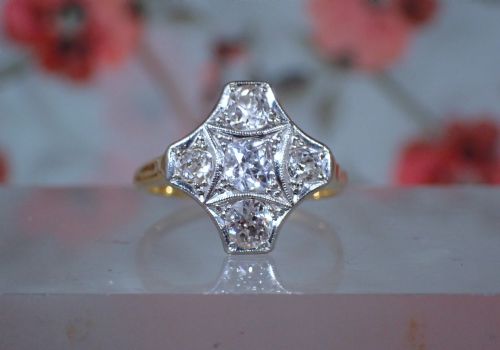
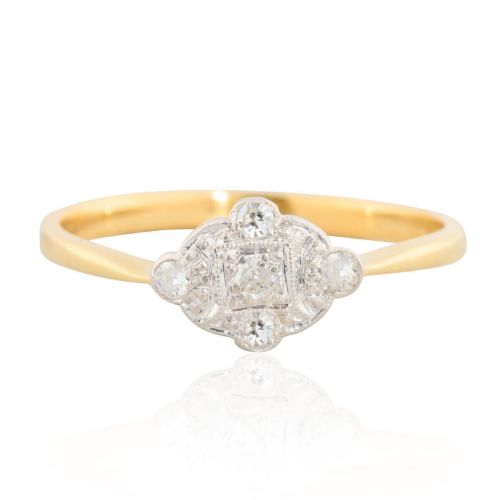


Platinum Plaque Ring
A platinum plaque ring offers a geometric face of precious metal set with diamonds, capturing the architectural spirit of early twentieth-century design.
Platinum Plaque Ring
A platinum plaque ring presents a flat or slightly curved face of metal, pierced and engraved in patterns that stretch across the finger. These jewels belong predominantly to the Art Deco and Edwardian eras, spanning from the nineteen-hundreds through the nineteen-forties.
You will most frequently meet pieces fashioned from platinum or paired with eighteen-carat gold, showcasing rectangular, elongated, or panel silhouettes. The central design often incorporates pavé or old cut diamonds alongside calibrated sapphires, rubies, emeralds, or black onyx.
The aesthetic leans heavily on symmetry and linear motifs, forming distinct geometric shapes that sit low on the hand. Dress rings and cocktail rings dominate the selections, serving as striking examples of period craftsmanship.
How they were made
The construction relies on the strength of platinum, which allowed metalsmiths to pierce intricate lace-like patterns without risking structural integrity. This dense white metal holds millegrain edges and tiny bead settings securely, framing the stones tightly together.
Diamonds used in these settings are primarily old cuts, including old European, transitional, and rose cuts, which display softer facets than modern stones. Goldsmiths frequently combined platinum heads with eighteen-carat yellow or white gold shanks, joining the metals through traditional fabrication techniques.
Materials appearing across the inventory include platinum, eighteen-carat gold, diamonds, sapphires, rubies, emeralds, and onyx.
What varies in quality
Quality rests in the crispness of the piercing work and the precision of the millegrainbeading along the platinum edges. Superior examples maintain sharp geometric lines and secure stone alignment without distortion in the metalwork.
The choice and matching of secondary stones, such as calibre-cut sapphires or deep green emeralds, dictate the distinction of the piece. Well-matched coloured stones with even saturation elevate a plaque ring beyond standard production.
The Platinum Plaque Ring Glossary
- Plaque ring
- A ring featuring a flat, ornamental panel that sits across the finger, often pierced in openwork designs. These pieces showcase detailed engraving and pavé-set stones typical of the early twentieth century.
- Millegrain
- A decorative technique involving tiny, raised metal beads along the edge of a setting. This subtle border softens the transition between metal and stone.
- Old cut diamond
- A diamond cut by hand before the mid-twentieth century, featuring a smaller table and larger culet. These stones exhibit a distinctive, softer candlelight sparkle.
- Navette
- A boat-shaped gemstone or ring setting that tapers to points at both ends. The silhouette creates an elongated appearance on the hand.
- Pavé setting
- A method of setting small gems close together with minimal visible metal, creating a continuous surface of stones. The tiny beads securing each stone are formed directly from the surrounding metal.
Platinum Plaque Ring: Frequently Asked Questions
How do I wear a plaque ring safely?
These rings sit low on the hand, which helps protect the flat metal face from daily knocks and catches. Even so, removing the ring during heavy manual tasks prevents undue stress on the fine platinum piercing.
Regular checks by a jeweller ensure the tiny claw or bead settings remain tight around the old cut diamonds and coloured gems.
Are these rings suitable for everyday wear?
Platinum provides a durable foundation that resists wear better than softer metals, making it resilient for frequent use. However, the intricate openwork and delicate millegrain require mindful care to preserve their fine details.
Pairing a delicate antique ring with heavy metal bands on adjacent fingers can cause friction wear over time.
How can I tell an Edwardian ring from Art Deco?
Edwardian designs typically favour lighter, garland-style motifs with flowing platinum filigree and softer floral influences. They lean towards delicate lace-like patterns reminiscent of embroidery.
Art Deco pieces introduce rigid geometry, sharp angles, and strong symmetry, often incorporating contrasting black onyx or calibré-cut sapphires.
What metals are combined in these rings?
Many period pieces pair a platinum top section with an eighteen-carat yellow gold shank. Platinum was chosen for the face because its strength allowed for secure stone setting with minimal visible metal.
Yellow gold shanks were common in earlier decades before white gold and platinum became the uniform choice for the entire mount.