


Diamond Plaque Engagement Ring
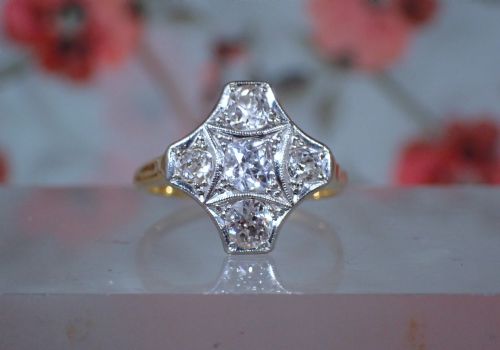
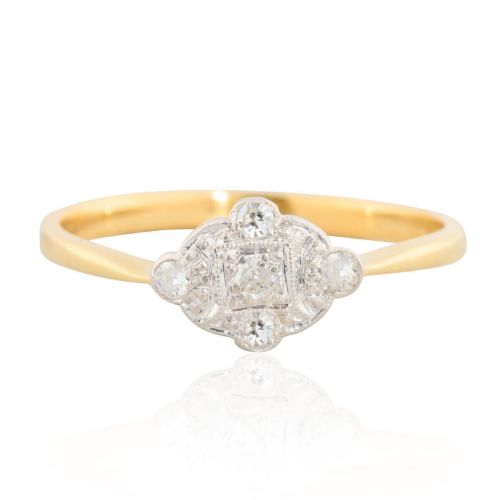
A diamond plaque engagement ring sits flat upon the finger, drawing the eye with geometric symmetry and brilliant old cut stones.
Diamond Plaque Engagement Ring
A diamond plaque engagement ring presents a wide, flat geometric face upon the hand, typically shaped as a rectangle, oval, or elongated panel. These pieces emerge predominantly from the Art Deco and Edwardian eras, spanning periods from the early twentieth century through the 1950s.
The selections encountered here combine central diamonds with surrounding materials, often taking the form of dress rings or cocktail rings. Collectors find examples utilising platinum and gold settings alongside contrasting gems.
Art Deco specimens dominate the selection, bringing sharp lines and symmetry, while Edwardian designs offer lighter, lace-like floral motifs in platinum and gold.
Materials and construction
Goldsmiths of the early twentieth century employed platinum alongside yellow and white 18ct gold to construct resilient, delicate basket and bezel settings. Platinum provided the strength needed to hold intricate openwork frames without adding heavy bulk.
Cutters utilised old cut, transitional cut, and rose cut diamonds, setting them alongside calibré-cut sapphires, rubies, emeralds, and onyx. Pave and cluster arrangements maximised the light return from smaller stones across the flat face of the ring.
Periods represented span from the 1900s through the 1950s, with a heavy concentration of Art Deco and Edwardian designs.
Distinctions in quality
The refinement of the pierced metalwork and the precision of the stone geometry separate standard items from finer examples. Pierced scrollwork executed by hand requires superior skill compared to simpler cast frames.
The selection of accent stones, such as calibre-cut onyx or natural rubies and sapphires fitted tightly around central diamonds, dictates the visual harmony of the panel. Original settings that retain crisp millgraining demonstrate superior preservation over time.
The Diamond Plaque Engagement Ring Glossary
- Old cut
- A diamond facet configuration hand-polished before modern standardised machinery existed. These stones exhibit smaller tables and higher crowns, casting deep candlelight reflections.
- Milgrain
- A decorative border of tiny raised metal beads along the edge of a setting. This technique defines Edwardian and Art Deco mountings with a soft texture.
- Navette
- A boat-shaped gemstone setting that tapers to sharp points at either end. The silhouette lengthens the appearance of the finger.
- Calibré-cut
- Coloured gemstones shaped precisely to fit a specific geometric channel or pattern within the mounting. This method ensures tight junctions between contrasting stones like sapphire or onyx.
Diamond Plaque Engagement Ring: Frequently Asked Questions
Are these rings suitable for daily wear?
These pieces suit daily wear provided the wearer respects their age and delicate platinum or gold settings.
Regular checks by a jeweller help secure old cut stones within their original bezel or pavé mounts.
How do I spot an Art Deco ring?
Art Deco pieces display strong geometric lines, symmetry, and contrasting materials like onyx or calibre-cut sapphires.
Platinum mountings frequently feature openwork filigree and milgrain borders.
What is an Edwardian panel ring?
Edwardian panel rings utilise lightweight platinum settings to create lace-like floral or garland motifs.
These designs often pair diamonds with emeralds or sapphires in intricate openwork frames.