



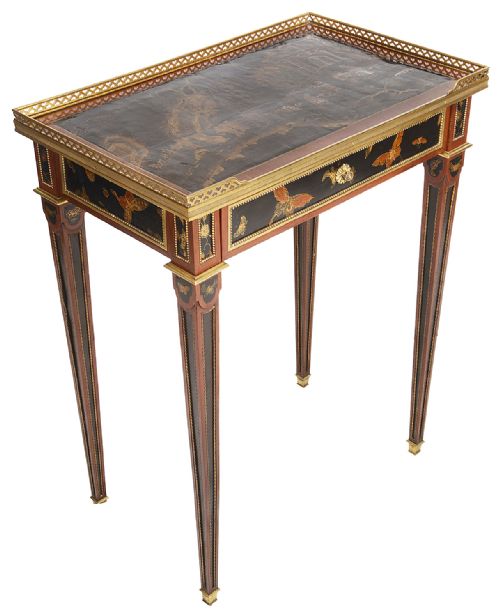
Pierced Brass Gallery
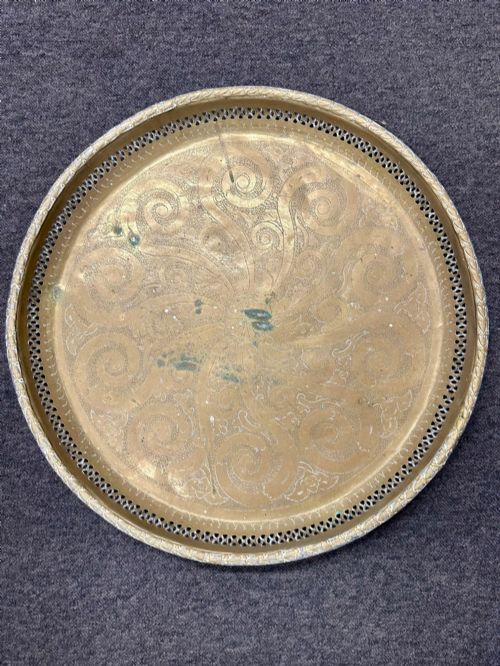
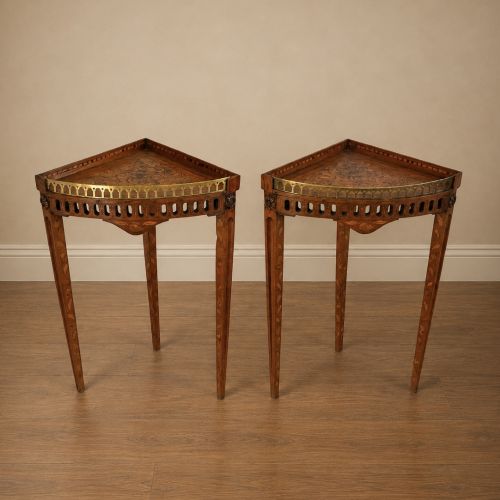
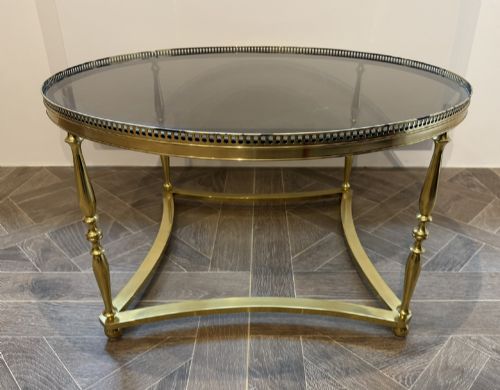
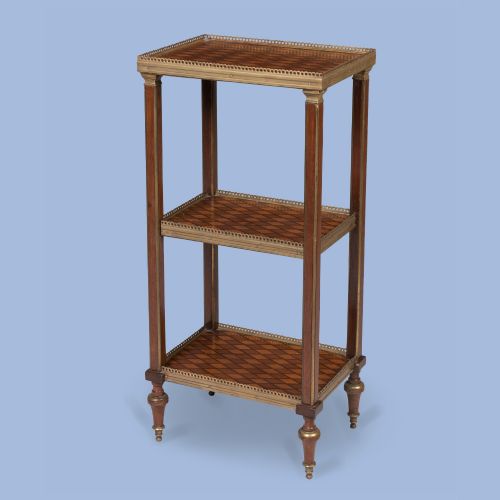
These pieces of pierced brass gallery work frame tops of tables, desks, trays, and stands with metal borders that keep things secure.
Pierced Brass Gallery
When you search for pierced brass gallery, you are looking at decorative openwork metal borders fitted to the edges of tables, desks, serving trays, and ink stands. These metal rims hold items in place while adding a crisp, metallic outline to wood surfaces.
The versions you are most likely to meet on this page include mahogany, kingwood, walnut, and satinwood side tables, occasional tables, and coffee tables, alongside occasional serving trays and desk accessories. Many pieces show strong French Neoclassical, Louis XVI, or Victorian influences.
Such items span from the 18th century through the 19th century and into the early decades of the 20th century. The metalwork sits directly upon the polished timber tops of corner tables, lamp tables, and small writing desks.
How they were made
The metal components rely on cast or pierced brass, ormolu, and gilt bronze, shaped into openwork patterns that form the characteristic gallery edge. These metal borders are then secured to the perimeters of timber surfaces.
Cabinetmakers paired the metal galleries with finely chosen woods such as mahogany, kingwood, burr walnut, and satinwood, often incorporating marquetry inlays or Chinoiserie lacquer to finish the bodies of the tables and desks.
Pierced Brass Gallery Retail Price Guide 2026
Typical asking prices for pierced brass gallery among the pieces listed under this phrase on Sellingantiques today, from the lower quarter to the upper quarter. They describe what is for sale here now, not the wider market.
A solitary brass gallery sits waiting for a table, proving that sometimes the fence is more interesting than the field.
What varies in quality
Quality rests upon the crispness of the casting in the pierced brass work and how cleanly the openwork geometric or scroll patterns are rendered. Finer examples show sharp definition and a heavy, substantial feel in the metal.
The standard of the underlying timber work, the precision of the marquetry inlays, and the harmony between the brass rim and the mahogany, kingwood, or walnut body separate ordinary pieces from exceptional ones.
The Pierced Brass Gallery Glossary
- Pierced brass gallery
- An openwork metal border fixed to the edge of a table, tray, or desk top. It serves both to contain objects and to provide a decorative metallic trim.
- Ormolu
- Gilt bronze mounted onto furniture or used for decorative accessories. It gives a bright, gold-coloured finish that complements dark cabinet woods.
- Marquetry
- Decorative veneer work arranged in patterns or pictures using various coloured woods. It frequently covers the tops and sides of tables framed by brass galleries.
- Guéridon
- A small French occasional table supported by a central column or multiple legs. These often feature decorative metal galleries along their circular or shaped tops.
- Etagere
- A piece of furniture with multiple open shelves for displaying small objects. They occasionally incorporate metal galleries to secure items on each tier.
Pierced Brass Gallery: Frequently Asked Questions
What is a pierced brass gallery?
A pierced brass gallery is an openwork metal railing fixed around the edge of a tabletop, tray, or desk. It forms a decorative barrier that stops items from sliding off.
Such galleries appear on various forms including side tables, coffee tables, serving trays, and ink stands across different periods.
How were galleried tables used?
These tables served as functional items for holding lamps, drinks, or writing equipment in 18th, 19th, and early 20th century interiors. The raised metal rim kept small objects secure when the furniture was in active use.
Serving trays and ink stands with similar galleries performed parallel tasks for carrying items or organising desk accessories.
What woods are found with brass galleries?
Makers most frequently mounted brass galleries onto mahogany, kingwood, burr walnut, and satinwood. These timbers were often selected for their rich grain or enhanced with marquetry inlays.
Some pieces also employ Chinoiserie lacquer surfaces beneath the metal borders, reflecting specific stylistic periods.
How do I date a pierced brass gallery?
Dating relies on the style of the furniture piece, the timber used, and the manufacturing technique of the metalwork. Pieces span from the 18th century through the Victorian era up to the 1920s.
Comparison of the brass casting style and the joinery of the wooden table provides clear indicators of the period.