
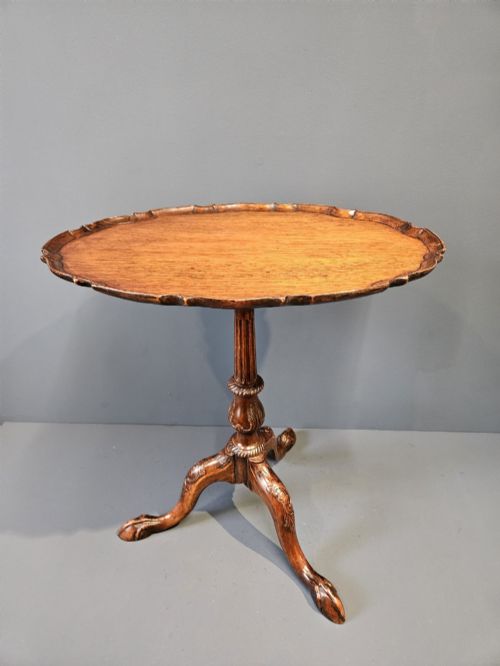
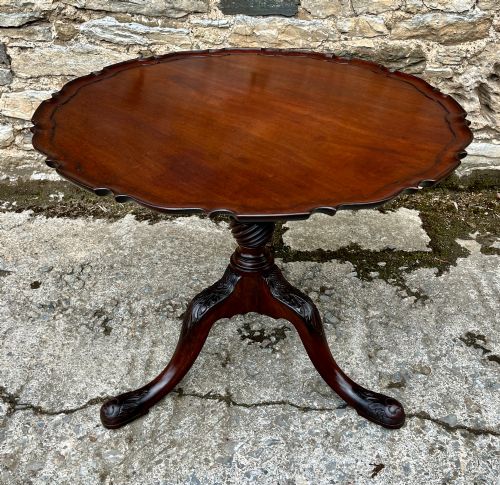
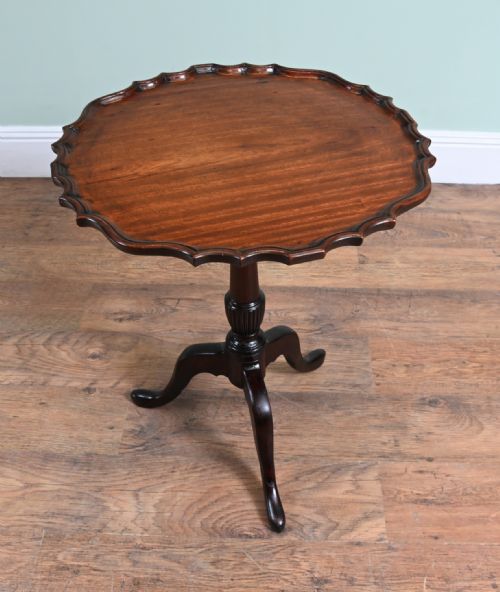


Pie Crust Tilt Top
A pie crust tilt top table brings a shaped rim and a pivoting surface together, offering both display space and practical convenience.

Pie Crust Tilt Top
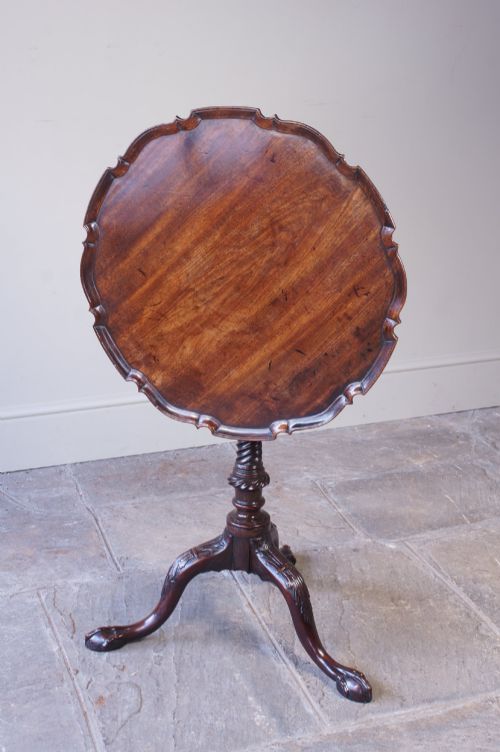
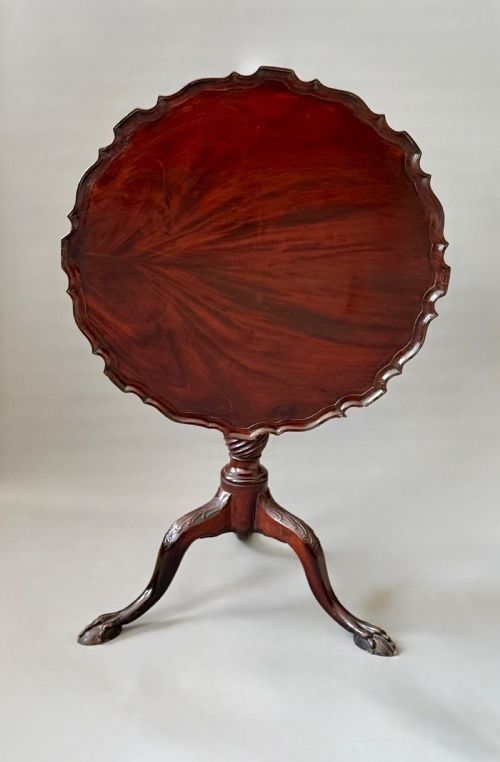
When you search for pie crust tilt top, you are looking at circular tables featuring raised, carved rims that mimic pastry edges, combined with a mechanism allowing the top to pivot upright. These pieces serve as tea tables, wine tables, or occasional tables, designed to stand neatly against a wall when not in use.
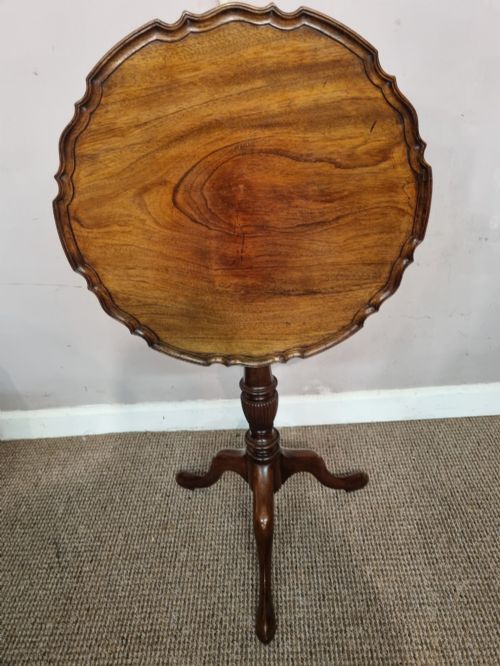
The version you are most likely to meet on this page is the mahogany tripod table from the Georgian period or the George III era. You will also find later revivals spanning the nineteenth century, the Edwardian era, and the nineteen-twenties, alongside occasional walnut examples.
Forms range from compact wine tables to larger tea and supper tables supported by central pedestals and three legs. Some incorporate sophisticated birdcage mechanisms beneath the top, allowing the surface to both tilt and rotate.

Materials and construction
Cabinet makers relied primarily on solid mahogany and walnut for these pieces, selecting dense timbers capable of holding intricate edge carving without splintering. Brass components frequently appear in the tilt mechanisms, catches, and subtle fittings of the pedestals.
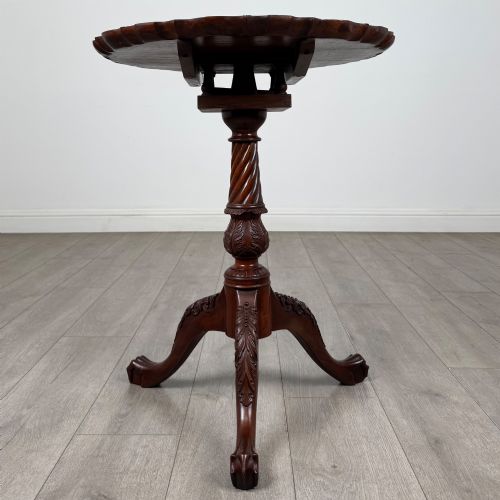
The distinctive rim requires carving directly from the solid thickness of the timber or building up sections to shape the undulating lobes. A central pillar rests on tripod legs, often connected by a birdcage revolving block that permits independent rotation and tilting of the tabletop.
Early makers designed these rims so precisely that guests could trust their expensive porcelain tea sets would not slide off during lively political debates.
Distinctions in quality
Quality rests heavily on the crispness and depth of the carved rim, where sharper, more fluid lobes separate finer examples from softer, more mechanical later interpretations. The proportion between the top, the central column, and the span of the tripod legs dictates the visual balance.
The engineering of the pivot mechanism also marks the difference between standard production and superior work. A well-fitted birdcage action operates smoothly without excessive play, demonstrating precise joinery that maintains stability in both the flat and upright positions.
The Pie Crust Tilt Top Glossary
- Tilt top
- A tabletop mounted on a pivoting mechanism that allows the surface to be turned vertical when not in use. This clever design saved valuable floor space in historic rooms.
- Birdcage
- A timber framework beneath the tabletop consisting of small vertical pillars and plates. It allows the table to both rotate horizontally and tilt vertically.
- Tripod table
- A freestanding table supported by a central pillar resting on three spreading legs. This configuration ensures firm contact on uneven floors.
- Snap top
- An alternative term for a tilt top table, referring to the spring catch that locks the surface flat. The catch prevents the table from tipping accidentally during use.
- Chippendale taste
- A design style inspired by Thomas Chippendale's mid-eighteenth-century pattern books. It frequently incorporates carved pie crust edges, cabriole legs, and claw-and-ball feet.
Pie Crust Tilt Top: Frequently Asked Questions
What is a pie crust table used for?
These tables served primarily as tea, coffee, or wine tables in eighteenth-century drawing rooms. The raised rim prevented cups and glassware from sliding off when the surface was in use.
Today, they function well as occasional tables beside seating or as decorative accent pieces in a hallway. Their tilting mechanism allows them to act as flat surfaces or display panels depending on the space available.
How do you operate the tilt mechanism?
Most examples feature a brass catch or a wooden wedge beneath the top that releases the locking mechanism. Lifting or sliding this catch allows the circular surface to pivot upward into a vertical position.
To lower the table, you simply press the top back down until the catch snaps securely into place. It is advisable to support the tabletop with one hand while operating the release.
How can I tell an 18th-century table from a later revival?
Eighteenth-century examples display hand-cut joinery, patination built up over generations, and subtle irregularities in the carved rim that reveal hand tools at work. The timber itself tends to show deeper colour and a softer sheen.
Later revival pieces from the Victorian era or the early twentieth century often feature more uniform machine shaping and tighter, newer-looking fixings. Examining the underside of the top and the pivot block usually clarifies the period of manufacture.
What is a birdcage support?
A birdcage is an ingenious secondary frame situated between the tabletop and the top of the central pillar. It comprises four small turned posts enclosed by horizontal plates, resembling a small birdcage.
This construction lets the tabletop revolve in a full circle independently of the tilt action. It represents a mark of higher craftsmanship found on many finer Georgian tripod tables.
Where should I place a tilt top table at home?
These tables fit naturally beside armchairs, in corners, or against blank wall spaces where their shaped tops can be appreciated. When tilted upright, they occupy minimal depth, making them useful in narrow hallways or landings.
Keep them away from direct heat sources and strong sunlight to protect the polished mahogany or walnut surfaces. Allowing adequate clearance around the tripod base prevents accidental trips.