

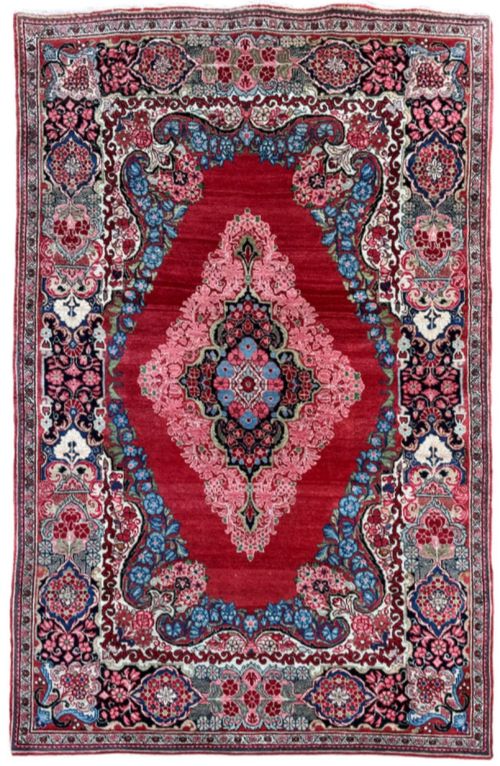

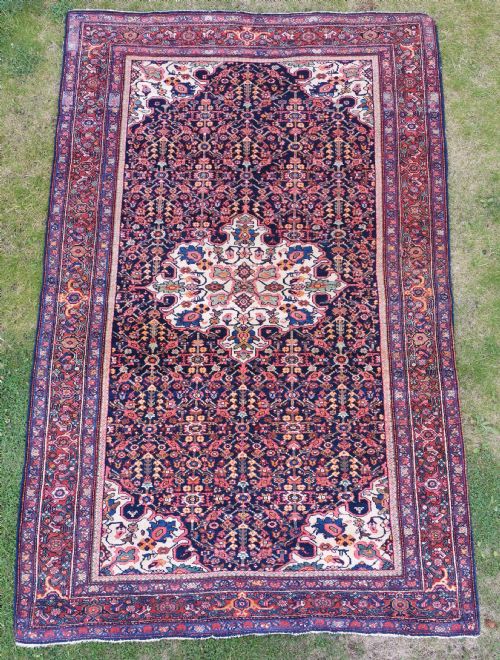
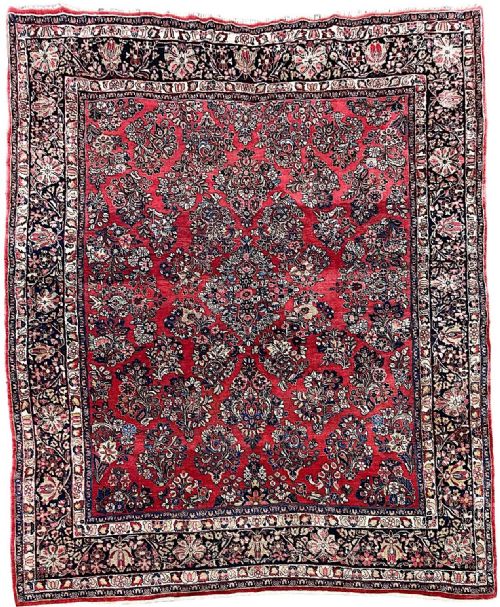


Persian Sarouk Medallion Rug
A persian sarouk medallion rug brings enduring warmth to a room through traditional Persian artistry and resilient wool.
Persian Sarouk Medallion Rug
A persian sarouk medallion rug is a hand-knotted floor covering originating from West Persia, encompassing regional village and workshop styles. When searching this phrase, buyers encounter traditional formats ranging from compact area rugs to substantial carpets and narrow runners.
The pieces available span from the mid-nineteenth century through the 1930s, capturing decades of West Central Persian weaving traditions. Many examples exhibit classic village characteristics, while others reflect finer, dense weaves associated with specific centres like Jozan, Ferahan, and Mohajeran.
How They Were Made
Weavers constructed these rugs using wool pile knotted onto cotton foundations, creating durable surfaces designed for daily use. Natural materials dictated the soft lustre and deep tones characteristic of the period.
Village weavers and workshop artisans employed traditional hand-knotting techniques, often producing dense structures that allowed intricate medallion layouts and floral motifs to hold their form over generations.
Persian Sarouk Medallion Rug Retail Price Guide 2026
Typical asking prices for persian sarouk medallion rug among the pieces listed under this phrase on Sellingantiques today, from the lower quarter to the upper quarter. They describe what is for sale here now, not the wider market.
Listings span periods from the mid-nineteenth century through 1930, utilising wool and cotton materials in traditional West Persian rug formats.
What Varies in Quality
Knot density and structural fineness distinguish the tier of weaving, separating everyday village production from exceptionally tightly woven carpets. A finer weave allows sharper definition within the central medallion and border details.
The handling of wool and dye saturation also influences the character of each piece, affecting how the pile responds to light and wear. Uniformity in the foundation tension contributes to the overall stability and flat lay of the carpet.
The Persian Sarouk Medallion Rug Glossary
- Medallion
- A prominent central ornamental design motif placed in the field of the rug. It serves as the primary visual anchor for the surrounding field patterns.
- Pile
- The upright yarn loops or cut ends that form the soft surface of the rug. This wool layer absorbs wear and displays the colour palette.
- Foundation
- The underlying grid of warp and weft threads that support the knotted pile. Cotton is standard for these structural elements in this region.
- Runner
- A long, narrow format of rug traditionally utilised in hallways or corridors. These pieces accommodate linear spaces while preserving traditional medallion layouts.
- Village rug
- A piece produced in a domestic or rural setting rather than a large urban workshop. These carpets often display local design interpretations and robust wool.
Persian Sarouk Medallion Rug: Frequently Asked Questions
Where were these rugs made?
These pieces originated in West Persia, specifically within villages and workshops across regions such as Jozan, Ferahan, and Mohajeran. Local weavers utilised traditional techniques passed down through generations.
Production spanned from the nineteenth century into the early decades of the twentieth century, reflecting the distinct stylistic preferences of western Persian weaving communities.
How do I choose the right size?
Consider the dimensions of your room and the intended placement, noting that sizes range from compact area rugs to long narrow runners and large carpets. Measure your floor space carefully to ensure the rug anchors your furniture arrangement appropriately.
Runners suit hallways and narrow spaces, while larger carpets anchor living rooms or dining areas, allowing the central medallion to remain visible.
How do I care for an antique rug?
Vacuum the rug gently on a low setting without a rotating brush bar to protect the wool pile from unnecessary friction. Rotate the piece periodically to ensure even exposure to light and foot traffic.
Address spills promptly by blotting with a clean, dry cloth rather than rubbing. Professional cleaning suited to antique textiles preserves the integrity of the wool and cotton foundation.
What defines a Jozan or Ferahan piece?
Jozan and Ferahan designate specific West Persian weaving origins known for particular structural qualities and design refinements. Jozan pieces often display robust village character with dense wool construction.
Ferahan examples frequently exhibit very fine weaves and intricate floral detailing, reflecting the sophisticated output of traditional West Persian workshops.