

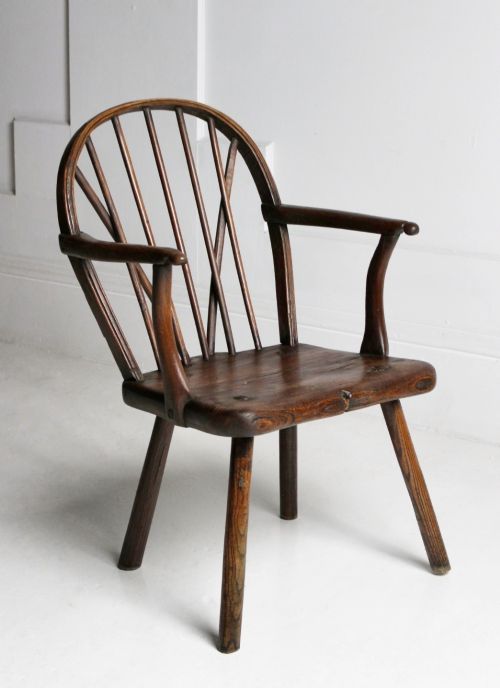


Period Vernacular Seating
Period vernacular seating brings honest, hardworking domestic history straight into a room through solid timbers and simple, time-worn shapes.
Period Vernacular Seating
Period vernacular seating encompasses robust functional chairs, armchairs, child's chairs, high chairs, and settle benches made for everyday use outside elite urban workshops. These pieces date across the seventeenth century, eighteenth century, and nineteenth century, showing regional British character rather than formal courtly design. Buyers looking for period vernacular seating will regularly encounter stick back chairs, Windsor chairs, ladderbacks, and bacon settles.
The objects on this page range from early joined construction armchairs in Welsh oak and yew-wood to country elm side chairs and ash child's chairs. Surviving examples often display the honest marks of domestic labour, vernacular repairs, and generations of sitting. They turn up in woods like elm, oak, ash, fruitwood, and beech, frequently fitted with rush seating.
Armchairs and side chairs form the backbone of these listings, alongside rarer forms such as child's lambing chairs and settle benches. These everyday survivors prove that utilitarian furniture could possess a sculptural presence all its own. Every piece carries the specific regional traditions of the British countryside where it was first built and used.
How they were made
Maker-joiners built these seats using locally available native timbers, pairing sturdy oak or fruitwood frames with solid elm seats and flexible ash or beech spindles. Turned components, mortise and tenon joints, and wedged stick-back construction provided the necessary strength for daily farm and cottage life. Rush was woven tightly across seat frames to create a durable, springy surface for sitting.
The construction relies on straightforward practical mechanics, where structural parts like armbows and legs were shaped with drawknives and shaves rather than fancy machinery. Yew-wood panels and turned spindles add regional variation to standard joinery techniques. Surfaces were left to weather naturally or developed a rich deep sheen through decades of handling and wax polishing.
Period Vernacular Seating Retail Price Guide 2026
Typical asking prices for period vernacular seating among the pieces listed under this phrase on Sellingantiques today, from the lower quarter to the upper quarter. They describe what is for sale here now, not the wider market.
Listings feature periods from the 17th century through to the 19th century, constructed in elm, oak, ash, fruitwood, rush, iron, beech, and yew.
What varies in quality
Quality in these rural pieces rests on the integrity of the timber, the balance of the proportions, and the survival of the original structure. A well-proportioned Windsor chair or joined armchair retains its original rake to the legs and comfortable pitch to the back without excessive alterations. The choice of woods also marks distinction, particularly where contrasting timbers like a yew-wood panel are set within an oak frame.
The distinction between ordinary utility and superior quality lies in the crispness of the turnings and the harmonious integration of repairs. Early joined examples from the seventeenth century command attention through substantial panel work and peg construction. Later nineteenth-century pieces show lighter framing, but success depends entirely on how sympathetically the timber has aged and worn.
The Period Vernacular Seating Glossary
- Stick back
- A chair construction method where turned spindles or plain sticks are inserted directly into a solid wooden seat or a bentwood armbow.
- Bacon settle
- A high-backed wooden bench with a compartment or rack beneath the seat or hood, historically used for curing and storing meat.
- Ladderback
- A chair back featuring multiple horizontal wooden slats or rails set between two upright posts.
- Rush seating
- A woven seat base made from dried marsh rushes twisted into cords and patterned tightly across a wooden frame.
- Windsor chair
- A chair built with a solid sculpted wooden seat into which the legs, back sticks, and arm pieces are separately socketed.
Period Vernacular Seating: Frequently Asked Questions
What is vernacular seating?
Vernacular seating refers to utilitarian furniture made by local country craftsmen rather than high-style urban cabinetmakers. These pieces served practical domestic needs in cottages, farmhouses, and rural workshops.
Built from readily available regional woods like oak, elm, and ash, they prioritise sturdy construction and comfort over fashionable ornament.
How do I identify a bacon settle?
A bacon settle is a high-backed wooden bench designed with a large storage box beneath the seat or an enclosed upper section. Historically, households used these enclosed spaces to store and cure sides of salted meat away from pests.
They offer an imposing enclosed bench form that doubles as draught protection in large farmhouse kitchens.
Are rush seats durable?
Rush seats woven from dried marsh grass are surprisingly tough and flexible when cared for properly in a stable indoor climate. They provide a comfortable, yielding surface that adapts to the sitter over time.
Avoid placing rush-seated chairs in damp environments, as moisture will weaken the natural fibres and cause them to rot.
How do I date an old Windsor chair?
Dating a Windsor chair involves looking at the turning of the legs, the thickness of the elm seat, and the timber species used in the undercarriage. Earlier examples often feature substantial multi-piece construction and heavier ash or fruitwood components.
Tool marks underneath the seat and the method used to fix the legs also provide strong clues to the period of manufacture.