


Peridot Seed Pearl Necklace
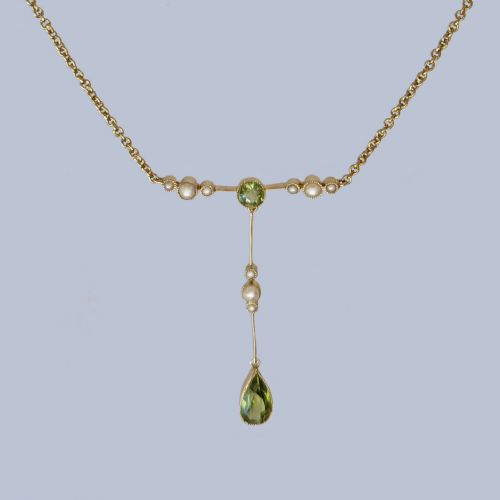
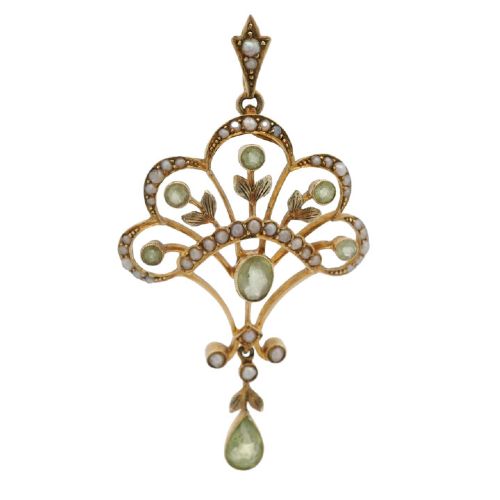
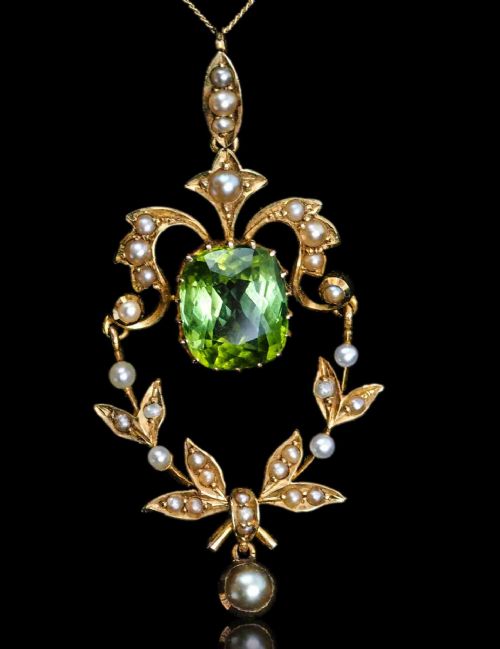
A peridot seed pearl necklace brings together pale olive greens and tiny lustrous pearls in characteristic Edwardian and Victorian gold settings.
Peridot Seed Pearl Necklace
A peridot seed pearl necklace is typically encountered in Edwardian and Victorian forms, spanning the late nineteenth and early twentieth centuries. These pieces frequently take the shape of delicate pendants, lavalieres, and fringe necklaces designed to sit close to the collarbone.
Makers of this period arranged bright green peridot stones alongside minute seed pearls in floral, scroll, and star configurations. The typical survival from this era relies on combinations of nine-carat or fifteen-carat yellow and rose gold.
How they were made
Goldsmiths constructed these mounts using cast and hand-formed nine-carat and fifteen-carat gold, occasionally incorporating platinum elements for fine stone settings. Seed pearls were meticulously drilled and secured on tiny wire pegs or threaded to follow the curves of floral and garland motifs.
Enamelling techniques such as plique-à-jour also appear, allowing translucent colour to catch the light behind or around the central peridot stones.
Art Nouveau and garland motifs frequently appear alongside standard floral drops in these antique necklace designs.
What varies in quality
The distinction between standard production and finer work rests on the crispness of the gold stampings and the regularity of the pearl settings. Superior examples display balanced proportions in garland or lavaliere drops, where every seed pearl remains uniformly matched in size and lustre.
The depth of hue in the peridot and the complexity of the surrounding metalwork, such as pierced scrollwork or integrated platinum detailing, further elevate the standing of a piece.
Murrle Bennett·BIRKS
The Peridot Seed Pearl Necklace Glossary
- Seed pearl
- A very small, naturally formed or early cultured pearl, often unperforated or finely drilled for cluster work. These tiny gems provide a delicate white border to coloured gemstones.
- Peridot
- A transparent olive-green gemstone belonging to the olivine group, favoured in Edwardian jewellery for its fresh, grassy tone. It is typically cushion-cut or faceted in circular drops.
- Lavaliere
- A pendant necklace featuring a central dangling drop, popular during the Edwardian and Art Nouveau periods. The design often incorporates asymmetrical floral or scroll elements.
- Plique-à-jour
- An enamelling technique resembling miniature stained glass, where enamel is applied without a backing metal, allowing light to shine through the transparent cells.
- Garland style
- A jewellery design motif inspired by eighteenth-century neoclassical decoration, featuring swags of ribbons, flowers, and leaves rendered in gold and gemstones.
Peridot Seed Pearl Necklace: Frequently Asked Questions
How do I date a peridot seed pearl necklace?
Dating relies on hallmarks stamped on the reverse of the pendant or the clasp, alongside characteristic stylistic traits of the mount. Edwardian pieces often display lighter, airier platinum and fifteen-carat gold scrollwork compared to heavier Victorian designs.
Examination of the seed pearls and the cut of the peridot also offers clues, as does the presence of original fitted boxes from retailers of the era.
Are these necklaces fragile to wear?
Seed pearls are historically sensitive to moisture, perfumes, and cosmetics because they are secured on traditional threads or delicate wire pegs. Gentle handling ensures the pearls remain secure within their gold settings.
Removing the necklace before swimming, bathing, or applying lotions protects both the soft pearls and the bright green peridot stones from chemical degradation.
What is the difference between nine-carat and fifteen-carat gold here?
Fifteen-carat gold contains a higher proportion of pure gold, resulting in a richer, warmer yellow hue commonly found in finer Edwardian and Victorian mountings. Nine-carat gold was also widely utilised, offering a slightly paler appearance while retaining structural durability.
Both purities appear frequently across these antique necklace designs, often accompanied by maker's marks or standard assay office stamps.
How should I clean my antique necklace?
Cleaning requires only a soft, dry microfibre cloth to remove surface dust from the gold, peridots, and seed pearls. Submerging antique pearl jewellery in liquid cleaner can weaken the historic threading inside the seed pearls.
For stubborn grime, a slightly damp cloth with mild soap can touch the metal parts, keeping moisture away from the pearl drill holes.