



Parquetry Tea Chest
A parquetry tea chest brings geometric wood-mosaic work into a room, offering a small lidded box that once kept dry leaf secure under lock.
Parquetry Tea Chest
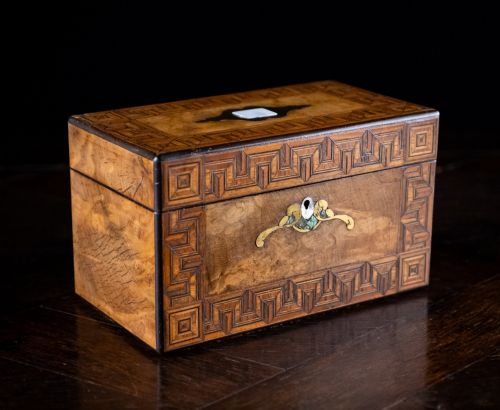
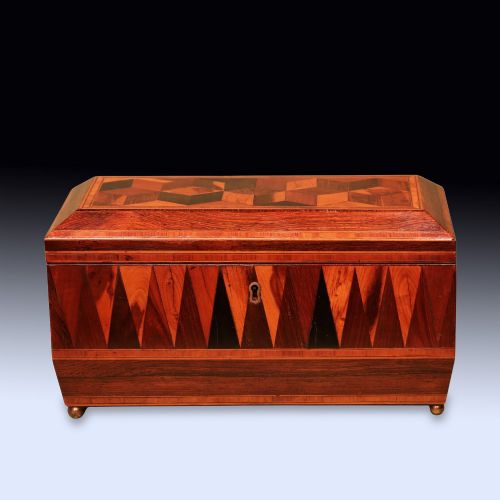
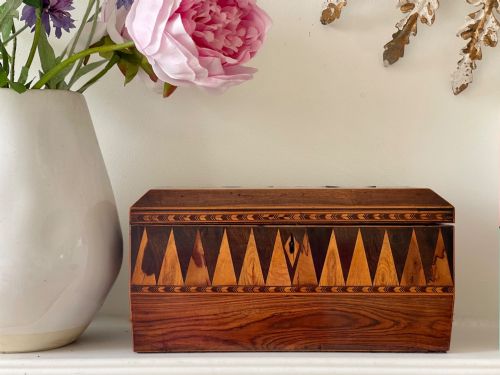
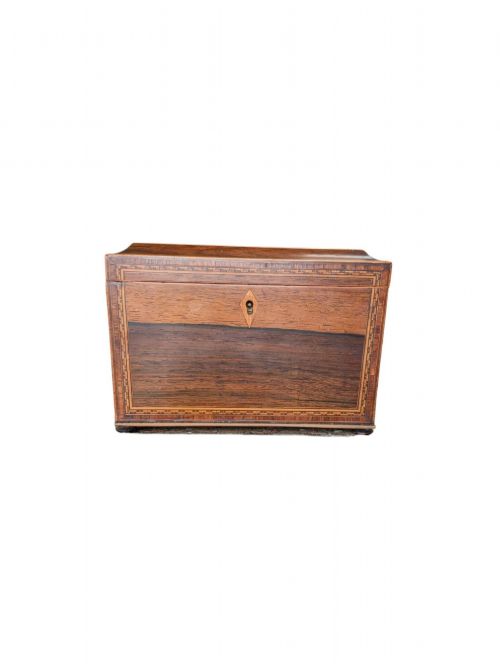
A parquetry tea chest is a lidded wooden box designed for storing tea leaves, built from geometric wood veneers arranged in regular patterns. The examples appearing here span the Georgian, Regency, and Victorian eras, alongside specific forms associated with Tunbridge Wells.
Most pieces on this page take the form of tea caddies, including sarcophagus shapes and fitted box designs. Makers utilised timbers such as rosewood, walnut, and laburnum as bases for intricate inlay work in boxwood, holly, and mixed wood veneers.
Originating in periods when tea was a costly commodity, these chests rely on surface pattern rather than carving for their visual impact. The variety ranges from bold geometric parquetry to the micro-mosaic pictorial scenes characteristic of Tunbridge Ware.
How they were made
Craftsmen built these chests using solid timber foundations, such as rosewood or walnut, before applying fine veneers to the exterior surfaces. Geometric parquetry required precision cutting of contrasting woods like boxwood and holly to form interlocking patterns.
Specialised workshops, particularly those in Tunbridge Wells, produced intricate mosaic bands and pictorial panels from thousands of tiny tinted wood prisms. These decorative elements were glued onto the box carcase and finished with polished varnish to protect the delicate wood grains.
Parquetry Tea Chest Retail Price Guide 2026
Typical asking prices for parquetry tea chest among the pieces listed under this phrase on Sellingantiques today, from the lower quarter to the upper quarter. They describe what is for sale here now, not the wider market.
Makers concealed tiny wooden landscapes inside the lids of their mosaic boxes, capturing castles in Kent using only natural tree grains.
What varies in quality
The standard of a parquetry tea chest rests on the precision of its geometric inlay and the complexity of its mosaic work. Finer examples display immaculate alignment in multi-wood patterns without visible gaps between individual tesserae.
The choice of primary timber also distinguishes the range, with dense exotic hardwoods like rosewood providing a superior ground for inlay compared to plain secondary woods. Additionally, the survival of internal fittings, such as mixing bowls and lidded canisters, elevates the completeness of the piece.
Henry Hollamby
The Parquetry Tea Chest Glossary
- Parquetry
- Geometric mosaic woodwork formed by fitting together small blocks or veneers of various coloured timbers to create a patterned surface.
- Tunbridge Ware
- A specialised form of British woodwork featuring microscopic mosaic tiles assembled into pictorial scenes or geometric bands, originating in Kent.
- Sarcophagus form
- A distinctive nineteenth-century box shape featuring a steep, flared lid and an elevated plinth base, often resting on carved feet.
- Veneer
- A thin slice of decorative wood applied over a sturdier structural timber base to provide a fine exterior finish.
- Tessera
- An individual small block of wood used in the construction of mosaic and parquetry designs.
Parquetry Tea Chest: Frequently Asked Questions
What is a parquetry tea chest?
A parquetry tea chest is a small lidded wooden box decorated with geometric wood inlay, designed originally to store and preserve dry tea leaves.
These pieces rely on patterns formed from contrasting timbers like boxwood, holly, and rosewood rather than three-dimensional carving.
How were these tea chests used?
In past centuries, tea was an expensive commodity kept under lock by the head of the household to prevent domestic theft.
The interior compartments held different varieties of tea leaves alongside a central mixing bowl where leaves were combined before brewing.
How do I identify a Regency tea chest?
Regency tea chests often feature architectural proportions, sarcophagus silhouettes, and classical brass ring handles or paw feet.
The woodwork typically employs dark exotic veneers combined with subtle satinwood stringing rather than dense pictorial mosaic.
What is Tunbridge Ware inlay?
Tunbridge Ware inlay consists of thousands of tiny tinted wood prisms glued together to form intricate mosaic pictures or geometric borders.
This technique originated in Kent and appears frequently on nineteenth-century tea caddies from this region.
How should I care for a wood tea chest?
Keep wooden tea chests away from direct sunlight and sudden temperature shifts to prevent the thin decorative veneers from lifting or splitting.
An occasional gentle dusting with a dry cloth maintains the polished surface without the need for modern liquid polishes.