

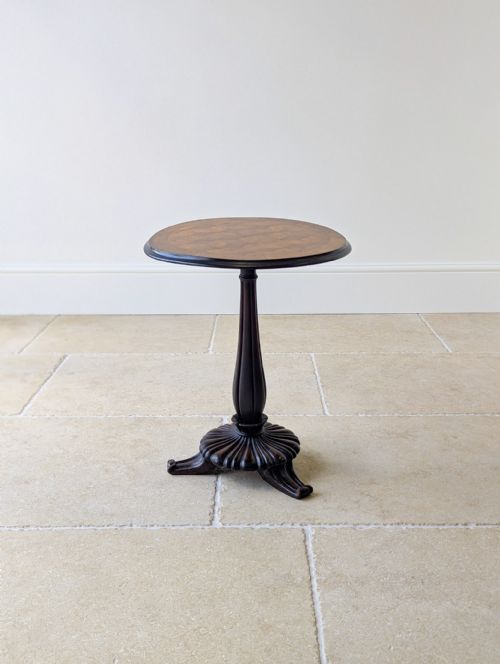
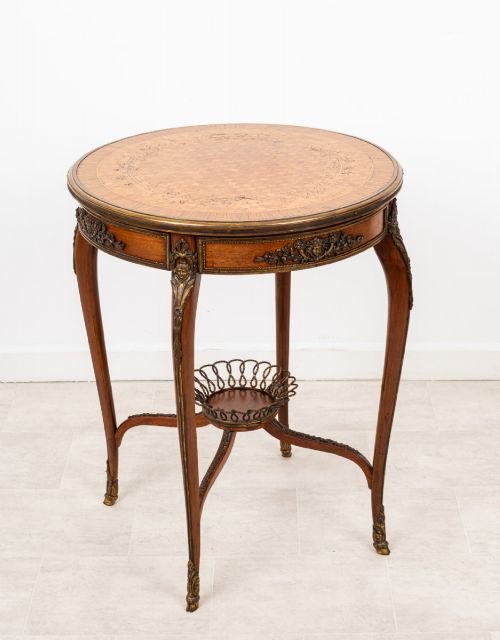

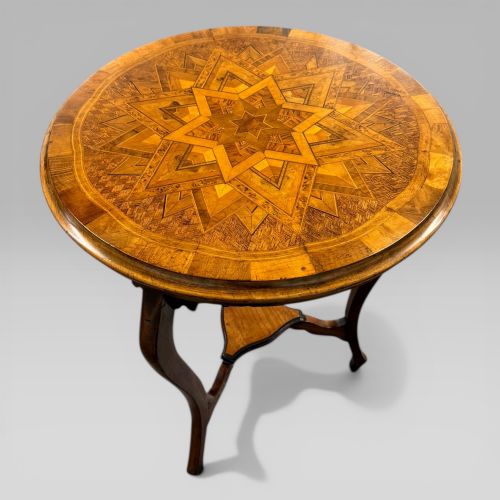


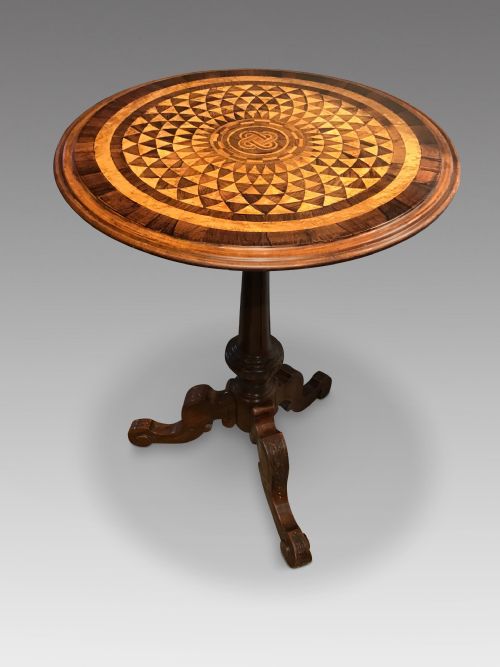


Parquetry Round Side Table
A parquetry round side table brings geometric timber work to a corner, offering a stable circular surface crafted from contrasting veneers.
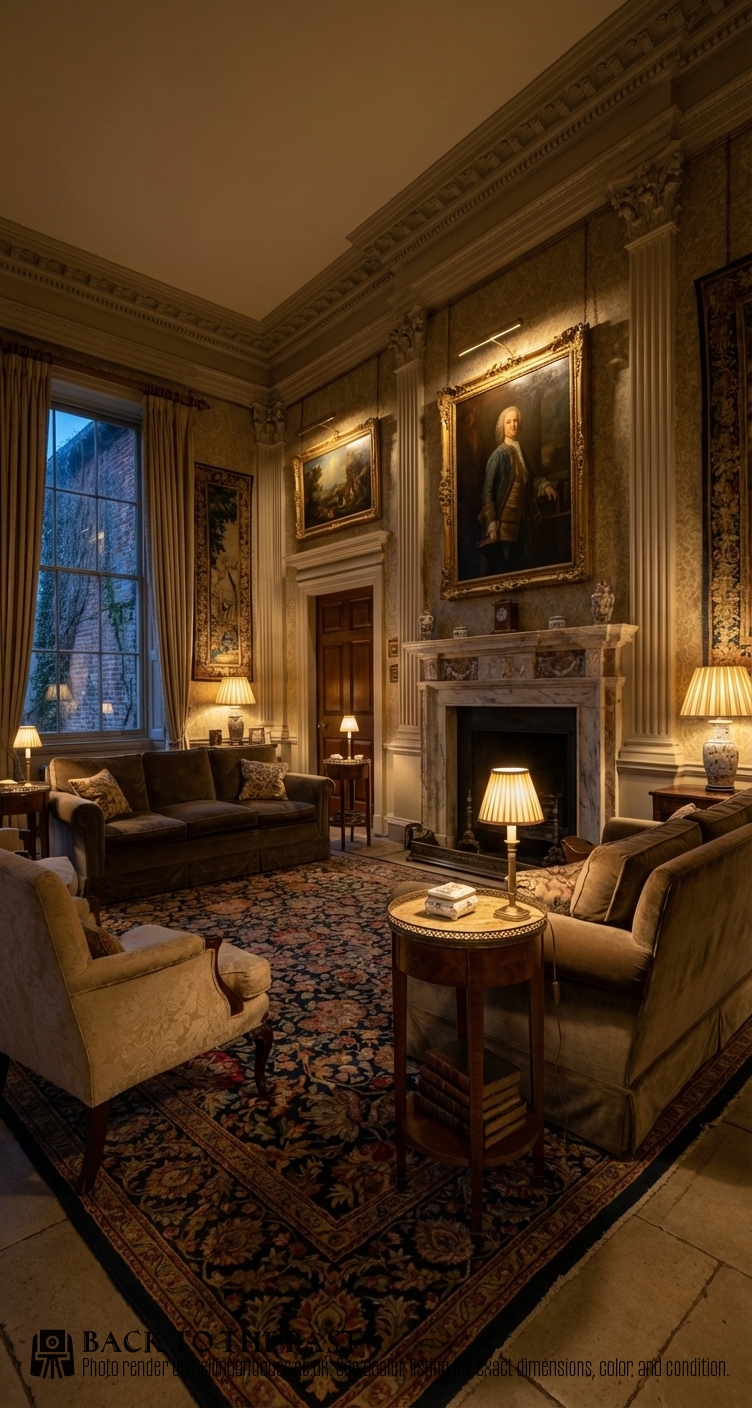
Parquetry Round Side Table
A parquetry round side table combines geometric wood veneers with a circular top designed to sit beside seating or in a corner. These pieces appear frequently in French nineteenth-century formats, often taking the form of gueridons, occasional tables, or small centre tables.
The construction typically involves a central pillar or slender legs supporting a round top decorated with patterned wood sections. Buyers meet walnut, oak, and kingwood examples spanning the nineteenth century through to the mid-twentieth century.
Makers utilised contrasting timbers to create optical depth across the circular surface, sometimes incorporating marble inserts or brass mounts. The forms range from simple tripod wine tables to elaborate two-tier occasional tables with inlaid geometric patterns.
Materials and construction
Cabinetmakers constructed these tables using a softwood or hardwood carcase faced with fine veneers of kingwood, walnut, rosewood, and mahogany. These decorative veneers were carefully cut and fitted together by hand to form geometric parquetry patterns across the circular tops.
Ormolu mounts and brass galleries were frequently added to enrich the edges and mounts of French nineteenth-century pieces. Structural stability was achieved through turned wooden pedestals, tripod legs, or four-legged frames joined by stretchers.
Parquetry Round Side Table Retail Price Guide 2026
Typical asking prices for parquetry round side table among the pieces listed under this phrase on Sellingantiques today, from the lower quarter to the upper quarter. They describe what is for sale here now, not the wider market.
The listings feature French nineteenth-century pieces alongside English Regency and Victorian examples, constructed in walnut, oak, and kingwood with occasional marble tops.
Quality and craftsmanship
Quality rests upon the precision of the veneer work and the choice of timbers used in the geometric pattern. Finer examples display tight, seamless joints within the parquetry and utilise rich woods such as kingwood and rosewood.
The execution of the underlying cabinetwork, from the turning of the central pillar to the stability of the joints, dictates the durability of the piece. Superior items integrate cast ormolu mounts and marble tops that fit flush within the wooden frame.
François Linke·Anton Seuffert
The Parquetry Round Side Table Glossary
- Parquetry
- Geometric mosaic woodwork arranged in repeating patterns of triangles, squares, or lozenges. This technique forms the primary decorative surface of the tabletop.
- Kingwood
- A dense, richly grained tropical timber used extensively in fine French cabinetry for its contrasting dark and golden tones. It provides the decorative highlights in parquetry designs.
- Ormolu
- Gilded bronze used for decorative mounts, feet, and gallery rims on nineteenth-century tables. It adds metallic contrast to the timber surface.
- Gueridon
- A small French round table supported by a central pillar or slender legs. These tables served various domestic functions in nineteenth-century interiors.
- Bouillotte table
- A small French circular side table featuring a raised brass gallery around the edge to prevent items from sliding off. They frequently incorporate marble tops and small drawers.
Parquetry Round Side Table: Frequently Asked Questions
Where do I place a round side table?
These tables fit easily beside armchairs, in narrow hallways, or as freestanding accents in the centre of a room. Their circular footprint avoids sharp corners in confined spaces.
They also function effectively as lamp tables or bedside cabinets depending on the height and presence of drawers.
How do I distinguish French styles?
French nineteenth-century pieces often display delicate ormolu mounts, marble inserts, and sophisticated kingwood veneers. Louis XV revival versions lean towards curved lines and floral marquetry alongside geometric parquetry.
English William IV and Victorian examples tend to rely on heavier walnut or mahogany frames with simpler pillar supports.
What is the difference between parquetry and marquetry?
Parquetry relies on geometric shapes such as cubes, squares, and triangles to create an abstract repeating pattern across the wood surface. This forms the standard surface decoration for these round tables.
Marquetry uses varied timber veneers to form pictorial scenes, such as floral sprays or landscapes, rather than strict geometric repeats.
How do I care for antique veneer?
Keep wooden tables away from direct heat sources and strong sunlight to prevent the timber veneers from drying out or splitting. Dust regularly with a dry cloth and apply a gentle wax polish sparingly to nourish the wood.
Avoid placing damp glasses directly on the polished surface to protect the delicate grain underneath.