

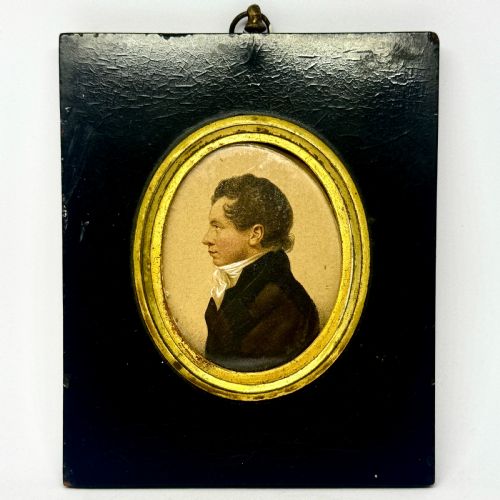


Papier Mache Frame Silhouette
These papier mache frame silhouette pieces offer striking historical portraiture, combining delicate painted detail with the distinctive dark moulded surrounds that collectors prize.
Papier Mache Frame Silhouette
A papier mache frame silhouette brings together traditional portraiture and moulded surrounds from the Georgian, Regency, and nineteenth century periods. These wall art and portrait miniature pieces capture likenesses of ladies, gentlemen, and children in profile.
The versions most commonly met on this page feature dark moulded surrounds housing painted paper, card, or glass. They span distinct historical eras, showing the evolution of profile portraiture over decades of British craftsmanship.
Makers recorded in the evidence range from named artists such as George Atkinson, Thomas London, J. Deacon, and Samuel Metford. Their works demonstrate the shift in portrait styles from the late eighteenth century into the Victorian age.
What Varies in Quality
The integrity and original condition of the moulded papier-mache surround dictate the piece's overall standing. Surviving brass hangers and uncompromised backing materials elevate the historic merit of the object.
Papier Mache Frame Silhouette Retail Price Guide 2026
Typical asking prices for papier mache frame silhouette among the pieces listed under this phrase on Sellingantiques today, from the lower quarter to the upper quarter. They describe what is for sale here now, not the wider market.
Listings draw exclusively from the Georgian, Regency, and nineteenth-century periods, utilising paper, glass, brass, and papier-mache.
George Atkinson·Thomas London·J. Deacon·Samuel Metford
The Papier Mache Frame Silhouette Glossary
- Papier-mache
- A composite material made from paper pulp or reinforced sheets mixed with glue, moulded under pressure and finished with dark lacquer. It provided a lightweight yet durable alternative to heavy timber frames.
- Profile
- A side-on view of a sitter's face, which artists cut from black paper or painted directly onto a pale background. This technique captured an instantly recognisable likeness before the widespread adoption of photography.
- Ebonised Wood
- Timber treated to imitate the dark, dense finish of ebony. It frequently appears alongside papier-mache to create contrasting borders.
- Portrait Miniature
- A small-scale painting or silhouette designed for intimate viewing rather than grand display. These portable works captured personal likenesses with remarkable economy of line.
Papier Mache Frame Silhouette: Frequently Asked Questions
What periods do these silhouettes come from?
The available evidence points to the Georgian, Regency, and nineteenth century periods. These eras encompass the height of profile portraiture before photography changed visual recording.
Collectors encounter various styles within these timeframes, from eighteenth-century gentleman portraits to detailed Regency depictions of ladies in caps.
How were these framed pieces displayed?
Owners typically hung these wall art pieces in parlours and intimate rooms alongside larger family portraits. Their compact size allowed for dense gallery arrangements on domestic walls.
Many retain original brass hanger loops at the top of the papier-mache border for this exact purpose.
What materials make up the surrounds?
The surrounds consist primarily of papier-mache, sometimes paired with ebonised wood and highlighted with brass fittings. This combination created a dark, reflective border that drew the eye straight to the pale profile within.
Some examples also incorporate protective convex glass held tightly by the moulded rim.
Are all the silhouettes painted?
While many examples feature painted watercolour on paper or card, others utilise painted colour directly on glass. Each technique required steady hands and precise execution due to the small scale of the portrait.
Artists occasionally added gold highlights to uniforms, dresses, or bonnets to enhance the visual impact.