

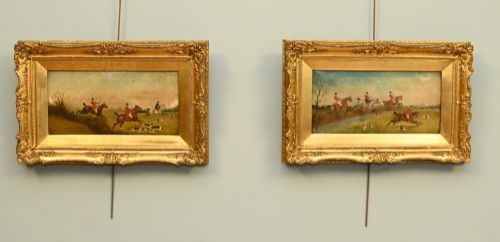
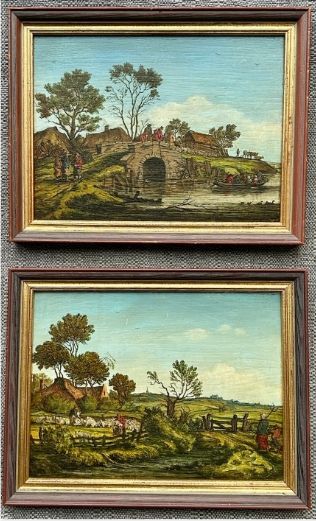
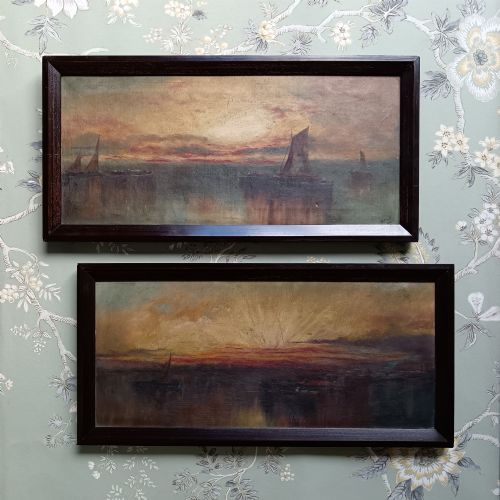
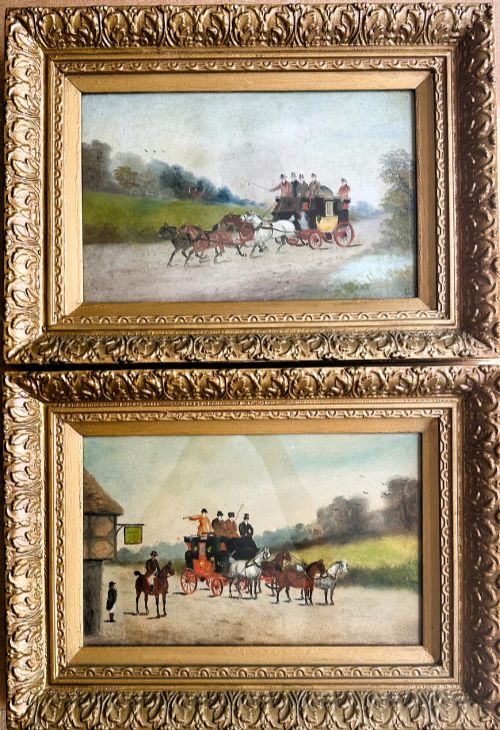
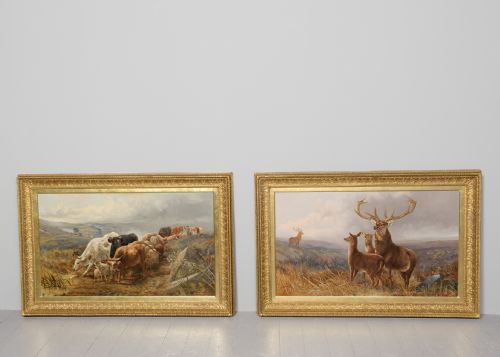


Pair Landscape Oil Paintings
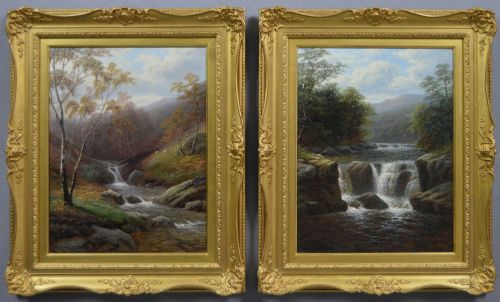
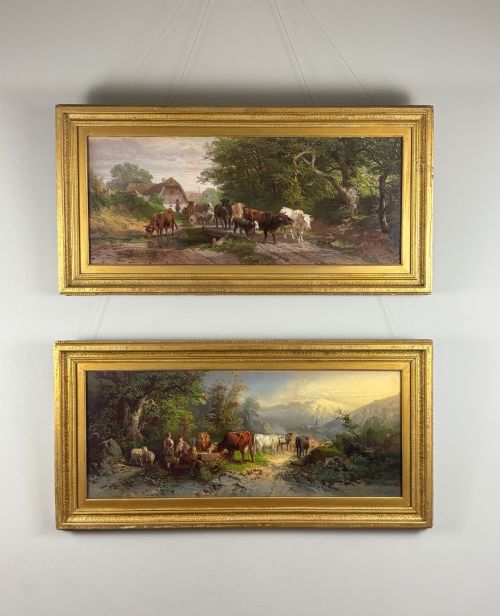
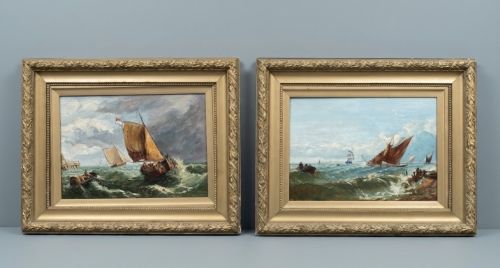
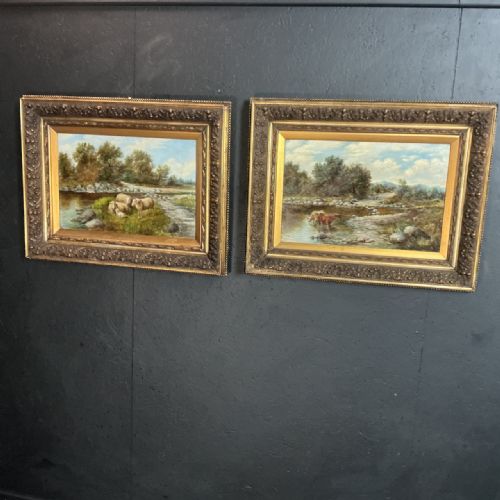
These pair landscape oil paintings unite pastoral scenes, coastal views and forest settings across two matched panels.
Pair Landscape Oil Paintings
Pair landscape oil paintings represent matched visual compositions designed for symmetrical display, often recording sunrise and sunset, companion seasons or corresponding rural vistas. Buyers encounter works stretching from the eighteenth century through the Victorian and Edwardian eras, executed by named artists and regional schools.
The subjects span domestic river valleys, Scottish highlands, Welsh lakes, continental forests and Mediterranean ruins. Many compositions balance topographical accuracy with romantic or pastoral interpretations of the countryside.
Companionship defines the group, where two panels share a uniform palette, scale and hand, intended to hang together as a unified decorative statement.
How They Were Made
Makers applied oil paint to stretched canvas, wooden panels or artist boards, building up rich pigment layers that retained brush texture and tonal depth. Supports varied according to period and scale, with smaller works frequently utilising prepared wood or board.
Moulded gesso and giltwood frames enclose the majority of works, utilising gold leaf applications to provide a decorative border that complemented the domestic interiors of the nineteenth century.
Pair Landscape Oil Paintings Retail Price Guide 2026
Typical asking prices for pair landscape oil paintings among the pieces listed under this phrase on Sellingantiques today, from the lower quarter to the upper quarter. They describe what is for sale here now, not the wider market.
Recorded subjects span maritime seascapes, architectural views and highland cattle scenes.
What Varies in Quality
Skill in draughtsmanship and atmospheric perspective dictates the success of a composition, separating formulaic studio output from accomplished observation. Handled paint application, convincing light effects and detailed rendering of foliage or water elevate individual works.
The integrity of the original pairing matters significantly, as matched panels that remain together retain greater historical cohesion than assembled companions. Surviving period frames with untouched gilding enhance the overall standard of preservation.
John Frederick Herring Jnr·Pieter Cornelis Dommersen·Gustave De Bréanski·William Mellor·Alfred Vickers Senior
The Pair Landscape Oil Paintings Glossary
- Oil on Canvas
- Pigment mixed with drying oil applied to a woven fabric support stretched over a wooden frame. This method became the dominant painting medium from the seventeenth century onward.
- Giltwood
- Timber carved and coated with gold leaf or metallic powder. It provides a reflective, ornate boundary around the canvas.
- Gesso
- A paint mixture consisting of a binder mixed with chalk, pigment, or plaster. It serves as a prepared surface for painting or forms the relief ornamentation on picture frames.
- Tondo
- A circular painting or relief sculpture. The format directs attention toward the centre of the composition.
- Provenance
- The chronological record of ownership of a work of art. It establishes authenticity and historical lineage.
Pair Landscape Oil Paintings: Frequently Asked Questions
How should pair landscape oil paintings be hung?
Display companion works at eye level with consistent spacing between the frames to maintain visual balance. Matching compositions benefit from symmetrical placement flanking a central architectural feature or piece of furniture.
Avoid direct sunlight and fluctuating heat sources to protect the canvas tension and pigment stability over time.
What subjects appear in these paintings?
Scenes incorporate river valleys, mountain streams, coastal waters, agricultural holdings and woodland glens. Many compositions record specific British and European locations, from North Wales to Dutch forests.
Artists frequently paired diurnal transitions, contrasting morning light with evening shadows across the two canvases.
How can I tell the period of the frames?
Nineteenth-century frames typically utilise cast gesso ornamentation mounted on a wooden subframe, finished with gold leaf. Earlier examples feature hand-carved wooden mouldings with distinct corner joints.
Examining the backing boards, fixings and gilding wear provides further indication of age and original assembly.
Are these works signed by the artists?
Many examples bear signatures, monograms or contemporary inscriptions on the canvas, stretcher bars or lower margins. Unsigned works frequently attribute to specific regional schools or stylistic circles based on technique.
Documentation on reverse labels or framing inscriptions often records titles and previous collections.