

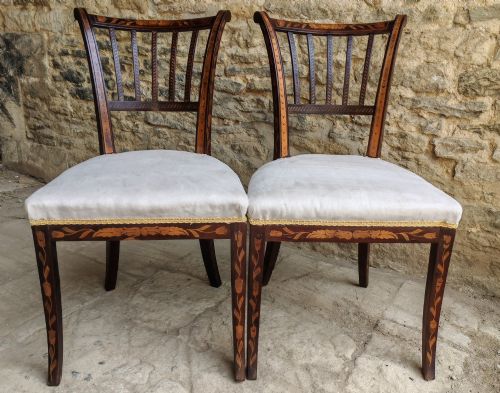


Pair Inlaid Dining Chairs
These pair inlaid dining chairs bring centuries of cabinet-making skill straight to your table, offering matched seating with distinctive decorative detail.
Pair Inlaid Dining Chairs
When you search for pair inlaid dining chairs, you encounter seating designed to face one another across a table, most frequently appearing in mahogany, walnut, and satinwood. The pieces on this page span several centuries and styles, ranging from Georgian and Regency forms to Edwardian interpretations.
The selections include side chairs, armchairs, and carver chairs featuring wood inlay, marquetry, and brass detailing. Edwardian examples and 19th-century interpretations occur frequently alongside earlier Georgian and 18th-century pieces.
Makers often drew upon Sheraton designs, Dutch Baroque, and Art Nouveau influences to shape these seats. Upholstery varies across fabric, velvet, and silk, completing the matched appearance required for formal dining spaces.
Judging Quality
Quality rests upon the crispness of the inlay and the selection of the timber figure in the wood. Sharp execution of marquetry and well-defined stringing separate standard production from superior craftsmanship.
Proportion and structural integrity dictate the standing of each piece within its period. Chairs retain distinction when the timber grain aligns naturally with the decorative scheme applied to the backrest and rails.
Pair Inlaid Dining Chairs Retail Price Guide 2026
Typical asking prices for pair inlaid dining chairs among the pieces listed under this phrase on Sellingantiques today, from the lower quarter to the upper quarter. They describe what is for sale here now, not the wider market.
Mahogany and walnut remain the predominant structural woods across the listed dining chairs, paired with satinwood and fruitwood for contrast.
Henry Maxwell
The Pair Inlaid Dining Chairs Glossary
- Marquetry
- The art of forming decorative patterns by fitting together veneers of different woods, metals, or other materials. This technique defines the ornamentation on many 18th-century and Victorian backrests.
- Stringing
- Inlaid lines of contrasting wood used to outline panels and structural edges. Cabinet-makers utilised this method extensively on Edwardian mahogany frames.
- Carver chair
- An armchair designed to stand at the head of a dining table or serve as a companion to smaller side chairs. These pieces often feature scrolling arms.
- Satinwood
- A durable, yellowish timber prized for its lustrous grain and used for contrasting inlays. Artisans employed it to brighten darker mahogany surfaces.
- Elbow chair
- An alternative term for an armchair, referencing the supportive rests for the arms. They appear frequently in Regency and Georgian dining sets.
Pair Inlaid Dining Chairs: Frequently Asked Questions
How do I spot a true Edwardian pair?
Edwardian examples typically combine lightweight mahogany frames with delicate satinwood stringing and factory-finished silk or fabric upholstery. They reflect a lighter revival of 18th-century aesthetics popular around the turn of the twentieth century.
Examine the underside and the joinery for machine-cut precision typical of the period, which distinguishes them from earlier hand-carved Georgian ancestors.
Were these chairs always used at dining tables?
While many served around dining tables, others functioned as salon, hall, or bedroom seating. Carver chairs and elbow chairs frequently sat at the heads of tables while side chairs filled the remaining spaces.
Design variations such as high backs or upholstered pads indicate whether a pair was intended for formal dining or occasional parlour use.
What is the difference between inlay and marquetry?
Inlay involves inserting pieces of wood into pre-carved recesses on a solid timber background. Marquetry assembles an entire pictorial veneer puzzle on a backing sheet before applying it to the chair frame.
Both techniques appear across the listed periods, with marquetry generally reserving itself for more elaborate decorative panels.
How should I care for antique wood and upholstery?
Keep wooden frames away from direct heat sources and strong sunlight to prevent the timber and veneer from drying out. Regular dusting with a soft cloth preserves the polished surface.
Upholstery in silk, velvet, or fabric benefits from professional cleaning when needed to protect the historical textiles from wear.