
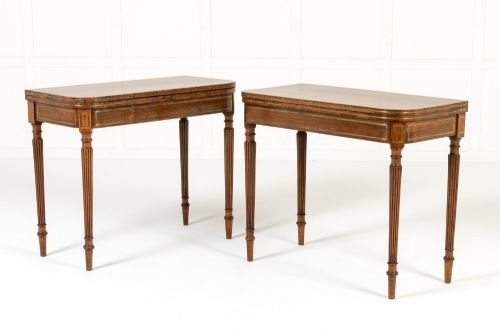
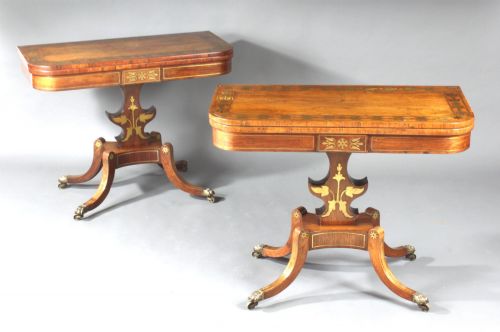
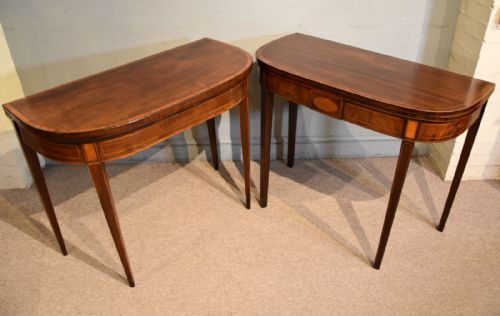


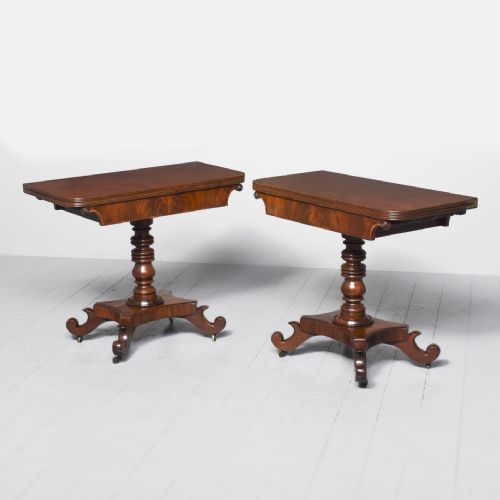

Pair Fold Top Tables
Pair fold top tables are dual-purpose surfaces opening to reveal baize-lined playing spaces or extended timber leaves, offering both elegance and practical versatility.
Pair Fold Top Tables
Pair fold top tables include card tables, tea tables, and games tables spanning the 18th century, Regency, George III, George IV, William IV, and Victorian periods. These pieces function as compact console or side tables when closed and open up to double their surface area for entertaining or dining.
The inventory on this page showcases mahogany and rosewood forms, alongside satinwood inlay, amboyna with porcelain plaques, and oriental folding side tables from 1920. Buyers encounter matched sets and dual items designed to flank a fireplace or balance a formal room.
Origin variations range from English workshops to Anglo-Indian production, reflecting styles such as Sheraton demi lune designs, octagonal bone inlay, and carved oriental construction. Each pair demonstrates the historical demand for adaptable furniture that transforms from a discreet wall table into an active surface.
How they were made
Cabinetmakers constructed these tables using dense timbers like mahogany and rosewood, frequently incorporating boxwood and satinwood inlay to define the edges and borders. Secondary woods provided structural stability beneath the polished show surfaces of the folding tops.
The folding mechanism relied on hinged leaves that swivel or flip open, supported by swing legs or pivoting frame sections that bear weight when the table is fully extended. Specialised interiors often incorporate green baize surfaces for card playing or polished timber recesses for serving tea.
Some tables hide secret compartments beneath their folding tops, ready to swallow stray playing cards and elusive counters after a spirited evening of Regency whist.
What varies in quality
Quality rests in the precision of the timber matching across both pieces in the pair, ensuring grain patterns and colours align harmoniously when positioned together in a room. Superior examples exhibit crisp carving on the legs and meticulous execution of stringing or satinwood inlay.
The integrity of the pivoting and folding mechanism dictates the daily usability of the table, where higher grade pieces retain smooth movement without sagging when the top is open. Finer construction is also visible in the choice of secondary timbers and the depth of the hand-polished finish.
The Pair Fold Top Tables Glossary
- Foldover top
- A hinged wooden surface that doubles the table area when opened flat. This design allows a console or side table to convert instantly into a card or tea table.
- Baize
- A woolen textile used to line the playing surface of card and games tables. It provides a soft, tactile mat that dampens the sound of dice and protects the counters.
- Demi lune
- A half-moon shape with a curved front and a straight back edge designed to sit flat against a wall. These tables frequently feature inlaid satinwood and fold open on a pivoting frame.
- Stringing
- A thin line of contrasting wood inlay used to outline the edges and borders of table tops and aprons. This decorative technique highlights the geometry of Georgian and Regency pieces.
Pair Fold Top Tables: Frequently Asked Questions
What is a pair fold top table used for?
These tables served primarily for social gatherings, functioning as compact console pieces against a wall before opening out for card games or tea service. The dual configuration allowed households to save floor space during the day while retaining the ability to host guests.
In modern rooms, they continue to serve as versatile side or display surfaces that expand when extra table space is required for entertaining.
How do I identify a Regency fold top table?
Regency pieces often display darker exotic timbers like rosewood, frequently accented with brass inlay, bold column supports, or carved paw feet. The overall aesthetic draws on classical Greco-Roman motifs with clean architectural lines and strong contrasts.
Examining the construction of the interior compartments and the timber grain beneath the finish helps confirm the period of manufacture.
How should I care for a rosewood fold top table?
Protect the polished timber surface from direct sunlight and moisture by using coasters and avoiding placement near heat sources. Regular dusting with a soft, dry cloth preserves the lustre of the wax or French polish.
When opening the top, support the hinged leaf carefully to prevent undue stress on the pivots and the supporting frame.
What is the difference between a card table and a tea table?
Card tables typically feature an interior lined with baize or felt designed for playing games, sometimes incorporating small corner wells for counters and coins. Tea tables generally feature a polished timber interior surface intended for serving tea and displaying porcelain.
Many period examples bridge both categories, serving interchangeably for dining, conversation, and leisure activities.