

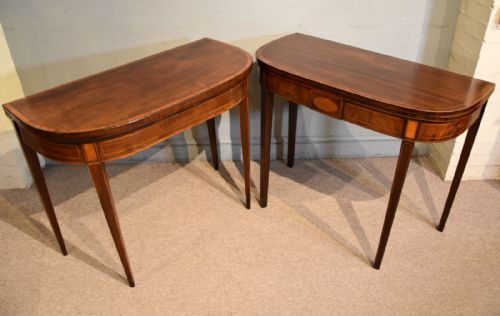

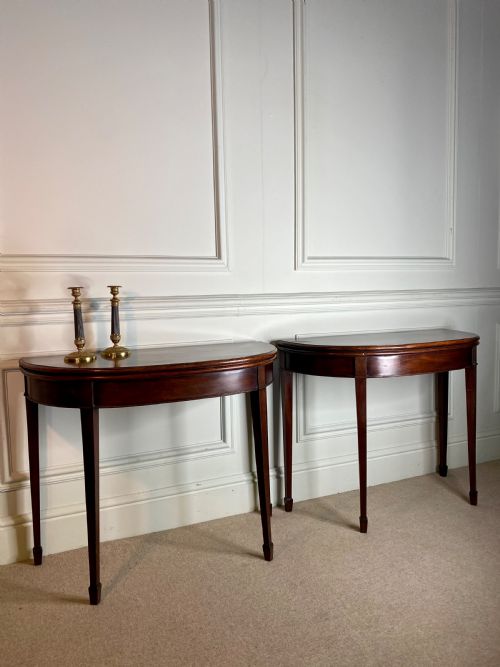


Pair Card Tables
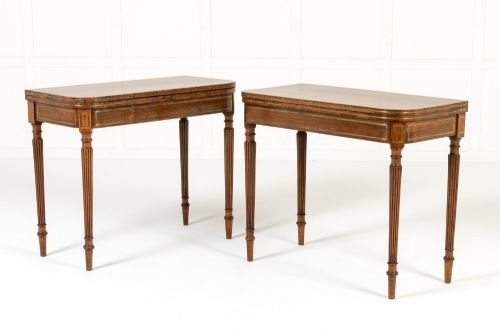
Pair card tables bring balanced symmetry to a room, offering fold-over surfaces designed for evening entertainment in the eighteenth and nineteenth centuries.
Understanding pair card tables
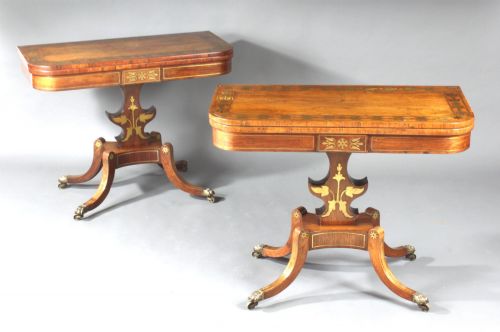
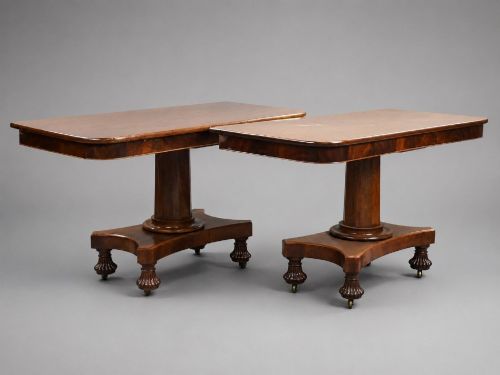
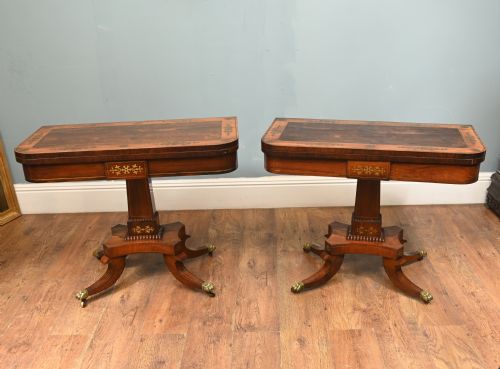
When searching for pair card tables, buyers encounter matching sets created to flank a fireplace or mirror in formal reception rooms. These dual pieces functioned as tea tables by day and gaming tables by night, featuring hinged tops that swivel and fold open to reveal baize-lined playing surfaces.
Materials and construction methods
Cabinetmakers utilised dense native and exotic timbers, predominantly mahogany and rosewood, alongside decorative veneers like satinwood, burr walnut, and flame mahogany. Oak frequently served as a sturdy secondary wood for internal frames and structural linings.
Surface enrichment relied on precision craftsmanship, incorporating contrasting stringing, marquetry, and brass inlay. Fine brass mounts and mounts of gilt bronze further accentuated the geometric lines of late eighteenth-century and Regency specimens.
Retail Price Guide 2026
Typical UK retail prices for pair card tables, calculated from the Sellingantiques database of over a million retail prices indexed since 2003. This retail price guide relies exclusively on Sellingantiques data; no external sources or auction records are used, so the figures do not describe the wider market.
The archive records documented pairs from English, Scottish, Irish, French, and Italian workshops.
Distinctions in craftsmanship
The distinction between standard examples and superior pieces rests on the choice of timber and the precision of the cabinetwork. High-ranking tables display richly figured grain, seamless matching across the folding leaves, and crisp, uncompromised inlay.
Structural integrity and the refinement of the swivel-action mechanism also separate workshop levels. Finer examples maintain absolute stability when open, with tight hinge tolerances and finely carved or reeded pillar supports.
George Oakley·Lamb of Manchester
The Pair Card Tables Glossary
- Demi-lune
- Half-moon shape, descriptive of tables with a flat rear edge designed to stand flush against a wall. This form became particularly popular during the late eighteenth century.
- Stringing
- Thin lines of contrasting timber inlaid into the surface to create geometric borders. Cabinetmakers utilised boxwood or ebony against darker woods like mahogany.
- Flame mahogany
- A veneer cut from timber where the branch meets the trunk, producing a rippling, flame-like pattern. It defines the visual impact of many nineteenth-century surfaces.
- Baize
- A coarse woollen fabric traditionally used to line the playing surface of gaming tables. It provides a soft, durable texture for card play.
- Reeded
- A decorative moulding consisting of parallel convex strips carved directly into wooden legs or pillar supports. This detail is characteristic of Regency design.
Frequently Asked Questions
How were pair card tables arranged?
These tables typically stood against opposite walls or flanked a fireplace when closed. Their symmetrical design provided visual balance to a formal drawing room.
When evening arrived, servants or hosts moved the tables into the centre of the room and unfolded the tops for card games or social assembly.
Can these tables still function for games?
Most surviving examples retain their hinged folding mechanism and internal storage well for cards and counters. The baize surfaces often show age, but the tables remain mechanically sound for display and occasional use.
Careful handling of the swivel top preserves the original pivot joints and prevents strain on the rear gate leg.
How do I identify a Regency period table?
Regency pieces often incorporate bold rosewood timbers, brass inlay, and saber legs or pedestal bases with paw feet. The aesthetic draws heavily on classical Greco-Roman motifs.
Cabinetmakers of this era favoured dramatic contrast between dark woods and bright metal highlights, departing from earlier Georgian restraint.
What is the difference between a tea and card table?
Many eighteenth and nineteenth-century examples served dual purposes as both tea and card tables depending on household needs. The internal well often stored tea caddies by day and gaming paraphernalia by night.
Because the dimensions and folding actions were identical, makers frequently designated them for interchangeable domestic functions.