



Pair Art Deco Bedside Lockers
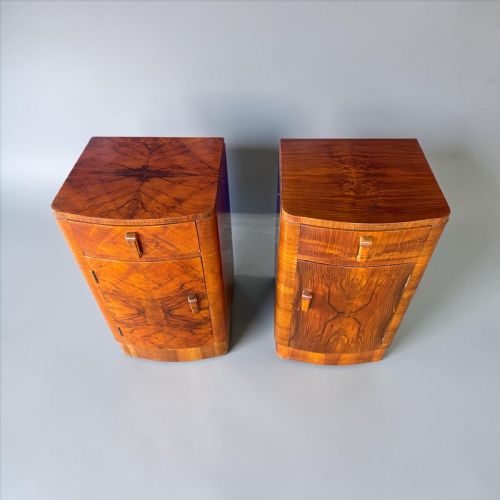
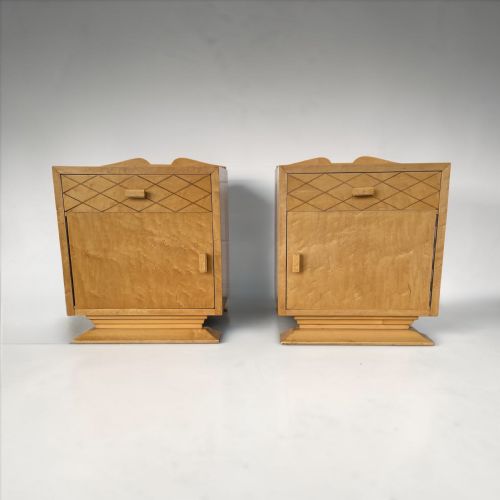
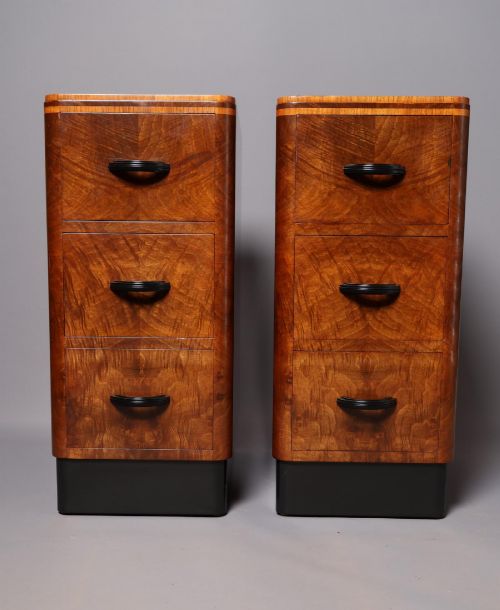
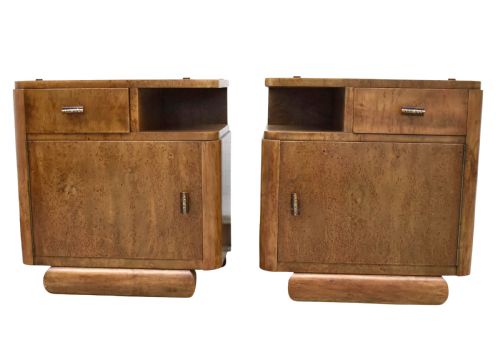
Pair art deco bedside lockers deliver compact storage with geometric symmetry, bringing period character to a bedroom.
Pair Art Deco Bedside Lockers
These matched pairs of bedside tables and cabinets provide enclosed storage and display surfaces beside the bed. Most examples date from the 1930s, spanning English, French, Scandinavian, and Italian workshops.
The inventory covers rectangular bedside cabinets alongside drum-shaped tables and lamp tables. Some pieces incorporate marble tops above enclosed cupboards, while others rely on wooden surfaces.
Buyers encounter walnut, mahogany, oak, and birch veneer across the selection. The overarching style remains strictly art deco, ranging from minimalist Scandinavian lines to decorative French forms.
How they were made
Joiners built these cabinets using sturdy timber carcases faced with decorative wood veneers. Walnut, mahogany, burr elm, and birch veneers created striking grain patterns across the front doors and top surfaces.
Brass fittings provided functional handles and structural accents that defined the aesthetic. Marble slabs were fitted to the tops of select French cabinets to offer durable and decorative surfaces.
Listings feature items dated across the 1920s, 1930s, and 1940s, constructed from walnut, mahogany, oak, burr elm, and birch veneer.
What varies in quality
The choice of surface veneer largely dictates the visual impact of each pair. Figured grains such as burr elm and rich walnut elevate the appearance beyond standard mahogany or plain oak.
Precision in the geometric cabinet shaping and the integration of matching grain patterns across both pieces separate standard production from finer work. The inclusion of original brass hardware and fitted marble tops further distinguishes the superior examples.
The Pair Art Deco Bedside Lockers Glossary
- Veneer
- A thin slice of decorative wood applied over a stable secondary timber carcase. This technique allowed cabinetmakers to display striking grain patterns across flat surfaces.
- Drum-shaped
- A cylindrical furniture form featuring curved doors wrapping around a circular storage space. These tables offer a softer profile than traditional rectangular cabinets.
- Burr elm
- A mottled timber grain resulting from tree growth irregularities, prized for its swirling patterns. It appears frequently on high-end art deco veneered furniture.
- Marble top
- A polished stone slab fitted to the upper surface of a bedside cabinet. It provided a heat-resistant and easily cleaned surface for daily use.
Pair Art Deco Bedside Lockers: Frequently Asked Questions
What periods do these cabinets cover?
The inventory spans pieces produced across the 1920s, 1930s, and 1940s. The majority of items originate from the 1930s.
Design influences during this timeframe stretch across French, Scandinavian, and Italian regional workshops.
How were these lockers used?
These pieces sat beside the bed to hold personal items, books, and lighting within easy reach. Enclosed cupboards kept bedroom necessities neatly out of sight.
Matching pairs ensured visual symmetry on both sides of the bed frame.
What materials appear most often?
Walnut and mahogany form the primary wood structures, often enhanced by birch or burr elm veneers. Brass hardware provides contrast through handles and decorative mounts.
Selected French cabinets incorporate marble tops to create durable upper surfaces.
How do I spot different regional styles?
French cabinets frequently incorporate contrasting marble tops and expressive veneering. Scandinavian examples tend toward cleaner lines and lighter wood tones.
Italian pieces explore distinct shapes such as circular drum configurations.