


Pair 19th Century Commodes
When you want symmetry in a bedroom or drawing room, pair 19th century commodes deliver matching presence and surface space.
Pair 19th Century Commodes
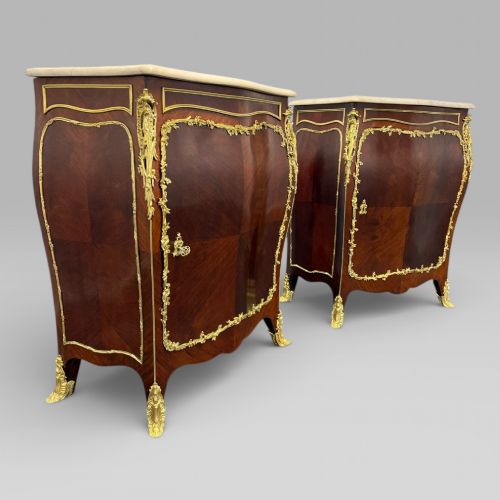
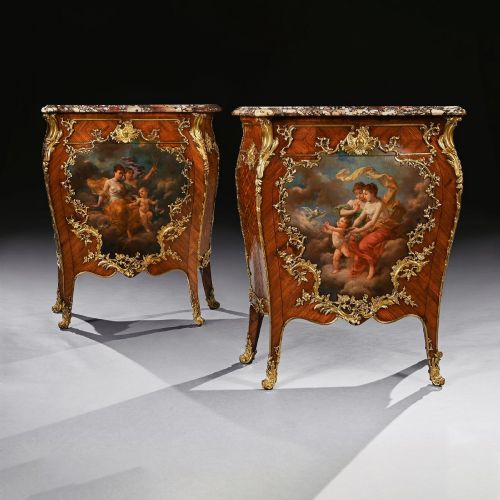
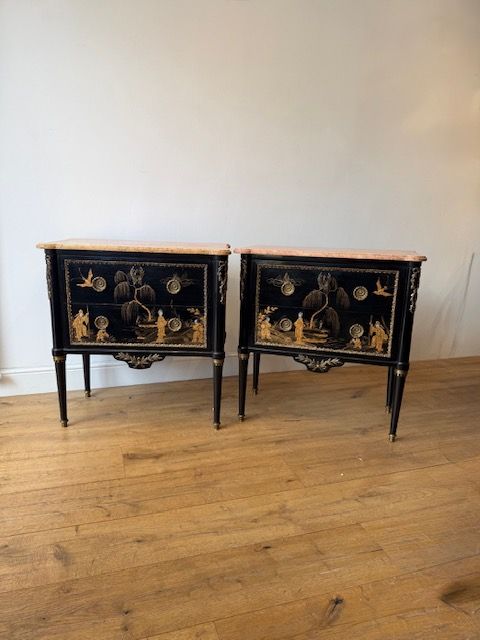
A pair 19th century commodes search uncovers matched sets of low storage chests, predominantly French and Swedish pieces from the nineteenth century alongside Victorian examples. These take the form of bombé cabinets, petite bedside chests, side cabinets, and painted drawer units.
The selection ranges from grand walnut, kingwood, and mahogany case pieces with marble tops to Scandinavian country painted chests and Gustavian influenced designs. Buyers meet both formal Revival styles and restrained provincial versions across this category.
How they were made
Cabinet makers built these carcasses in pine, walnut, or mahogany, applying fine veneers of kingwood, tulipwood, burr elm, or satinwood in parquetry and marquetry patterns. Surface decoration also involved hand painting on timber and lacquer work such as Vernis Martin.
Mounts in ormolu, gilt bronze, and brass accent the corners and handles, while tops frequently consist of fitted marble or faux marble slabs. Carved elm, giltwood, and lacquer complete the range of materials recorded across these workshops.
Some nineteenth century bedside commodes doubled as discreet night furniture, proving that Victorians valued hidden utility alongside grand marquetry.
What varies in quality
Quality rests upon the ambition of the timber work and the crispness of the secondary mounts. Pieces featuring detailed marquetry, matched veneer grains, and heavy fire-gilt bronze demonstrate superior workshop standards compared to simpler painted pine alternatives.
The integration of heavy marble slabs and the structural joinery of curved bombé drawers distinguish high cabinet making from standard regional production. Proportion and the precision of revival details dictate the standing of each matched pair.
E. Kahn·J.H. Riesener
The Pair 19th Century Commodes Glossary
- Commode
- A low chest of drawers or cabinet designed for domestic storage. Originating in France, the form evolved from heavy cupboards into decorative drawer units.
- Bombe
- A swollen or outwardly curving furniture shape. This curved profile requires skilled veneer work to follow the complex contours.
- Ormolu
- Gilt bronze mounts applied to furniture for decoration and edge protection. The technique involves fusing gold and mercury to a bronze base.
- Parquetry
- Geometric wood inlay patterns resembling mosaics. Makers arrange contrasting timber veneers to create repeating shapes on drawer fronts and tops.
- Vernis Martin
- European imitation of East Asian lacquer work developed in France. The technique uses multiple resin layers to achieve a glossy finish.
Pair 19th Century Commodes: Frequently Asked Questions
Where do people place pair 19th century commodes?
Buyers position these matching pieces on either side of a bed, flanking a fireplace, or balancing a large hallway. Their identical proportions create visual symmetry in formal and domestic interiors alike.
The surface space accommodates lamps and decorative objects while the drawers provide concealed storage for everyday items.
How do French and Swedish commodes differ?
French examples lean towards ornate veneered surfaces, curved bombé shapes, marble tops, and gilded bronze mounts. They reflect Louis XV and Louis XVI revival tastes.
Swedish pieces tend to favour bright hand painted finishes, pine construction, and restrained Gustavian lines. They offer a lighter aesthetic suited to simpler interiors.
What is a petit commode?
A petit commode is a smaller version of the standard chest of drawers, often used as a bedside cabinet or side table. These compact pieces retain the decorative detailing of their larger counterparts.
Cabinet makers scaled down the proportions to fit narrower spaces while keeping multiple functional drawers.
How do you care for marble top commodes?
Marble surfaces require gentle cleaning with warm water and mild soap to avoid etching the stone. Acidic liquids like wine or citrus should be wiped away immediately to protect the polish.
For the timber bodies, a regular application of traditional wax maintains the lustre of veneers and painted finishes.