
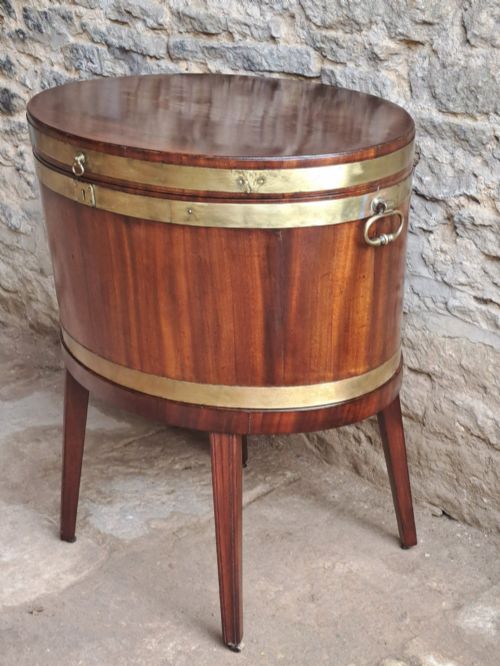

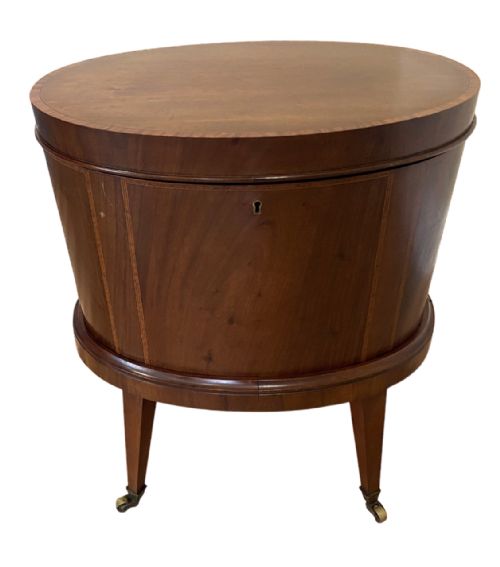


Oval Wine Chest
These oval wine chest pieces are classic cellarettes and coolers designed to hold bottles in style.
Oval Wine Chest
When you search for an oval wine chest, you are looking at substantial wooden vessels designed to chill or store wine bottles during formal dining. The pieces you meet on this page span the eighteenth century, the Regency period, and later Victorian revivals.
Most examples take a distinct oval form and are built from rich timber such as mahogany or elm, often resting on their original stands. They appear under various historical names including cellarettes and wine coolers.
The domestic role of these vessels was to keep wine close to the dining table while locking the bottles away from servants. They represent a specific intersection of practical dining room furniture and fine cabinet making.
How they were made
Cabinet makers constructed these vessels using solid timbers like mahogany and figured elm, shaped into curved staves or panels held together with structural framing. Many examples feature substantial brass banding or bronze mounts that added both decorative contrast and structural strength.
Surface decoration often involved contrasting veneers and stringing, utilising boxwood and satinwood inlay to create geometric or classical motifs. Interiors were traditionally lined to hold bottles safely alongside ice or water.
Elm wood was chosen for some of these coolers because its interlocking grain made it naturally resistant to splitting.
What varies in quality
The detailing of the metalwork also separates ordinary pieces from superior examples. Finely cast bronze mounts and robust, heavy brass binding indicate a higher grade of manufacture than thin or plain fittings.
The Oval Wine Chest Glossary
- Cellarette
- A lockable container used for storing wine bottles in the dining room. They were frequently kept under the sideboard or mounted on their own low stand.
- Brass bound
- A descriptor for wooden vessels secured with heavy brass bands around the exterior. This technique provided extra strength to containers holding heavy bottles and liquid.
- Boxwood inlay
- A method of embedding light-coloured boxwood into darker timber surfaces to form contrasting lines or patterns. It is characteristic of finer Sheraton period pieces.
- Patina
- The surface sheen and mellow depth developed by old wood over centuries of handling and polishing. A good patina is valued by collectors for its authenticity.
Oval Wine Chest: Frequently Asked Questions
What is an oval wine chest used for?
These pieces were originally designed to hold wine bottles and ice in the dining room during meals. They kept the wine chilled and secured the bottles when not in use.
Today, they make striking decorative floor pieces or can be utilised to display plants and hold logs by the fireplace.
How do I tell an 18th century piece from a later revival?
Eighteenth century examples display the natural timber grain, softer hand-cut dovetails, and a deep patina acquired over long periods of use. The wood feels different to the touch compared to later machinery-cut timber.
Later Victorian revival pieces often feature brighter, more uniform wood finishes and slightly heavier, more rigidly applied brass mounts.
Are these cellarettes still lined for ice?
Most surviving examples have lost their original metal or lead interior linings due to centuries of moisture and corrosion. Many now feature clean wooden interiors suitable for modern domestic display.
Finding one with an original fitted interior is uncommon, though not strictly necessary for enjoying the piece as furniture.
Where should I place an oval wine chest in a modern room?
Because of their curved oval shape and low stance, these pieces work well standing independently in a dining room, hallway, or living space. They do not require a wall for support and look best when viewed from all angles.
Keep them away from direct heat sources and strong sunlight to protect the polish and prevent the wood from drying out.