





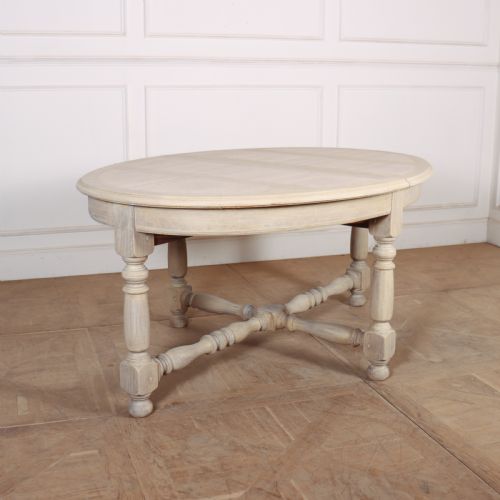


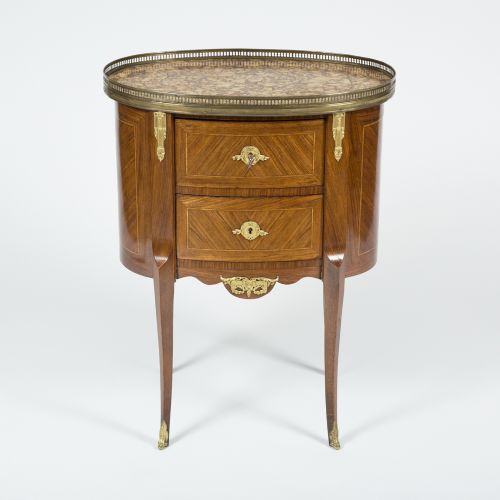
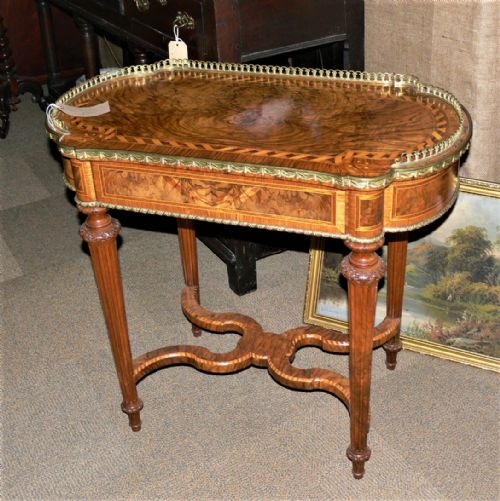


Oval Parquetry Table
An oval parquetry table brings geometric wood floors up to eye level, offering a soft footprint for a drawing room or salon.
Oval Parquetry Table
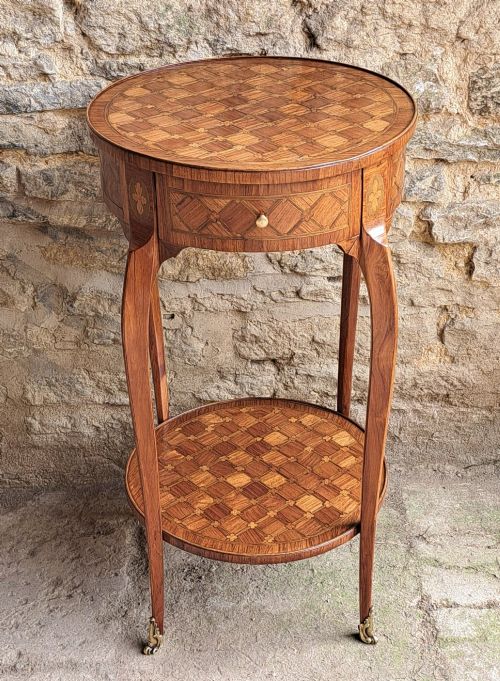
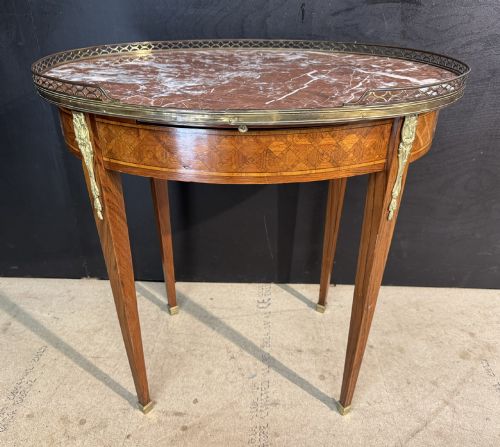
An oval parquetry table displays a geometric wood mosaic top framed by curved rails, appearing most often in nineteenth-century French and Georgian forms. These pieces serve as side tables, centre tables, and occasionally coffee tables within domestic interiors.
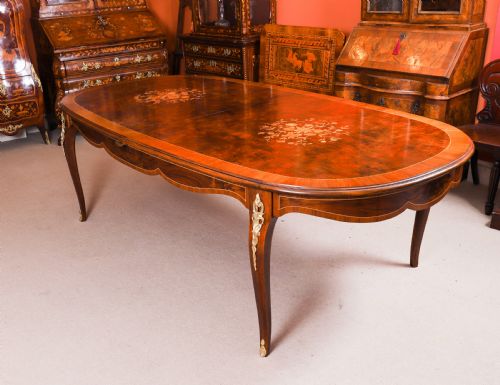
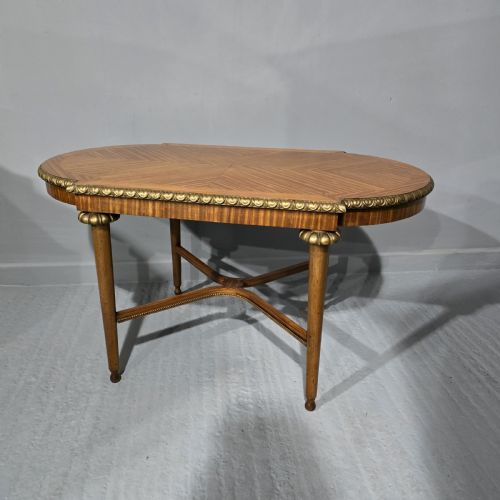
The inventory on this page shows walnut, kingwood, and satinwood constructions, frequently drawing on Louis XV and Louis XVI revival styles. Buyers encounter everything from compact occasional tables to larger dining pieces.
Makers and designers working in these French and English traditions utilised distinct proportions, ranging from slender cabriole legs to tapered neoclassical supports. Each piece balances decorative surface work with practical utility.
Materials and construction
Cabinetmakers constructed these tables by laying thin geometric veneers of kingwood, walnut, and satinwood onto a solid secondary timber substrate. This parquetry technique created interlocking patterns that resisted warping better than solid boards.
Many examples incorporate cast or chased ormolu mounts and brass edgings to protect the vulnerable curved perimeters. Marble tops also appear inset into the wooden frames, providing a cool and durable surface.
Frames join together using traditional tenons and dowels, hidden beneath layers of polished veneer. The precision of the initial sawing dictates how tightly the individual wood blocks fit together over the curves.
Oval Parquetry Table Retail Price Guide 2026
Typical asking prices for oval parquetry table among the pieces listed under this phrase on Sellingantiques today, from the lower quarter to the upper quarter. They describe what is for sale here now, not the wider market.
The recorded pieces span nineteenth-century revival styles alongside Georgian Pembroke and occasional formats.
Assessing quality and execution
The hierarchy of quality rests on the precision of the veneer cutting and the harmony of the timber selection. Finer tables display exact grain matching across the curved perimeter without filler in the geometric joints.
Superior execution shows in the crispness of the ormolu mounts and the weight of the underlying timber carcase. Lesser examples rely on printed patterns or hasty assembly where the wood blocks meet the brass rim.
The age of the timber and the depth of the hand-applied polish further separate workshop tiers. A well-preserved surface retains natural chatoyancy rather than a flat, modern sheen.
Charles Topino·Francois Linke
The Oval Parquetry Table Glossary
- Parquetry
- A geometric mosaic of wood veneers used to cover floors or furniture surfaces. It creates repeating patterns like cubes or bricks.
- Kingwood
- A dense, heavily figured Brazilian timber with dark violet-brown stripes, favoured by eighteenth and nineteenth-century cabinetmakers. It polishes to a deep lustre.
- Ormolu
- Gilded bronze mounts applied to furniture edges and legs for decoration and protection. Makers cast and chased these metal elements by hand.
- Satinwood
- A pale, lustrous timber with a satiny sheen, originating from the tropics. It provides high contrast when banded alongside darker woods like kingwood.
- Cabriole leg
- A furniture leg that curves out at the knee and tapers in at the ankle, mimicking animal limbs. This form defines much of the Louis XV style.
Oval Parquetry Table: Frequently Asked Questions
What is parquetry?
Parquetry is an inlaid woodwork technique where small geometric blocks of different coloured timbers are fitted together to form a decorative pattern. Cabinetmakers use this method primarily on table tops and cabinet doors to catch the light from different angles.
Unlike marquetry, which depicts pictorial scenes like flowers or landscapes, parquetry relies strictly on repeating geometric shapes such as cubes, chevrons, and triangles.
How were these tables used?
These tables functioned as movable furniture in reception rooms, serving for tea, card games, or displaying decorative objects. Their curved profiles allowed servants and guests to circulate easily around them in crowded salons.
Smaller side and occasional versions stood against walls or beside seating, while centre tables occupied the middle of the room as a visual anchor.
How do I care for a veneer top?
Protect the wooden surface from direct sunlight and sudden humidity changes to prevent the underlying veneers from lifting or cracking. Use coasters and avoid placing damp items directly onto the polished wood.
Apply a traditional beeswax polish sparingly and buff with a soft cloth to maintain the finish without building up heavy wax layers.
How do I date an antique table?
Examine the construction methods visible underneath and inside the frame, looking at the type of wood used for the secondary carcase and the hand-cut joinery. Tool marks and fastener types often point to specific manufacturing decades.
Compare the overall style, such as the proportions of the legs and the choice of veneer species, against known period design books and comparable authenticated examples.