

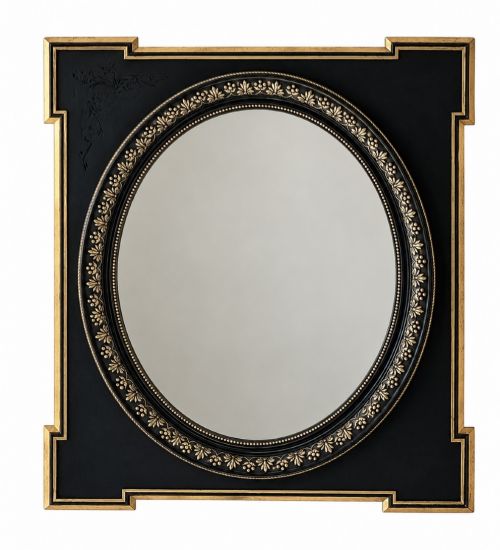
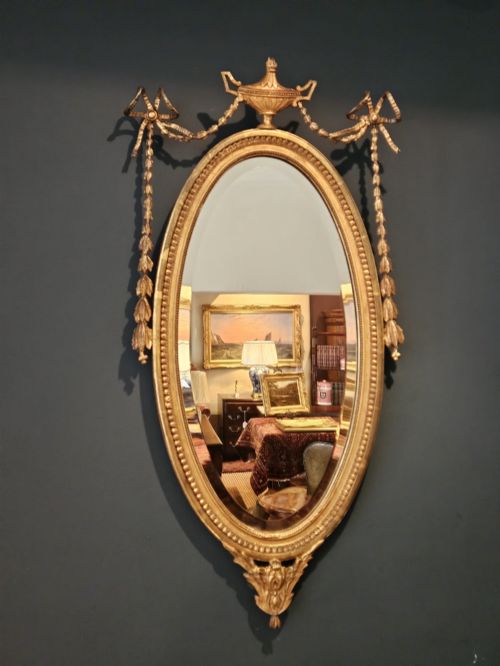
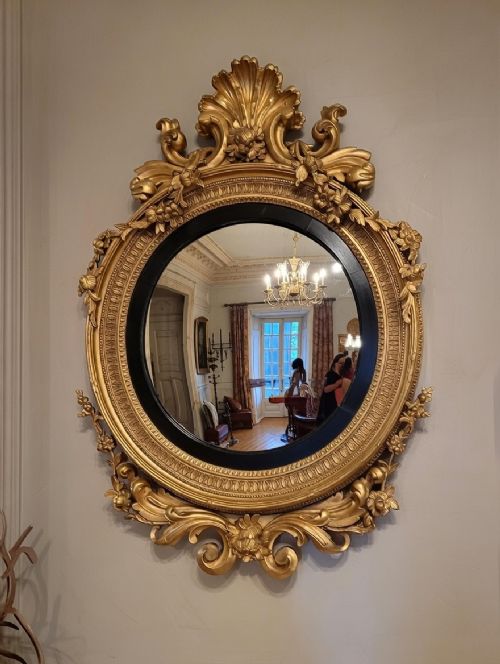


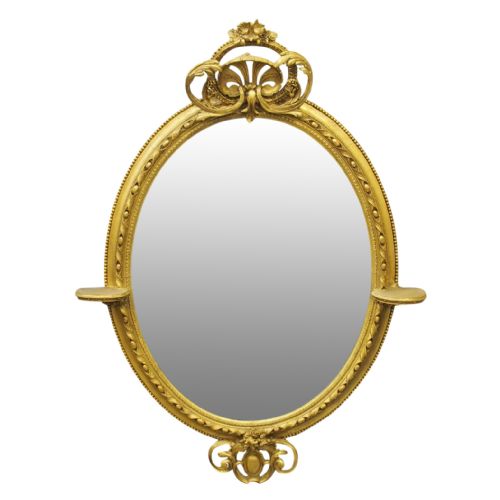

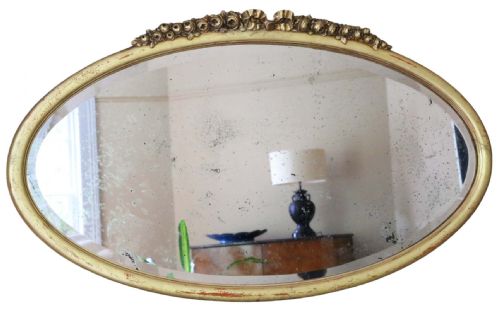

Oval Gilt Mantle Mirror
An oval gilt mantle mirror brings scale and reflection to a room, drawing the eye with its curved frame.
Oval Gilt Mantle Mirror
An oval gilt mantle mirror serves as a grand focal point above a fireplace or along a principal wall. The selection spans the nineteenth century, taking the form of large overmantle and wall mirrors.
Most examples originate from the nineteenth century, including Regency and Victorian periods. Pieces frequently integrate styles such as French Neoclassical, Rococo Revival, and Adam, alongside simpler designs.
Makers and craftsmen of the era produced these items as both functional looking glasses and decorative statements. Surviving pieces range from plain frames to ornate versions with elaborate friezes and candle sconces.
How they were made
Frames rely primarily on giltwood, gesso, and composition applied over a wooden base, often featuring carved details or moulded ornament. Mahogany appears as a primary wood in certain pieces, sometimes paired with parcel-gilt or ebonised elements.
Mirror glass is set within the frame, occasionally accompanied by marginal glass sections that enhance the reflective surface. Gilding techniques provide the characteristic golden finish seen across the nineteenth-century examples.
Oval Gilt Mantle Mirror Retail Price Guide 2026
Typical asking prices for oval gilt mantle mirror among the pieces listed under this phrase on Sellingantiques today, from the lower quarter to the upper quarter. They describe what is for sale here now, not the wider market.
Certain grand examples incorporate candle sconces, designed to multiply the flickering evening light across the room.
What varies in quality
Quality depends on the crispness of the moulding and the depth of the carved or applied ornament on the frame. Elaborate details such as laurel wreaths, eagle motifs, ribbons, and griffin friezes distinguish superior work from simpler designs.
The integrity of the original gilt surface and the preservation of the underlying gesso or wood structure dictate the standing of a piece. Examples retaining their original mirror glass and secondary woods carry greater historical consistency.
The Oval Gilt Mantle Mirror Glossary
- Giltwood
- Wood that has been prepared and coated with gold leaf. This surface treatment gives the frames their characteristic metallic sheen.
- Gesso
- A plaster-like mixture applied to wooden frames as a base for gilding. It allows craftsmen to mould intricate decorative reliefs.
- Composition
- A moulded material made from Whiting, oil, resin, and glue used for rapid ornament production. It is commonly found on nineteenth-century mirror frames.
- Overmantel
- A large mirror designed to hang specifically above a mantelpiece or fireplace. These pieces often dictate the decorative scheme of a room.
- Parcel-gilt
- A finish where only specific parts of an object are gilded, leaving other areas like exposed mahogany visible. This creates a contrast between the wood grain and the gold leaf.
- Girandole
- A branched wall mirror holding candle sconces. The candles multiply the light reflection in the glass.
Oval Gilt Mantle Mirror: Frequently Asked Questions
Where should I hang an oval gilt mantle mirror?
These mirrors traditionally sit centrally above a fireplace mantel, where their curved silhouette breaks the straight lines of a chimney breast.
They also function effectively on large living room or hallway walls to bounce light into the space.
How do I identify a Regency period mirror?
Regency pieces often incorporate classical motifs such as laurel wreaths, eagles, and restrained moulding styles popular in the early nineteenth century.
They typically display precise proportions and clean architectural lines compared to later Victorian revivals.
What is the difference between a wall mirror and an overmantel mirror?
Overmantel mirrors are generally larger and proportioned specifically to span the width of a fireplace surround.
Standard wall mirrors are built in various sizes for general placement around a room.
Are these mirrors heavy to hang?
Due to the dense wooden frames, gesso, and large glass plates, these pieces carry substantial weight.
Secure wall fixings into solid masonry or proper wall studs are essential for safe installation.