



Oval Gem Cluster Ring
An oval gem cluster ring places a vibrant central stone within a bright border of smaller gems, offering immediate brilliance and enduring character.
Oval Gem Cluster Ring
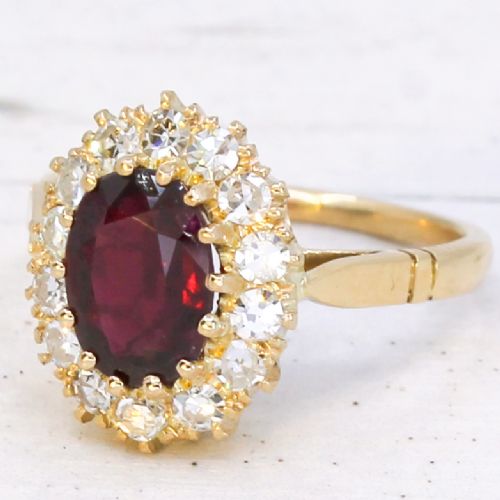
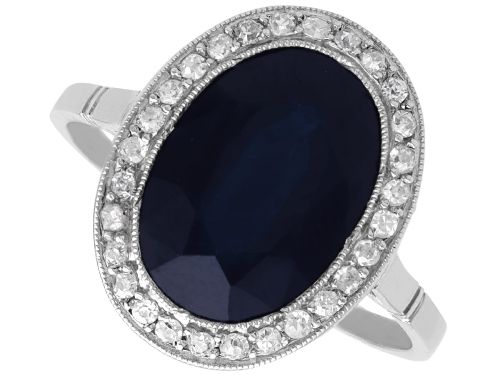
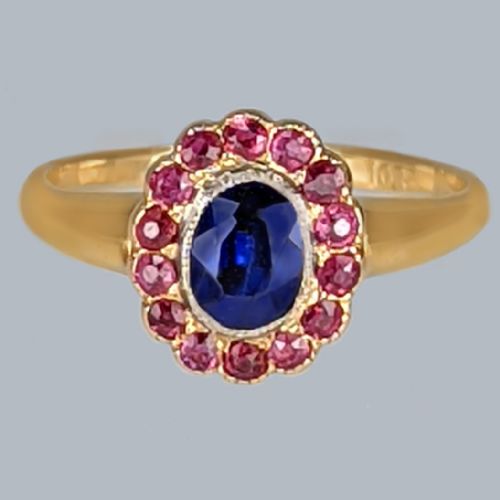
An oval gem cluster ring centres upon a prominent oval gemstone, most frequently sapphire, ruby, emerald, or diamond, encircled by a border of smaller accent diamonds or pearls. This form spans multiple eras, with examples appearing across Victorian, Edwardian, Art Deco, and mid-century periods.
The most common variations on this page combine sapphire or ruby centres with gold or platinum bands. Pieces range from delicate Edwardian halo designs to bolder Art Deco configurations utilising geometric diamond arrangements.
What varies in quality
The fineness of an oval gem cluster ring depends upon the saturation and clarity of the central stone, whether sapphire, ruby, emerald, or diamond. Superior examples feature well-matched accent stones and precise claw or bezel work that holds each gem securely without obscuring its facets.
Construction quality shows in the weight and durability of the metal band, particularly where adjustable shanks or delicate gallery wirework meet the main cluster. Finer pieces demonstrate careful attention to symmetry in the surrounding halo and balanced proportions between the central oval gem and its frame.
The listings here include rings from the Edwardian, Victorian, Art Deco, and mid-century periods, utilising platinum alongside 9ct and 18ct gold.
The Oval Gem Cluster Ring Glossary
- Cluster ring
- A ring design featuring a prominent central gemstone surrounded by a group of smaller stones. This arrangement maximises surface brilliance and creates a substantial visual presence on the hand.
- Halo ring
- A setting style where a central gemstone is encircled by a continuous border of smaller accent stones, typically diamonds. The surrounding circle enhances the apparent size and light return of the middle gem.
- Old cut
- A diamond cutting style prevalent in antique and period jewellery, characterised by a smaller table, higher crown, and open culet. These cuts were shaped by hand to catch candlelight and low-light environments.
- Rubover setting
- A mounting technique where a thin rim of metal is pushed over the edge of the gemstone to hold it in place. This creates a smooth, continuous outline around the stone.
- Cabochon
- A gemstone shape with a smooth, rounded, convex top and a flat or slightly curved base rather than faceted surfaces. This finish is typical for opaque or translucent stones like opals and jadeite.
Oval Gem Cluster Ring: Frequently Asked Questions
What is an oval gem cluster ring?
An oval gem cluster ring is a piece of jewellery featuring a central oval stone framed by smaller accent gems, usually diamonds. This design layout creates a distinct floral or halo effect on the finger.
These rings appear in various historical periods, incorporating materials like platinum, yellow gold, and white gold alongside sapphires, rubies, and emeralds.
Are these rings suitable for everyday wear?
Many of these rings can be worn daily, provided the materials and stone hardness match your lifestyle needs. Harder stones like diamonds, sapphires, and rubies withstand regular use better than softer materials.
Checking the security of the settings and the thickness of the band ensures the ring remains durable over time.
What is the difference between Edwardian and Art Deco clusters?
Edwardian cluster rings typically feature lacy, intricate platinum work with delicate floral motifs and milgrain detailing. They emphasise graceful lightness and traditional gemstone arrangements.
Art Deco rings introduce bolder geometric lines, sharp contrasts between white metals and coloured stones, and stylised symmetry that reflects 1920s and 1930s design principles.