
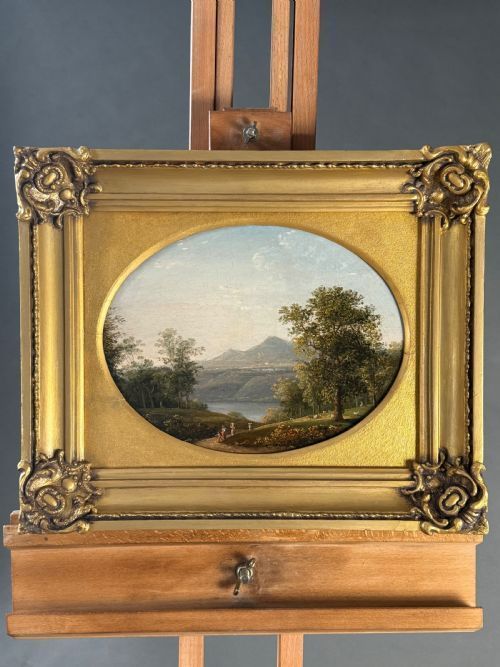
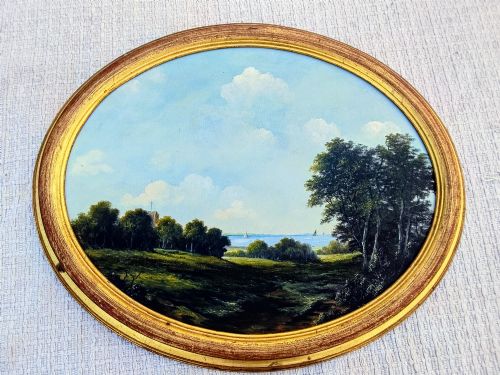


Oval Framed Landscape Painting
An oval framed landscape painting brings depth and architectural interest to a wall in a way standard rectangles cannot manage.

Oval Framed Landscape Painting
When you search for an oval framed landscape painting, you encounter works spanning the eighteenth, nineteenth, and twentieth centuries, executed in oil on canvas, watercolour, and gouache. These pieces encompass pastoral scenes, sea views, and grand tour compositions housed within fitted surrounds.
The format itself influences the composition, drawing the eye toward a central focus while softening the corners of a room. Most examples on this page date from the nineteenth century, reflecting Victorian and traditional maritime interests.
How they were made
Painters applied oil and watercolour onto canvas and paper, capturing pastoral and marine subjects within curved boundaries. Frames were constructed from wood and finished with gold leaf or giltwood to accentuate the oval aperture.
Makers utilised glass to protect delicate watercolours and gouaches, while canvas works on stretchers required custom frames shaped specifically to house the curved edges.
The listings span from the eighteenth century through to the 1960s, featuring wood, canvas, and gold leaf.
What varies in quality
The distinction between tiers rests upon the skill of the brushwork and the preservation of the medium, whether oil or watercolour. Finer works display controlled handling of light, particularly in moonlight or coastal scenes, while lesser examples show stiff application.
The integrity of the frame also defines the piece, with original giltwood and gold leaf surrounds holding greater visual harmony than later replacements. The depth of the carved wooden moulding contributes significantly to the presence of the artwork on the wall.
JACOB PHILIPP HACKERT·James Hardy Junior·James Thomas Linnell·Walter Meegan·Francis Moltino
The Oval Framed Landscape Painting Glossary
- Gouache
- An opaque water-based paint that dries to a matte finish. Artists utilised this medium on paper to achieve rich colour saturation in landscape scenes.
- Grand Tour
- A cultural journey undertaken by wealthy Europeans during the eighteenth and nineteenth centuries. Paintings from this period frequently record Italian views and classical scenery.
- Pastoral landscape
- An artistic genre depicting rural life, shepherds, and agricultural scenery. These subjects dominate many of the nineteenth-century watercolours seen here.
- Oil on canvas
- Pigment bound in an oil medium applied to a stretched woven fabric support. This combination provides durability and allows for subtle blending of light and shadow.
Oval Framed Landscape Painting: Frequently Asked Questions
How do I hang an oval framed landscape painting?
These pieces require a secure wall fixing due to the weight of wooden and gilt frames. Ensure the cord or D-rings at the back are strong enough to support the vertical load.
Because the shape draws the eye immediately, position the centre of the frame at eye level. Avoid placing them in direct sunlight to protect watercolours and paper surfaces from fading.
Are these paintings usually oil or watercolour?
The selection includes both oil on canvas and works on paper, such as watercolours and gouache. Oils offer robust textures, whereas watercolours require glass protection.
Examine the surface under natural light to determine the medium. Oil works present a textured paint layer, while works on paper sit flat beneath glass.
How do I identify a nineteenth-century frame?
Nineteenth-century frames often utilise gesso over carved wood, finished with gold leaf or gilt. Age is visible in the subtle cracking of the gesso and minor wear to the gilt surface.
Inspect the reverse of the frame for old fixings and timber shrinkage. Hand-carved or moulded corners provide further indication of period manufacture.
How do I care for framed works on paper?
Works on paper demand stable indoor humidity to prevent the paper from warping or developing foxing spots. Keep them away from damp walls and extreme temperature shifts.
Clean the glass gently with a dry cloth, avoiding liquid sprays that might seep beneath the rebate and damage the paper or watercolour pigments.