






Ornate Carriage Clock
An ornate carriage clock brings together polished brass, glass panels and intricate mechanical movement, offering both functional timekeeping and fine decorative presence.
Ornate Carriage Clock
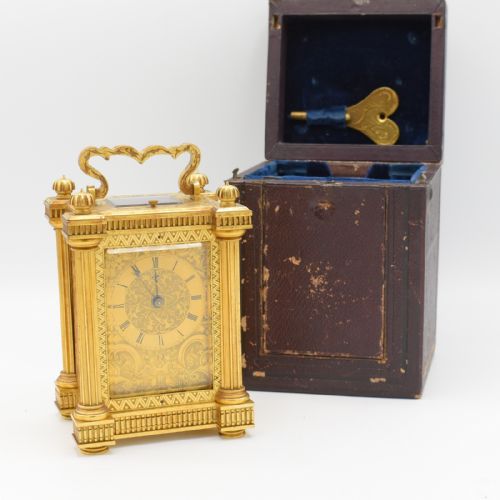
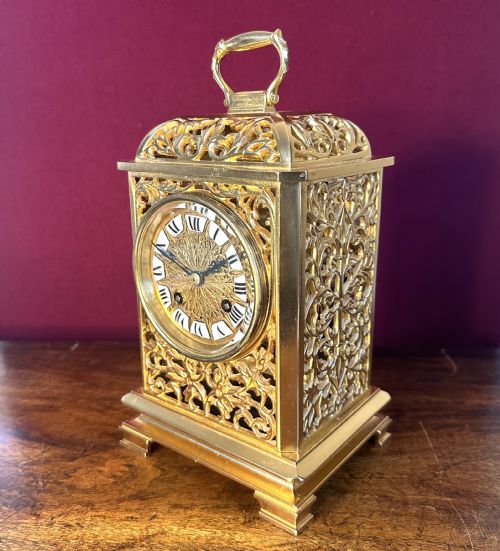
When you search for an ornate carriage clock, you encounter portable timepieces produced primarily during the Victorian and Edwardian eras, spanning from the mid-nineteenth century up to nineteen hundred. The pieces visible here heavily feature French origins alongside English makers, taking the form of carriage clocks, miniature bedside clocks and four glass mantel clocks.
Most examples you meet on this page display heavy cast or gilded brass framing, often incorporating decorative elements such as enamel dials, chased side panels and inset glass panels. These objects range from standard repeating mechanisms to grand sonnerie and alarm configurations designed for travel and domestic display.
The styles recorded in these listings draw heavily on nineteenth-century French designs, Rococo Revival, Victorian Gothic Revival and Second Empire aesthetics. Miniature proportions appear frequently alongside larger grand examples, housing sophisticated escapements and lever platforms.
Materials and construction methods
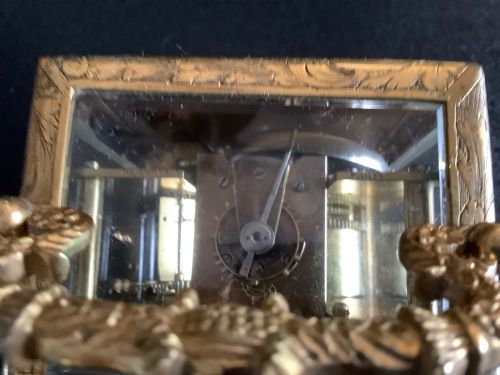
Makers constructed these clocks using brass, gilt brass, gilded brass and ormolu bronze, combined with bevelled glass panels to enclose the movement and reveal the escapement within. Silver cases, leather travel accessories, rouge marble and painted Limoges enamel also feature in the material record.
Engraving, chasing and casting techniques define the exterior metalwork, creating textured surfaces on the cases and dial masks. Interior movements rely on precision brass gear trains, platform escapements and fusee or spring-driven mechanisms.
Separating standard pieces from exceptional examples
Quality in these clocks rests upon the crispness of the cast and chased ornament on the brass case, the complexity of the internal movement such as repeaters or grand sonnerie, and the integrity of the enamel dials and painted panels. Signed movements by recognised makers elevate a piece above unmarked workshop output.
The weight and gauge of the brass, the presence of fully engraved rather than plain cases, and the sophistication of the platform escapement distinguish the finer items in the range.
Howell And James London·Brunelot·Gontard And Bolviller Paris·Thomas Cole And James Cole·Hunt And Roskell·James Moore·E.J.Dent·Paul Garnier·Luxor·Tiffany
The Ornate Carriage Clock Glossary
- Carriage clock
- A portable mechanical timepiece originally designed for travel, featuring a protective glass and metal case with a handle on top. These clocks typically utilise spring-driven movements rather than hanging weights.
- Platform escapement
- The small horizontal assembly mounted on top of the movement train that regulates the release of power. This visible component is often a mark of higher mechanical refinement.
- Repeater
- A mechanism that chimes the hours and quarters on demand when a lever or button is pressed. This complication requires extra gear trains within the clock body.
- Grand sonnerie
- A striking movement that automatically chimes both the hours and the passing quarters on bells or gongs. It represents a high level of horological complexity.
- Ormolu
- Finely ground high-carat gold mercury-gilded onto a bronze or brass base. This technique produces a warm, durable metallic lustre found on nineteenth-century French cases.
Ornate Carriage Clock: Frequently Asked Questions
What is an ornate carriage clock?
These pieces are portable mechanical timepieces housed in glazed metal frames with carrying handles on top. They combine heavy brass casting and decorative engraving with spring-driven movements.
Originating largely from nineteenth-century French and English workshops, they served as luxury travel items and decorative interior objects for mantelpieces and desks.
How do repeating mechanisms work?
A repeating mechanism sounds the current time on bells or gongs when the owner presses a button or lever on the case. This allows you to check the hour in the dark without viewing the dial.
Clocks with this feature require complex internal gear trains and careful hand-adjustment by skilled horologists.
How do I identify the period?
You can determine the age by examining the style of the brass casting, the shape of the handle, the design of the dial mask, and any signatures stamped on the backplate of the movement. Victorian and Edwardian examples often bear registration marks or maker signatures.
Later twentieth-century pieces shift toward different colour palettes, such as lapis blue cases, while nineteenth-century items favour traditional gilt brass and champlevé enamel.
Where were these clocks made?
The majority of the pieces recorded here originate from French workshops in Paris, alongside significant English contributions from London makers. Swiss examples produced specifically for the export market also appear.
French makers dominated decorative case production and complex escapement design throughout the nineteenth century.