

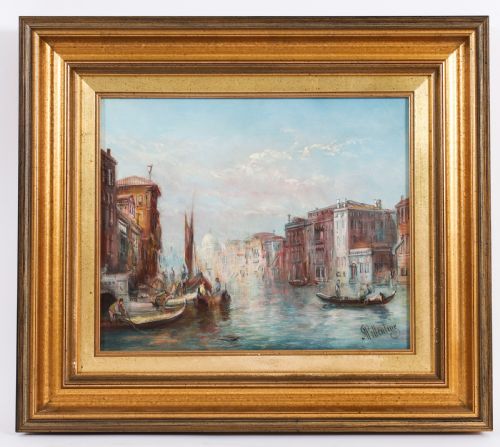
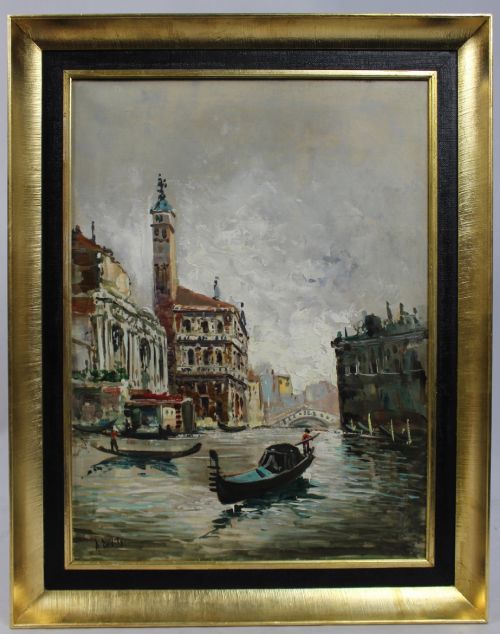
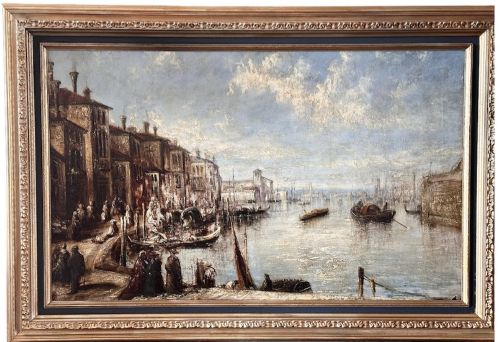
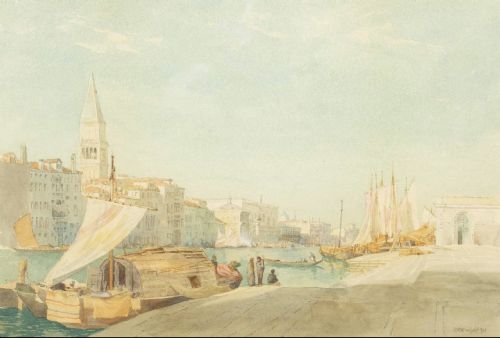
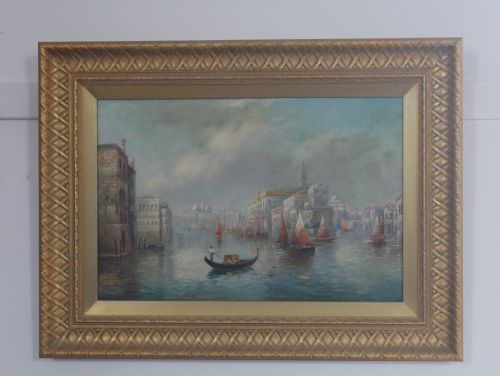
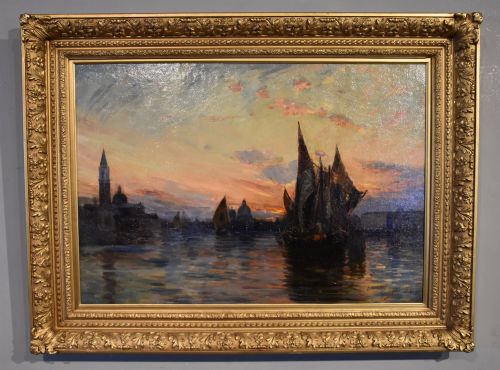


Original Venetian Landscape Painting
An original venetian landscape painting brings the light and architecture of the canals directly into a room.
Original Venetian Landscape Painting
An original venetian landscape painting captures the distinctive waters, palazzos and monuments of Venice through the eyes of various artists. These works range across the nineteenth and twentieth centuries, encompassing Victorian, Edwardian and mid-century movements.
Buyers will encounter both oil paintings on canvas and watercolours on paper. Subjects frequently focus on the Grand Canal, Santa Maria della Salute and the Doge's Palace.
The selection includes detailed townscapes and atmospheric harbour scenes executed in oil paint, watercolour, pastel and gouache.
How they were made
Artists painted primarily in oil on canvas or applied watercolour on paper, sometimes employing mixed media such as pastel and gouache. Canvases are frequently housed in giltwood or gilded wood frames that complement the composition.
Techniques range from the controlled academic detail seen in nineteenth-century works to the looser brushwork of British and mid-century impressionism. Pigments were applied to render the specific quality of light reflecting off the Venetian lagoons.
Commonly depicted landmarks include the Grand Canal, Santa Maria della Salute and the Doge's Palace.
What varies in quality
The standard of an original venetian landscape painting depends upon the artist's ability to capture atmospheric light and perspective. Works by recognised painters exhibit greater precision in architectural rendering and water movement.
Framing and preservation contribute significantly to the overall integrity of the piece, with period giltwood frames enhancing the visual presentation of canvas and paper works alike.
Alfred Pollentine·Francis Moltino·Claude Jousset·Hercules Brabazon Brabazon·Frank Wasley
The Original Venetian Landscape Painting Glossary
- Giltwood
- Wood carved and covered with a thin layer of gold leaf. This material is commonly used for the ornate frames enclosing 19th-century oil paintings.
- Watercolour
- A paint consisting of soluble pigment suspended in a water-based solution, typically applied to paper. It is frequently utilised for atmospheric depictions of Venetian canals.
- Impressionism
- An art movement characterised by relatively small, thin yet visible brush strokes and an emphasis on accurate depiction of light. Mid-century examples appear within this collection.
- Gouache
- A water-based paint consisting of pigment and other inert materials designed to be opaque. It is occasionally combined with pastel and ink in Venetian harbour scenes.
Original Venetian Landscape Painting: Frequently Asked Questions
What subjects do these paintings show?
These works primarily depict the Grand Canal, the Doge's Palace, and the Santa Maria della Salute. Artists also captured gondolas and various island views across the Venetian lagoon.
The compositions range from busy market scenes to quiet moonlight vistas over historic mansions.
How do I hang a framed painting?
Ensure the wall fixings are suitable for the weight of the giltwood or wood frame. Position the artwork at eye level to properly appreciate the painted details.
Keep the piece away from direct sunlight and damp environments to protect the canvas or paper.
Are these works painted on canvas?
Many examples are executed in oil on canvas, while a substantial number are watercolours on paper. Mixed media pieces involving pastel and gouache also appear in the collection.
The support material generally corresponds to the specific period and technique of the artist.
How do I date a Victorian painting?
Dating relies on the recorded period of the artist, stylistic markers such as 19th century romanticism, and framing materials. Signatures and dates inscribed on the canvas or paper provide further evidence.
Victorian and Edwardian works often exhibit specific academic or impressionistic tendencies characteristic of their decade.