
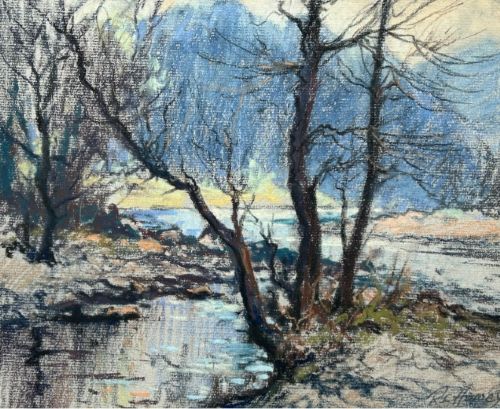
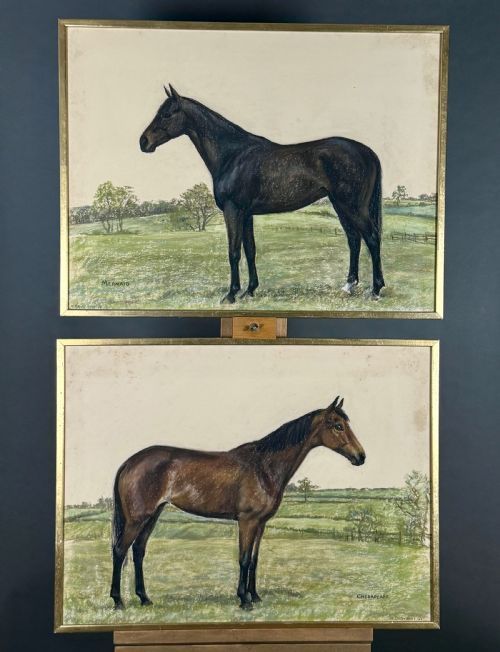
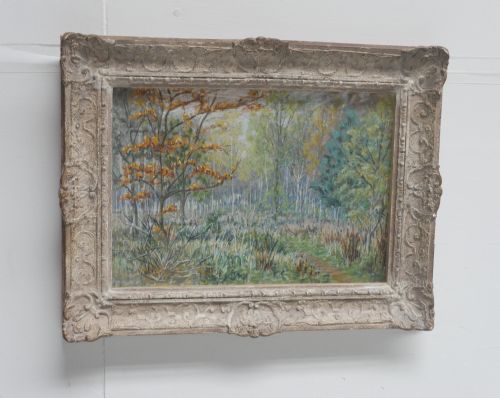

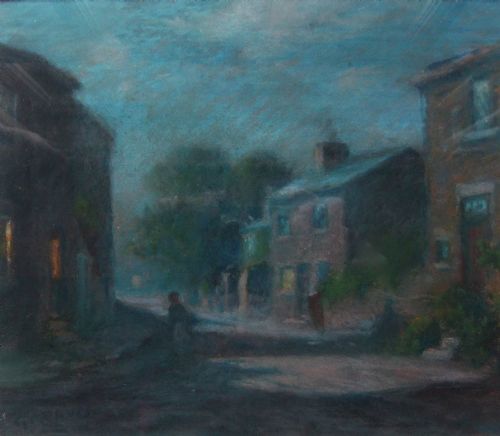


Original Pastel Landscape
An original pastel landscape captures the quiet drama of countryside and coast through the direct application of pure pigment on paper.
Original Pastel Landscape
An original pastel landscape brings together atmospheric depictions of fields, harbours, and rivers executed in dry mediums. When searching for an original pastel landscape, buyers encounter works ranging from Victorian pastoral scenes to mid twentieth century British views.
The selections span various regional British and European subjects, including Yorkshire valleys, Cornish harbours, and Venetian waterways. These pieces appear on paper, frequently housed behind glass within period frames.
Works from this category bridge the gap between drawing and painting, capturing light and weather with immediate strokes. The selection includes both intimate studies and large scale topographical works.
Materials and Construction
Artists utilise soft pastel sticks composed of pure powdered pigment and a binder, applied directly to textured paper. Many compositions incorporate gouache, watercolour, or charcoal to build up underlying tones or define structural details.
Framing plays a vital protective role, as pastel powder remains friable on the paper surface. Wood, gilt wood, and plaster frames enclose the glass panels that safeguard the delicate pigment from disturbance and moisture.
Subjects documented in the archive range from Cornish harbours and Venetian canals to Yorkshire dales and Scottish castles.
Assessing Quality and Execution
Quality rests upon the artist's handling of pigment density and the retention of crisp, deliberate marks rather than overworked areas. Superior examples demonstrate a secure grasp of light and atmosphere, rendering foliage, water, or sky with distinct economy.
The integrity of the paper support and the preservation of the original framing elements influence the overall standard of a piece. Works that maintain vibrant colour saturation without excessive fading or loss of pigment display superior preservation.
Robert Leslie Howey·Joseph Knight·William Greaves·Gyrth Russell·John Hobson Nicholson·Berthe des Clayes·Henry Wimbush·Marjorie Christine Bates·Leonard Richmond·Paul Koehler·Angus Rands·Edward Handley Read·Carl Otto Fey·Rudolf Helmut Sauter
The Original Pastel Landscape Glossary
- Pastel
- A dry painting medium consisting of powdered pigment combined with a binder and shaped into sticks. It allows for immediate colour application and blending directly on the paper surface.
- Gouache
- An opaque water-based paint often used alongside pastel to provide solid highlights or dense foundational washes. It adds weight and opacity to specific areas of the composition.
- Fixative
- A liquid spray applied to pastel works to bind the pigment particles to the paper and prevent smudging. Historical pieces may exhibit varying degrees of historical protection.
- Gilt Wood
- Wood framing coated with a thin layer of gold leaf or metallic gilt finish. These frames frequently accompany period landscape artworks from the nineteenth and early twentieth centuries.
- Impressionist
- A style characterised by relatively small, thin yet visible brush or pastel strokes that emphasise accurate depiction of light and its changing qualities. Works in this manner capture fleeting atmospheric conditions.
Original Pastel Landscape: Frequently Asked Questions
How do I clean the glass on a pastel?
Cleaning the glass requires standard glass cleaner applied to a cloth rather than directly to the frame, ensuring liquid does not seep inside.
Great care must be taken to avoid applying pressure that could cause the glass to flex and touch the delicate pastel surface.
Where should I hang a pastel landscape?
Pastel artworks require placement away from direct sunlight to prevent the fugitive pigments from fading over time.
Stable indoor humidity levels also protect the paper support and the surrounding frame from warping or moisture damage.
Are pastels considered drawings or paintings?
Art historians classify pastels as both, because the medium utilises drawing materials to build up fully saturated painted surfaces.
When pigment covers the majority of the paper sheet, the resulting work functions visually as a painting.
How do I identify a Victorian pastel?
Victorian examples often feature heavier gilt wood frames, darker tonal palettes, and subjects focused on pastoral or romanticized rural scenes.
Paper stocks and framing construction methods from the nineteenth century further aid in dating these atmospheric landscapes.