





Onyx Desk Clock
These onyx desk clock pieces combine polished stone and precision timekeeping, offering a striking functional centrepiece for any surface.
Onyx Desk Clock
An onyx desk clock brings together natural banded stone and mechanical timekeeping, serving both a practical purpose and a decorative role in interior spaces. When you search for an onyx desk clock, you encounter variations spanning the Victorian era through the Art Deco period, often incorporating brass and marble alongside the primary stone.
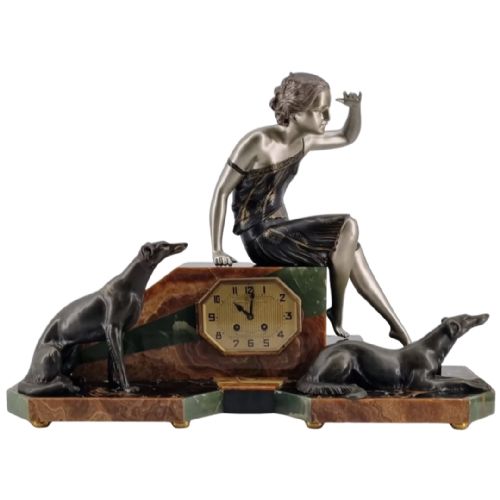
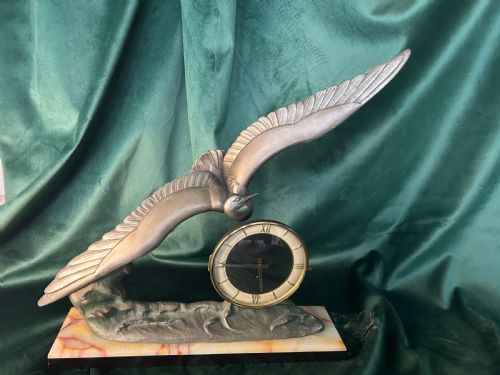
The selection ranges from simple desk accessories and barometer combinations to elaborate mantel clock sets featuring sculptural figures in spelter or metal. French and English origins predominate across the pieces, displaying styles from Belle Epoque and Louis XVI to streamlined Art Deco designs.
Materials and construction
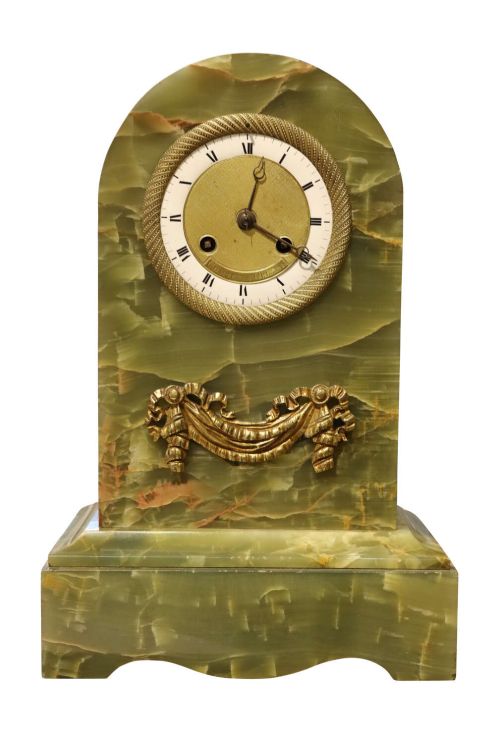
The primary construction relies on solid blocks of onyx or marble, shaped and polished to highlight the natural variations and banding of the stone. Green onyx is particularly prominent, often paired with contrasting materials like brass, chrome, and glass.
Mechanical movements are integrated directly into the stone housings, frequently accompanied by metal or spelter sculptural elements, including cast animal figures. Dials are protected behind glass, sometimes forming part of larger garniture sets that include matching side pieces.
Onyx Desk Clock Retail Price Guide 2026
Typical asking prices for onyx desk clock among the pieces listed under this phrase on Sellingantiques today, from the lower quarter to the upper quarter. They describe what is for sale here now, not the wider market.
Listings feature pieces spanning the nineteenth century through the Art Deco era, utilising green onyx, marble, brass, and chrome.
Assessing quality
Quality rests upon the selection and uniformity of the stone itself, with superior examples exhibiting rich, consistent banding and expert polishing across every surface. The integration between the heavy stone housing and the metal components dictates the overall finish.
The inclusion of named makers, high-grade brass fittings, and detailed sculptural additions such as cast metal figures elevate certain items above standard utilitarian timepieces. Harmony between the clock face, auxiliary instruments like barometers, and the stone body defines the better pieces in the range.
Charles a Orleans·Elliott·Michel Decoux·Ferdinand Priess·Garrards
The Onyx Desk Clock Glossary
- Onyx
- A form of chalcedony quartz featuring parallel bands, valued for its translucent quality and smooth polished finish.
- Garniture
- A matching set of ornamental pieces for a mantel or desk, typically comprising a central clock flanked by two decorative ornaments.
- Spelter
- A zinc alloy commonly used as a base metal for decorative sculptures and figures on clock sets, often given a bronze or gilt finish.
- Crystal regulator
- A clock housed in a glass-panelled metal or stone frame that allows the movement and pendulum to be viewed from multiple angles.
- Barometer
- An instrument measuring atmospheric pressure, frequently mounted alongside the clock face in combination desk instruments.
Onyx Desk Clock: Frequently Asked Questions
How do I clean an onyx desk clock?
Dust the stone gently with a soft, dry cloth to prevent accumulation in the carved details and crevices.
Avoid using abrasive cleaning agents or excessive water, as moisture can damage both the mechanical movement and the polished stone surface.
Are these clocks suitable for daily use?
These mechanical timepieces function reliably when wound correctly and serviced by a professional clockmaker.
Treat the vintage movements with care, winding them gently according to their specific mechanical requirements rather than forcing the spring.
What is an onyx clock set?
A clock set typically includes a central timepiece accompanied by matching side ornaments, garnitures, or matching desk instruments such as barometers and thermometers.
These coordinated ensembles were designed to create a balanced, symmetrical display on a mantelpiece, sideboard, or large desk.
How can I tell the period of a clock?
Stylistic indicators such as geometric lines, streamlined forms, and minimalist numerals point towards Art Deco pieces from the early twentieth century.
Ornate details, classical motifs, and heavier brass mounts generally suggest earlier Victorian, Belle Epoque, or nineteenth-century origins.