


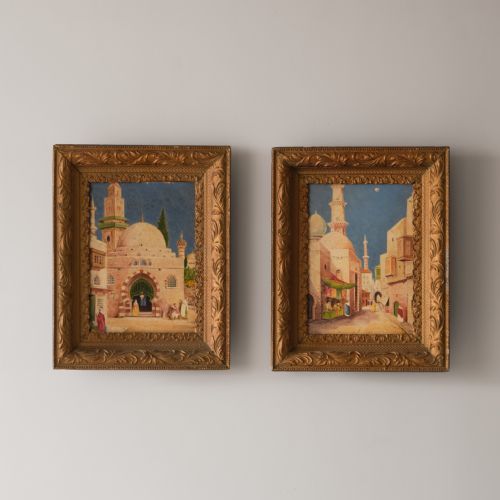


Old Watercolour Painting
An old watercolour painting brings the subtle tones of past centuries directly onto a wall, capturing landscapes and portraits through delicate washes.
Old Watercolour Painting
An old watercolour painting captures scenes on paper using water-soluble pigments, often framed behind glass in gilt wood or simple timber surrounds. These works range from naive portrayals of historical events to careful topographical studies of piers, bridges, and village mills.
The selections span distinct periods including the Regency era, Victorian times, the Edwardian period, and the nineteen-forties. Buyers often encounter framed artwork depicting coastal views, architectural landmarks, and intimate interior moments.
Makers and artists range from named professionals such as David Woodlock, Arthur Wilde Parsons, Henry John Kinnaird, Lilian Stannard, Fred Lawson, John R. Houston, and Bruce Bairnsfather, alongside anonymous hands producing engaging naive pieces.
Materials and construction
These works rely principally on watercolour and ink applied to paper sheets, sometimes described as watercolour drawings or original artwork. The foundational support is consistently paper, housed securely within traditional frames of wood or gilt wood.
Techniques vary from fine art realism to naive illustration and genre scenes, employing fluid washes of pigment. Protective glass covers the delicate paper surfaces to guard against atmospheric moisture and handling.
Old Watercolour Painting Retail Price Guide 2026
Typical asking prices for old watercolour painting among the pieces listed under this phrase on Sellingantiques today, from the lower quarter to the upper quarter. They describe what is for sale here now, not the wider market.
Common subjects include toll bridges, rural mills, coastal piers, and Scottish inns.
Assessing quality
Quality rests upon the skill of the brushwork and the precision with which the artist handles light and shadow across the paper. Works by established painters demonstrate a firmer command of perspective and atmospheric depth compared to simpler folk or naive pieces.
Condition plays a central role, particularly the preservation of the original paper surface and the stability of the surrounding frame. Pieces that retain their subtle pigment tones without excessive fading or discoloration stand distinctly above compromised examples.
Bruce Bairnsfather·David Woodlock·Arthur Wilde Parsons·Henry John Kinnaird·Lilian Stannard·Fred Lawson·John R. Houston
The Old Watercolour Painting Glossary
- Naive Art
- Art produced by a self-taught artist typically lacking formal academic training, characterised by a charming disregard for strict perspective.
- Gilt Wood
- Timber that has been coated with a thin layer of gold leaf or gold paint, frequently used for traditional picture frames.
- Genre Realism
- Artistic representation of subjects from everyday life, such as figures gathered inside an inn or working near a bridge.
Old Watercolour Painting: Frequently Asked Questions
How should I hang an old watercolour?
Keep the piece away from direct sunlight to prevent the delicate pigments from fading over the years.
Ensure the room maintains a stable humidity level to protect both the paper and the wooden frame.
Are these paintings always signed?
Many works bear the signature of the artist, while others remain attributed to specific schools or anonymous hands.
Unsigned pieces can still be appreciated for their period materials and technical execution.
What framing is typical for these?
Most works are presented in traditional wood or gilt wood frames beneath protective glass.
This framing helps shield the fragile paper from dust and environmental damage.
How do I identify the period?
Stylistic clues, framing materials, and subject matter often point toward eras like the Victorian or Edwardian periods.
Signatures and specific historical references within the titles also assist in dating the work.